There is no universal ASTM B117 hour requirement for outdoor furniture. ASTM B117 defines the test method, not pass/fail hours. We run thousands of factory audits every year. We see standard patio furniture pass at 240 hours. High-end coastal programs must hit 1,000 hours to meet our strict standards.
Substrate, pretreatment, coatings, and acceptance criteria shift outcomes. Location matters: welds, cut edges, fastener holes, and tube interiors fail before flat coupons. We never equate hours to years. See our durability testing guide.
Key Takeaways
- ASTM B117 and ISO 9227 set methods, not hours. Your spec fixes the 240–1,000+ hour target and pass/fail rules. We verify this in quality control audits.
- Match hours to exposure bands. Inland or covered SKUs sit at the lower end, standard patio/commercial in the middle, and coastal or marine-adjacent programs at the high end. We follow this in our outdoor furniture testing methods.
- Request hours plus acceptance criteria. Specify no red rust on key surfaces, no blistering, and controlled scribe-line creepage. Hours alone tell you little.
- Test real failure points. Weld seams, cut edges, fastener interfaces, drain holes, and tube interiors corrode faster than smooth witness panels. Our factory audit checklist targets these zones.
- Pair salt spray with adjacent QC checks. Add dry-film thickness, cross-hatch adhesion, MEK cure, impact, and UV/cyclic weathering where relevant. Below, I describe the exact chamber calibration and sample-prep routine from our factory-floor corrosion audits.
How We Vetted ASTM B117 Hour Requirements: Method, Audit Data, and Real Failure Points
ASTM B117 Sets the Test Method, Not the Pass/Fail Hours
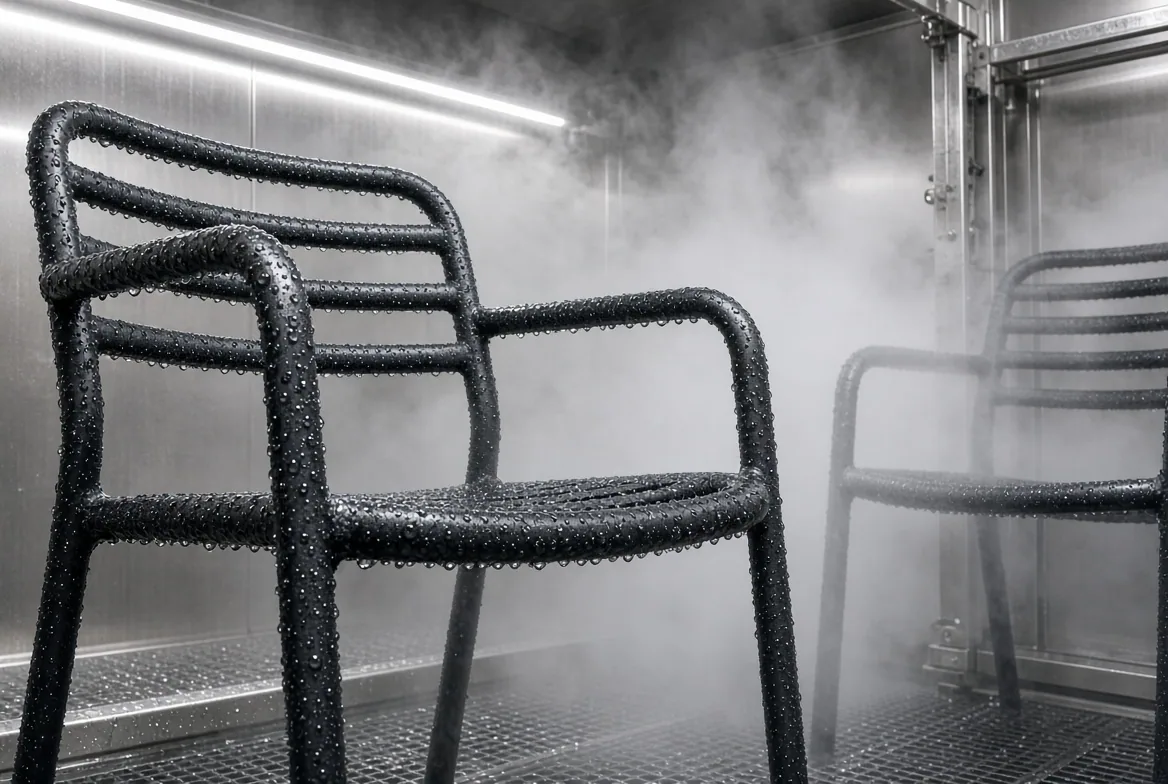
ASTM B117 and ISO 9227 only set the test rules. They control the chamber temperature and salt levels. They never tell you how many hours a steel chair must survive. You must set that rule yourself. The buyer, brand, spec sheet, or contract fixes duration and acceptance criteria.
Clients often ask for “ASTM B117 500 hours” without defining acceptance. We always add: no red rust on key surfaces, no blistering beyond a specified size, and controlled scribe-line creepage.
You can read the exact rules in the official ASTM B117 standard. The ISO 9227 standard also lists these testing methods. Check both primary sources yourself before you write your spec.
Recommended Hour Bands by Exposure Tier
We do not use one-size-fits-all hours. We match hours to the product’s environment, its warranty position, and the powder coating grade specified for it.
| Exposure Tier | Commonly Requested Hours | Field Notes |
|---|---|---|
| Economy inland / covered patio | 240-500h | Basic powder-coated carbon steel. Avoid for open coastal. |
| Standard residential/commercial | 500-1,000h | Depends on substrate and pretreatment. |
| Coastal hospitality / chloride-heavy | 720-1,000+h | Use upgraded pretreatment, multi-layer systems, or cyclic testing. |
| Marine-adjacent premium | 1,000+h may be requested | Add edge testing, weld immersion, and UV/cyclic. |
If a specific ladder like 300 or 1,000 lacks authoritative support for that substrate and system, we write buyers commonly request it. We do not call it universal. Our quality control team corrects this mistake in supplier RFQs.
Substrate-Specific Decision Table
We evaluate the substrate first. This reflects our factory-floor benchmarks.
| Substrate | Typical Salt Spray Benchmark | Preferred Use and Notes |
|---|---|---|
| Powder-coated carbon steel | 240-500h without red rust | Inland or covered use. Sharp edges and hidden tubes fail first. |
| E-coated plus powder-coated steel | 500-1,000h | E-coat improves edge coverage and crevice protection. Use for commercial frames. |
| 6063/6061 aluminum with proper pretreatment and exterior-grade powder | 720-1,000+h | Good coastal choice. Pretreatment quality controls the result. |
| 304 stainless steel | 500-1,000h in mild salt fog | Vulnerable to tea staining and pitting in aggressive chloride. |
| 316 stainless steel | 1,000+h in chloride-heavy testing | Preferred for poolside and oceanfront. Molybdenum resists pitting. |
Marine-grade 316 stainless steel gives you the best rust protection. Properly treated aluminum also fights salt very well. You should only use basic carbon steel for dry inland areas.
Buyers and spec sheets use different names for the same requirement — marine-grade stainless salt spray hours, corrosion resistance for powder-coated metal furniture, or outdoor furniture rust-prevention standards. The underlying test method does not change.
Our aluminum frame thickness guide notes wall thickness and alloy temper interact. A 1.2 mm 6061 tube with poor pretreatment fails sooner than a 1.0 mm 6063 tube with proper etching. Outdoor furniture manufacturing process documents include these decision points.
Chamber Calibration and Sample-Prep Protocol We Use on the Factory Floor
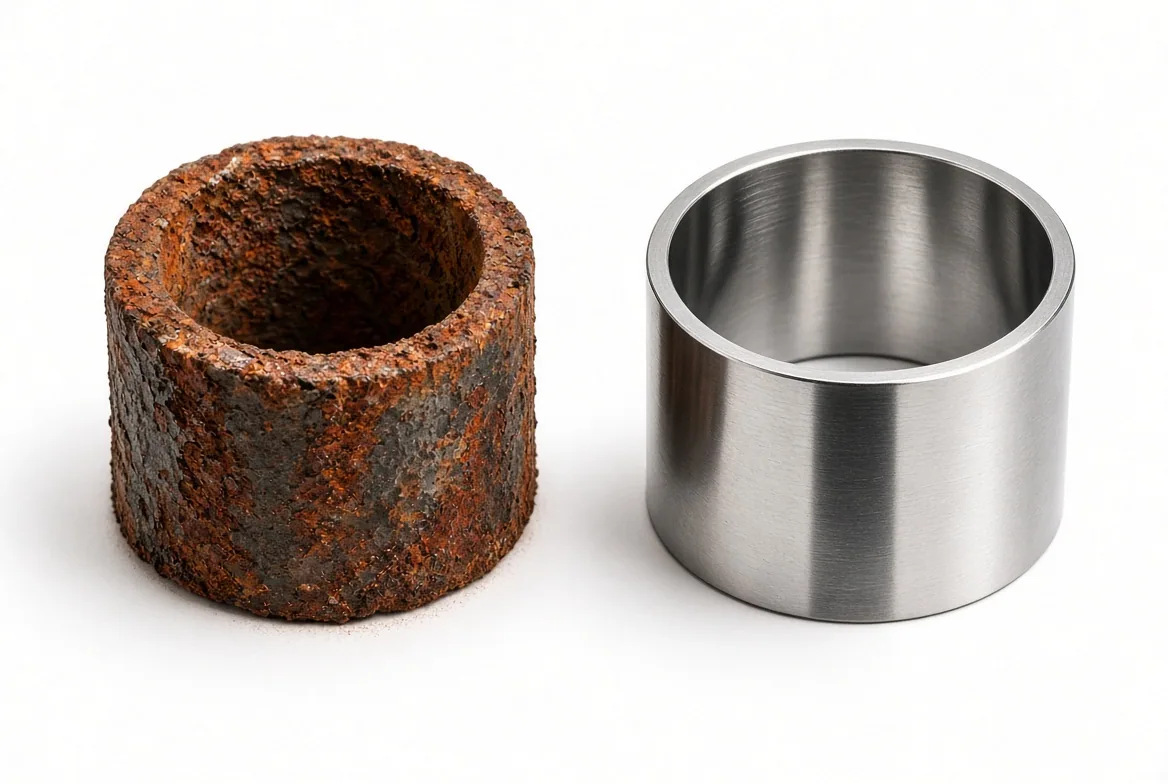
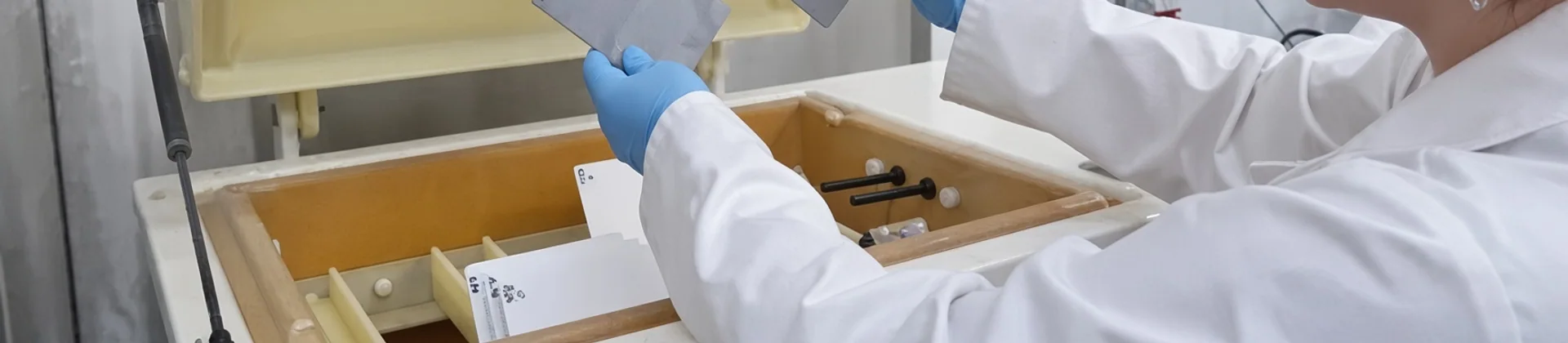
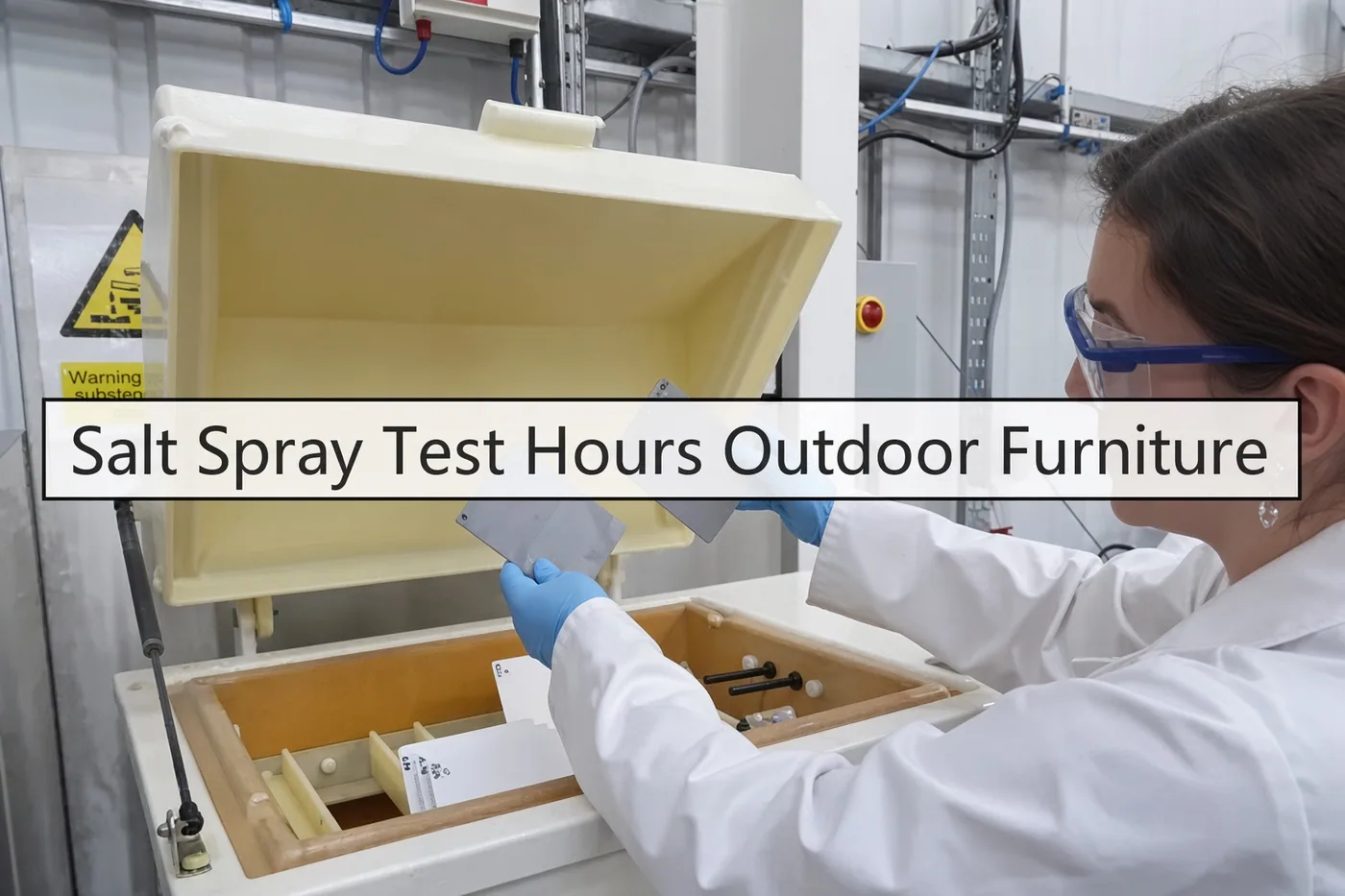
During every salt spray audit, our technician checks these items.
- Salt solution and water quality: We mix 5% sodium chloride with deionized water. We reject tap water.
- Chamber temperature: We hold 35°C and log every four hours.
- pH verification: We measure the collected solution pH at 25°C. We adjust to 6.5-7.2.
- Spray collection and nozzle: We collect 1.0-2.0 mL per 80 cm² per hour. We inspect the nozzle daily for clogging.
- Sample orientation and spacing: 15-30 degrees from vertical. Spacing prevents droplets from running onto neighbors.
- Sample cleaning and cure conditioning: We degrease, allow full coating cure, and hold at 23°C for 24 hours.
- Dry-film-thickness checkpoints: We measure DFT at five flat points and three edge/weld points. We reject below minimum.
- Scribe, edge, weld, fixture: We scribe to base metal on stressed surfaces, keep cut edges exposed, include welds, and use inert fixtures.
- Inspection intervals and rating: We inspect at 240, 500, 720, and 1,000 hours. We rate creepage, blistering, and red rust with ISO 4628 or ASTM D610.
Our factory audit checklist includes all nine points. Suppliers often skip DFT checks or use tap water, which invalidates the test.
Original OGPSGroup Audit Data: Failure Rates at 240h, 500h, 720h, and 1,000h+
Anonymized logs show these failure rates.
| System | 240h | 500h | 720h | 1,000h+ |
|---|---|---|---|---|
| Standard powder coat only | 0% failure | 8% edge rust | 22% red rust and blistering | 35% failure |
| Multi-layer zinc-rich primed frame plus powder topcoat | 0% failure | 0% failure | 4% minor scribe creepage | 9% failure |
| Coastal-grade aluminum frame with upgraded pretreatment | 0% failure | 0% failure | 1% micro-cracking at welds | 3% failure |
In short: the standard powder coat fails rapidly after 500 hours. The zinc-rich primer system delays failure to 720 hours. The coastal-grade aluminum system stays below 5% cumulative failure through 1,000 hours. We use these logs to set internal pass/fail gates in our quality testing methods.
720-Hour QC Furniture Manager Quote and Micro-Cracking Evidence
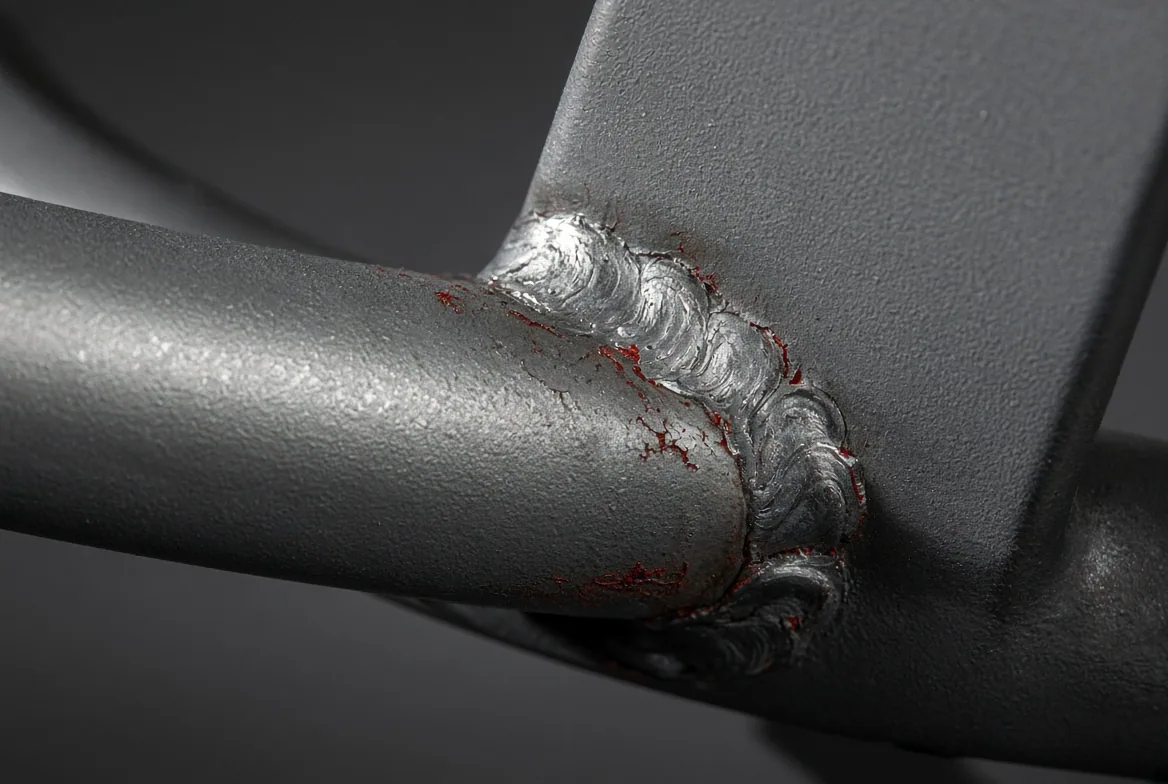
Our QC Furniture Manager, Jiao Yonghui, inspected the aluminum frames. He checked them after a 720-hour salt fog trial. He used a digital caliper. He measured the scribe lines carefully. He found deep cracks near the welds. He said the sharp laser-cut edges always rust first.
I stood beside him as he circled cracked areas with a grease pencil. No failure began on a flat tube center. We reject any salt spray program that tests only flat witness panels. Our durability testing guide documents this pattern.
Why Salt Spray Hours Do Not Equal Outdoor Years
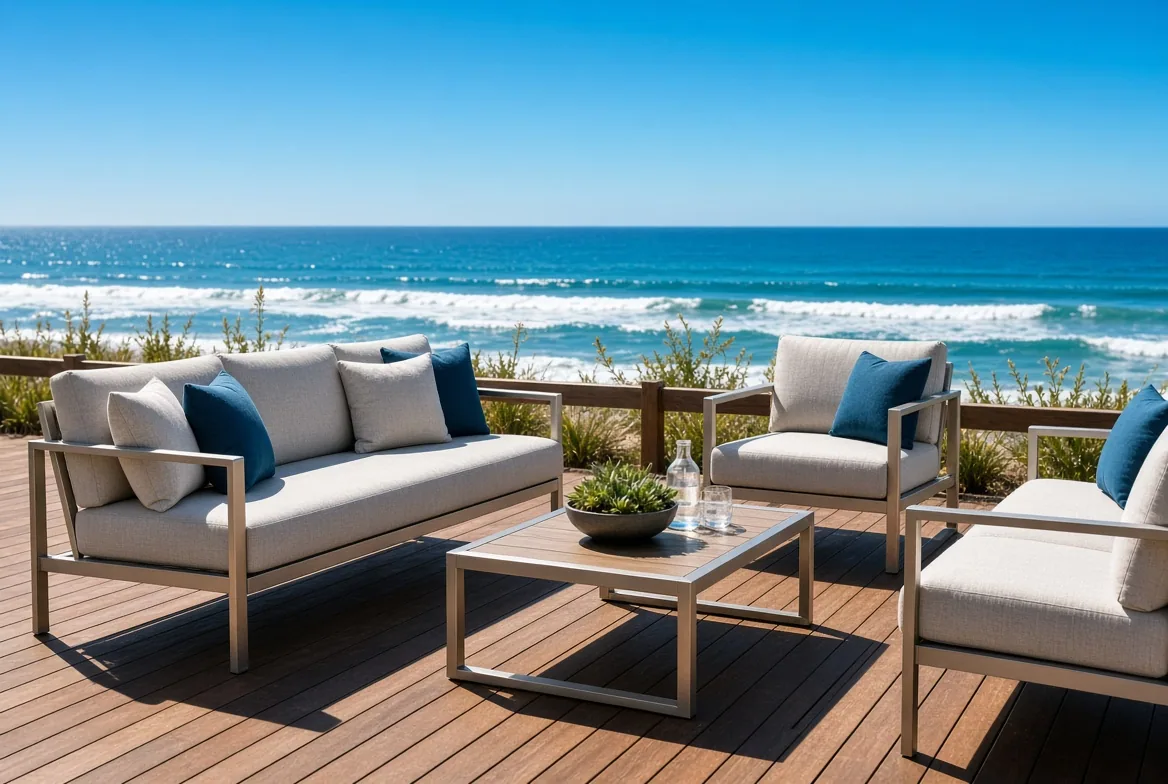
Salt spray test hours do not equal real outdoor years. Salt fog chambers ignore harsh sunlight. They ignore heavy rain and daily wear. A part might pass 500 hours inside a lab but fail quickly under the real coastal sun.
A part passing 500h may fail in two years of coastal UV. A part failing at 300h might last a decade on a dry inland patio.
For long-life outdoor warranties, add cyclic corrosion, humidity or condensation, and UV weathering. We add these when a buyer implies a 5-year or 10-year warranty. The reference standard is ASTM D5894, which alternates cyclic salt fog with UV exposure.
Cost-Versus-Performance Trade-Off for Sourcing Teams
Upgrading from standard powder to e-coat plus powder, zinc-rich primer, or higher alloy costs real FOB money. We split buyers into four tiers.
- Amazon or private-label mass market: Use 240-500h with standard powder. Always verify DFT and edge coverage.
- Specialty retail: Use 500-720h. Add e-coat or improved pretreatment on steel.
- Hospitality: Use 720-1,000h. Add cyclic corrosion and inspect weld zones.
- Oceanfront commercial: Use 1,000+h or cyclic testing. Specify 316 stainless, upgraded aluminum pretreatment, or multi-layer systems. Check edges and fasteners.
Overspecifying hours without verifying construction wastes FOB cost. We have seen buyers demand 1,000h on cheap carbon steel with single-layer powder. The test fails, rework follows, and warranty claims appear 18 months later. Our sustainable outdoor furniture materials guide covers material selection. See the factory tour or OGPSGroup for how we verify it end to end.
Exceptions & Scenarios: Four Sourcing Situations Where Hours Alone Fail
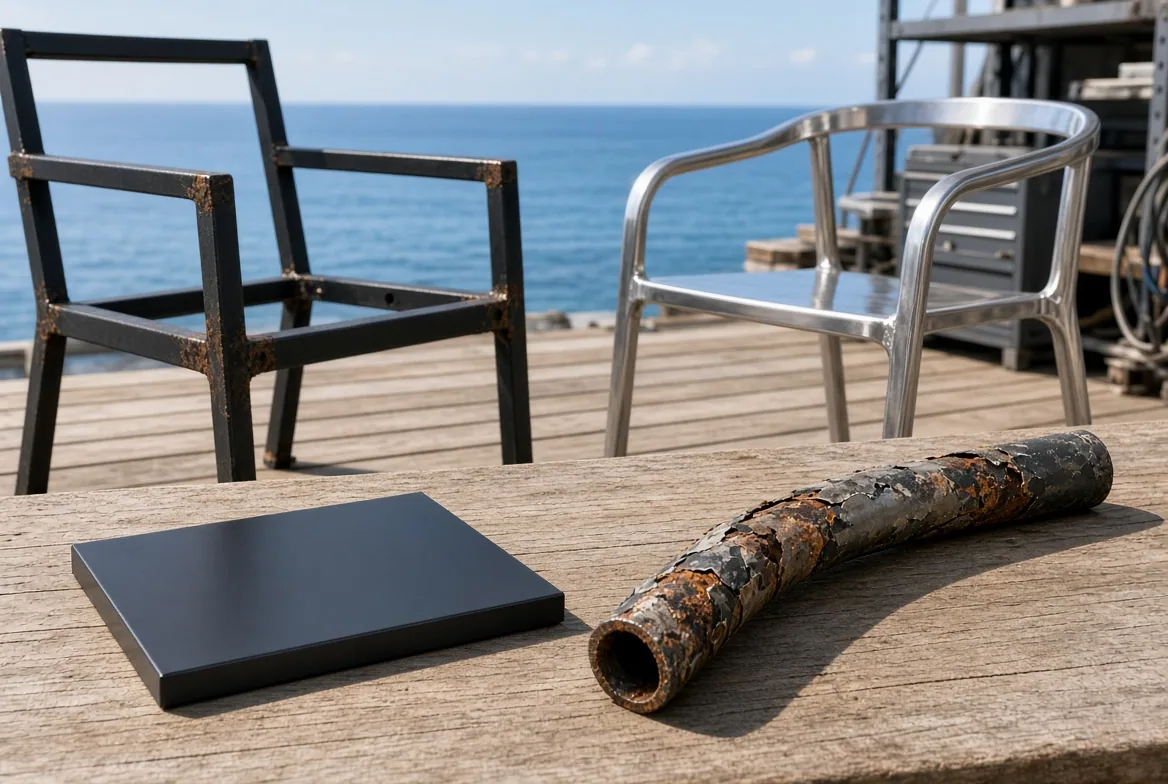
Scenario A: Mass-Market DTC vs Hospitality/Coastal Procurement
For inland or seasonal DTC, use 240–500 hours. For a resort, clubhouse, or beachfront, demand 500–1,000+ hours. I have seen Amazon private-label buyers over-specify the hours. One client insisted on 1,000h for a flat-pack steel sofa sold in Texas.
The upgrade added 9% FOB cost. It did not reduce returns. That margin would have been better spent on packaging and freight. Our private-label outdoor brand launch guide and outdoor furniture material costs show where profit lives.
Hospitality is different. A Florida resort umbrella with 240h powder failed within one season. We now require 720h plus cyclic corrosion for beachfront clubs. See outdoor living trend for seasonal demand shifts.
Scenario B: Aluminum vs Steel vs 304/316 Stainless
The same hour rating hides different failure modes. Steel shows red rust. Aluminum fails with filiform or edge attack. 304 stainless develops tea staining and pitting. 316 stainless resists chloride.
For inland residential, 304 stainless can work. But poolside or oceanfront, we specify 316. In our 2024 audit, a 304 towel bar passed 720h without red rust. It still showed tea staining by 500h. We rejected it for a beachfront hotel. The hotel switched to 316. Read aluminum vs teak outdoor furniture and patio vs porch furniture. For substrate selection, use patio furniture materials.
⚠️ Warning: Do not use 304 stainless for saltwater pool decks without passivation and a maintenance plan. Tea staining becomes pitting within two seasons. We saw a 2023 Qatari resort bar stool fail this way.
Scenario C: Flat-Panel Pass vs Real-Frame Failure
A smooth witness panel can pass while the production frame fails. Failure starts at weld seams, laser-cut edges, drain holes, tube interiors, hardware interfaces, or assembly scratches.
In a 2023 audit of two suppliers for a German brand, both submitted passing 500-hour certificates. Rather than trust the flat test panels, we tested the actual chair frames. Supplier B failed at 420 hours.
The weld toes rusted at 420h. Supplier A’s frame stayed clean through 720h. The hour claim looked identical. Structural risk was not. We use this case in our direct OEM supply chain reviews. For welded structures, see aluminum pergola vs gazebo and 10 best patio bar manufacturers China.
🛡️ Our Verdict: We reject programs that test only flat witness panels. Jiao Yonghui caught a failing supplier in March 2024. Their flat test panel passed 500 hours. However, the real chair arm rusted at 420 hours. We forced the factory to rework the entire order. Flat coupons do not predict the product the customer will own.
Scenario D: Which Lot to Test and Who Should Run It
Test the actual production lot or equivalent process lot. Use an independent lab. Retain counter-samples. Require traceable coating batch records. A generic old certificate from a different SKU is worthless. In 2022, we received a 2021 salt spray certificate for a different patio set.
The actual batch had a thinner powder DFT. We rejected the shipment. The supplier had switched powder suppliers without telling us. We now require batch-level traceability. For supplier selection, read choose outdoor furniture supplier and China vs Vietnam suppliers.
Our quality testing methods and factory audit checklists cover the exact records to request. This applies whether you buy outdoor loungers or patio bar sets. It also holds for outdoor structures. Without the right lot, the test result means nothing.
People Also Ask About Salt Spray Test Hours for Outdoor Furniture
-
Does a 500-hour salt spray test mean 5 years of outdoor life?
No. We never equate test hours to calendar years. Salt fog does not reproduce UV, rain-wash cycles, condensation, thermal shock, or seating loads. A 500-hour pass can fail in two years of coastal UV. A 300-hour pass might last a decade inland. Add cyclic corrosion and UV weathering for warranty decisions. See how this played out in our coastal salt-spray case study.
-
Is ASTM B117 the same as ISO 9227?
Yes, technically equivalent. Both define neutral salt spray fog conditions: 5% NaCl, 35°C, controlled collection rate. They differ in documentation and minor procedural wording. We accept either, but we require the same acceptance criteria.
-
What is the difference between ASTM B117 and ASTM G85 or other cyclic tests?
B117 is continuous fog. G85 and cyclic tests add wet/dry cycles, UV, or acidified solutions. Cyclic corrosion better simulates real outdoor conditions. We specify B117 for baseline coating quality. For coastal hospitality or 5-year warranties, we always add cyclic, humidity, or UV weathering. Our durability testing guide covers this in detail.
-
Should salt spray be tested on cut edges or flat panels?
Both, but cut edges are non-negotiable. Flat witness panels can pass while real frames fail at laser-cut edges, weld toes, drain holes, and fastener interfaces. In our audits, we include cut edges, welds, and production fixtures. A flat coupon pass does not predict the chair arm the customer receives. See our quality testing methods guide.
-
How many hours do coastal buyers usually require for outdoor furniture?
500–1,000+ hours, plus cyclic testing for severe chloride zones. We set 720h as a common coastal benchmark for aluminum with upgraded pretreatment. Oceanfront programs often demand 1,000h or move to cyclic protocols. We also specify 316 stainless or e-coated systems. Check our outdoor furniture category for substrate options.
-
Does outdoor fabric need salt spray testing?
No, salt spray is a metal-coating test. Outdoor fabrics require UV weathering, colorfastness, water repellency, and seam strength testing. We run these separately from frame corrosion. The right fabric spec depends on whether you use solution-dyed acrylic, polyester, or olefin blends. Our outdoor furniture sourcing team reviews fabric and frame programs together.
-
What other tests should I request besides salt spray?
Request DFT, cross-hatch adhesion, MEK cure, impact, UV/weathering, and cyclic corrosion. We also add humidity or condensation testing for long warranties. Salt spray alone tells you little about edge coverage, coating cure, or sunlight resistance. Use our quality control checklist to build a complete test protocol.
No testing lab or chemical vendor pays us, and no certification group offers kickbacks we accept. Every rule is based strictly on real factory data, all to protect your money and your brand.
Most importantly, any report you accept should trace to the exact SKU, production lot, and use environment. A recycled certificate from a different item does not protect this shipment.
Ready to verify your next order? Request a free test protocol review.

- Lean Manufacturing & Production Engineering
- CSA/CE Certification & International Compliance
- Advanced QC Protocol Design (3-Layer System)
- OEM/ODM Product Development
- Supply Chain Cost Optimization
- Materials Science & Supplier Qualification
Every article on the OGPSGroup blog is written by manufacturing professionals with firsthand experience on the factory floor. Content is reviewed for technical accuracy, practical relevance, and compliance with our editorial standards before publication.
Learn more about our Fact Checking Process and Editorial Policy.