
Every Published Claim.
Primary-Source Evidence.
OGPSGroup does not publish claims based on supplier marketing collateral, unverified industry hearsay, or pay-to-play directory listings. Every factual assertion about manufacturing capabilities, certifications, material specifications, and compliance is verified against primary-source documentation — reviewed by the same CSA/CE certified engineers who run our production lines.

The Hierarchy of
Verification Evidence.
Not all sources are valid for factual assertions about manufacturing, compliance, and supply chain capability. OGPSGroup classifies every source into one of three tiers before it can support a published claim. If a claim cannot be traced to a Primary source, it is either qualified with an explicit disclosure or removed entirely.
Mandatory Verification Sources
Certification documentation (CSA, CE, UL, ISO 9001), original BOMs and CAD drawings, independent third-party audit reports (BSCI, SA8000), ASTM/ISO laboratory performance test results, official regulatory body publications (CPSC, Health Canada, EU Directives), executed NNN agreements and OEM/ODM contracts, and container loading manifests with customs documentation.
Supporting Context Sources
Academic research papers in materials science and industrial engineering journals. Industry association reports from organizations such as the Hearth, Patio & Barbecue Association (HPBA) and Casual Furniture Manufacturers Association. Reputable trade publications and expert analyses that cite primary data — never as standalone verification.
Unacceptable Sources
Generic blogs, unverified industry forums, non-specialized news outlets, and marketing claims without supporting primary documentation are strictly prohibited as sources for factual assertions. Supplier self-declarations, pay-to-play directory listings, and uncertified test results do not meet the OGPSGroup evidence threshold.
Four Categories of
Primary-Source Verification.
Every sourcing claim, manufacturing assertion, and compliance statement is verified against at least one primary-source database in these four categories. We cite the issuing body directly — not secondhand summaries or trade blog roundups.
Certifications & Compliance
- CSA, CE, UL, ISO 9001 certificates
- Underlying test reports from TÜV SÜD, Intertek, SGS
- BSCI, SA8000 social compliance audits
- Certification expiry tracking & renewal alerts
Engineering & Manufacturing
- Original Bills of Materials (BOMs)
- CAD drawings & material data sheets
- Welding schematics & tooling blueprints
- Production batch records & QC logs
Regulatory & Legal
- CPSC & Health Canada advisories
- European Commission Directives
- REACH Annex XVII compliance
- Cross-border manufacturing law review
Logistics & Trade Data
- Bills of lading & customs documents
- Freight forwarder shipping records
- Container loading photographs
- Pallet integrity & strapping verification
Five Verification Gates.
No Exceptions. No Shortcuts.
Every piece of content passes through five sequential verification gates before publication — whether the article is 500 words or 5,000. Each gate is staffed by domain specialists, not generalist editors. A draft that fails any gate returns to the author with specific revision requirements.

Source Identification & Classification
Every factual claim is tagged with its evidence tier at the drafting stage. Writers identify and link each assertion to a primary or verified secondary source. Claims that cannot be traced to an acceptable primary source are flagged during editorial intake and either removed or qualified with an explicit disclosure of evidentiary limitation before the draft proceeds to verification.

Document Verification & Certification Cross-Check
A dedicated fact checker retrieves the underlying documentation — certification records, test reports, audit summaries, and regulatory filings — and validates each against the issuing authority's database. CSA, UL, and ISO certification numbers are cross-referenced against live registries. Dated screenshots and digital audit trails are captured for every verification event.
Engineering & Compliance Review
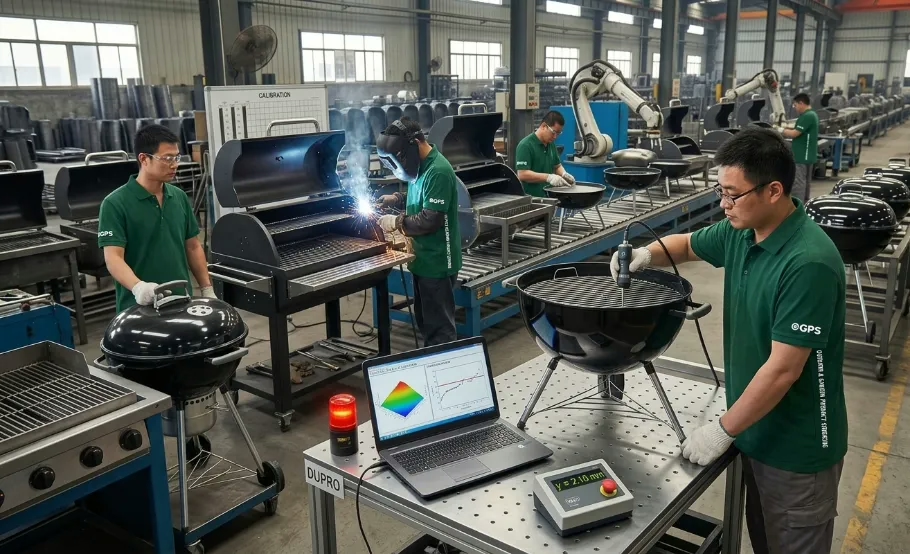
Claims related to product performance, safety features, material composition, or manufacturing processes are reviewed by OGPSGroup in-house CSA/CE certified engineers. Technical assertions are validated against live production data, internal audit logs, and on-site factory observations — not against supplier marketing collateral or unverified specification sheets.

Legal & IP Counsel Review
Any statements pertaining to intellectual property protection, NNN agreement enforcement, international trade compliance, or jurisdictional regulatory frameworks are reviewed by legal counsel specializing in cross-border manufacturing law. This gate ensures that published claims about legal protections are accurate and do not create unintended liability.

Post-Publication Monitoring & Re-Verification
Published content is re-verified on a scheduled cadence calibrated to subject-matter volatility. Tariff and regulatory guides are checked monthly. Supplier listings and certifications are re-run quarterly. Evergreen technical content is reviewed semi-annually. Every re-verification event is logged with a timestamp and auditor identification.
Not Generalist Editors.
Certified Engineers.
The difference between OGPSGroup fact-checking and standard editorial review: our verification team includes the same engineers who design gas routing systems, specify weld tolerances, and sign off on production QC protocols. When we publish a technical claim, someone who tests those parameters has verified it.
Direct Access to Certified Engineers
Technical claims are not reviewed by generalist editors. They are reviewed by OGPSGroup in-house engineers who hold active CSA and CE certifications — the same engineers who design gas routing systems, specify weld penetration tolerances, and sign off on production QC protocols. When we publish a claim about combustion efficiency or material durability, an engineer who tests those parameters has verified it.
Production Floor Validation
For critical assertions regarding manufacturing capabilities, QC protocols, or asset-heavy operations, claims are validated against live production data — not static capability statements. Internal audit logs, batch-level inspection records, and on-site factory observations serve as the verification substrate. If a claim cannot be confirmed on the production floor, it does not get published.
Cross-Border Legal Counsel
Statements about IP protection, NNN agreement scope, and international regulatory compliance are reviewed by legal counsel specializing in Chinese manufacturing law and cross-border trade. This is not a formality — it is a substantive review that has resulted in claim revisions, qualification language additions, and in several cases, the removal of assertions that could not be legally substantiated.
Verification Doesn't End
At Publication.
Tariffs change, certifications expire, and supplier legal statuses shift. OGPSGroup content is on a scheduled re-verification cadence calibrated to the volatility of the subject matter. Every re-verification event is logged with a timestamp and auditor identification.
Tariff & Regulatory Guides
Tariff rates, customs classifications, and trade policy content are checked against GACC and CBP sources every 30 days. Any regulatory change triggers an immediate update with a dated correction notice at the top of the affected article.
Supplier Listings & Certifications
Every listed supplier is re-run through certification databases. Expired certifications are flagged. Any entity with a newly recorded compliance violation triggers an article update reflecting the current status within one business week.
Evergreen Technical Content
Content referencing specific engineering specifications, material standards, or manufacturing processes is re-checked against current production data and updated industry standards twice per year.
Foundational Guides & Explainers
Foundational content on manufacturing strategy, sourcing methodology, and supply chain architecture is reviewed annually for relevance, accuracy, and alignment with current operational capabilities and market conditions.
What Separates Industry Claims
From Verified Facts.
Most sourcing companies publish whatever suppliers tell them. OGPSGroup verifies every claim against primary-source documentation — and when new evidence emerges, we publish dated corrections, not stealth edits.
Supplier self-declarations accepted as fact. Certifications listed without verification against issuing-body databases. Marketing claims published without engineering review. Errors corrected quietly — or not at all. Readers have no way to distinguish verified information from supplier sales collateral.
Every factual claim traced to a primary-source document and verified against the issuing authority's live database. Technical assertions reviewed by certified engineers. Legal and IP claims reviewed by cross-border manufacturing counsel. Dated correction notices published within 48 hours of confirmed error discovery. Full audit trail maintained for every verification event.
When New Evidence Changes
What We Know.
Verification rigor means correcting errors transparently when they are discovered. Here is a real example of our correction protocol in practice — dated, specific, and published prominently, not buried in a changelog.
Correction Scenario: EN 1860-1 Compliance Documentation
An initial publication stated that all charcoal grills manufactured by OGPSGroup for the European market comply with EN 1860-1:2013 standards for solid fuel appliances.
Further internal engineering review against the latest European Union harmonized standards revealed that certain auxiliary components, while structurally sound, required updated material data sheets to explicitly reference the most recent REACH Annex XVII amendments concerning specific polymerizers.
The claim was updated to reflect full compliance pending the submission of these updated material declarations — a process verified by our compliance team. A dated correction notice was published at the top of the affected article within 48 hours of the engineering review's completion.
Verification Rigor
Builds Confidence.
“OGPSGroup was the only partner who could show us independent verification of their factory certifications — not just a list of names from a paid directory. Their fact-checking process gave us the confidence to commit to a seven-figure annual program after being burned twice by suppliers who couldn't back up their claims.”
“When we asked for the underlying test reports behind their CE certifications, OGPSGroup sent them within 24 hours — complete, dated, and verifiable against the notified body's database. No other factory we've worked with in 15 years of sourcing has ever responded to a compliance request with that level of transparency. That single exchange convinced us they operate at a different level.”
Questions About
Fact-Checking.
Fact-checking is performed by OGPSGroup in-house CSA/CE certified engineers and quality specialists — not by marketing personnel or external contractors. Technical claims are reviewed by the same engineers who oversee production QC protocols. Legal and IP-related claims are reviewed by cross-border manufacturing counsel. This ensures that verification is performed by professionals who understand the underlying technical and regulatory subject matter — not by generalist fact-checkers applying a checklist.
Re-verification frequency is calibrated to content type. Tariff and regulatory guides are re-checked monthly against GACC and CBP sources. Supplier listings and certifications are re-verified quarterly. Evergreen technical content undergoes semi-annual review. Foundational guides receive annual review. Every re-verification event is logged with a timestamp and auditor identification. When an update is required, a dated correction notice is published at the top of the affected article.
Errors are corrected within 48 hours of confirmed discovery. The correction is published as a dated notice at the top of the affected article — not buried in a changelog or quietly edited. The notice specifies what changed, why it changed, and what evidence triggered the correction. If the error has compliance or safety implications, affected clients who have referenced the content are notified directly.
Yes. Many of our enterprise clients engage independent third-party auditors — such as SGS, Bureau Veritas, or Intertek — for supplementary verification of our published claims. Our engineering and compliance teams coordinate directly with these auditors, providing full access to certification records, test reports, production data, and on-site inspection opportunities. Independent verification is welcomed, not resisted — it reinforces the credibility our process is designed to establish.
Ask Us to Verify
Any Claim. Right Now.
Our fact-checking process is not a marketing promise — it is a verifiable, auditable system that you can test. Pick any factual assertion on this page or anywhere on our site. Our engineering team will provide the primary-source documentation package that supports it — within 48 hours, at no cost, with no obligation. If a claim cannot be verified to this standard, we will tell you and publish a dated correction.
Minimum annual procurement volume: $400K+. Enterprise engagements only.