
Custom Outdoor Patio Umbrella Manufacturer.
Engineered to Your Wind Load. Built to Your Brand.
24-hour DFM turnaround. 2–3 week pre-production sample. AQL 2.5 Level II inspection on every batch. BOM-level pricing — you see every cost component at the factory gate. 50-unit MOQ. Dedicated production cell with fixed QC team per programme. Mixed-container consolidation with your other SKUs.
From a Market Umbrella to a
4-Metre Cantilever.
A centre-pole for a café table. An offset cantilever spanning a 6-seat dining set. A wall-mounted unit folding flat against a balcony rail. Same factory floor, same QC standard — different engineering for each application.
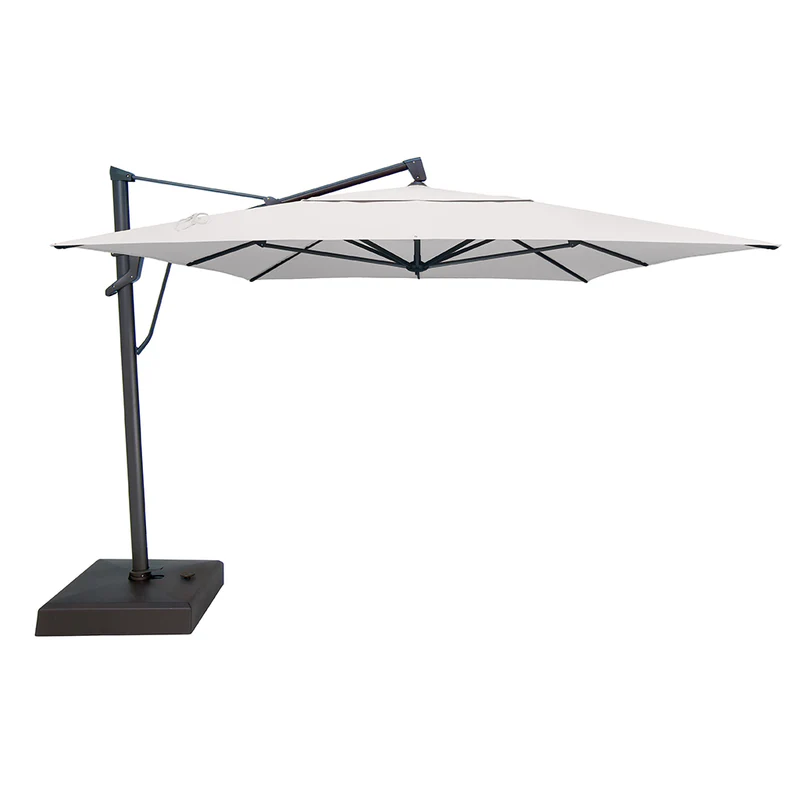
Cantilever Umbrellas
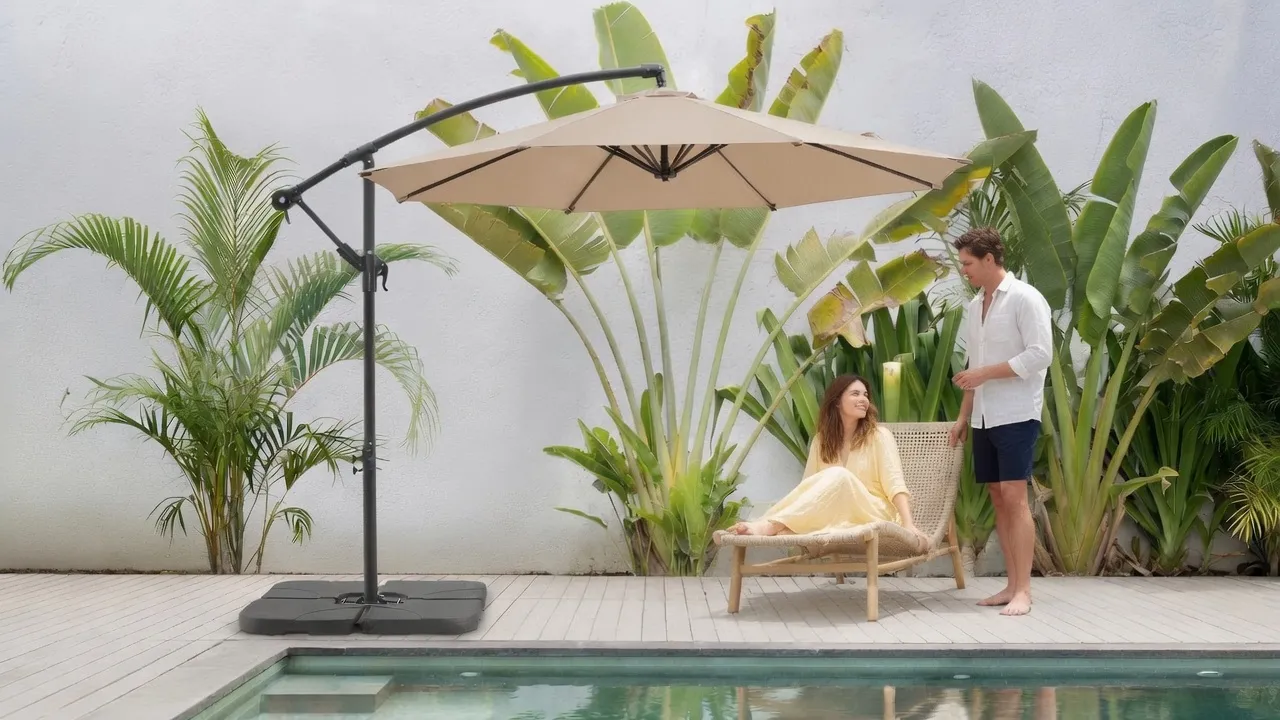
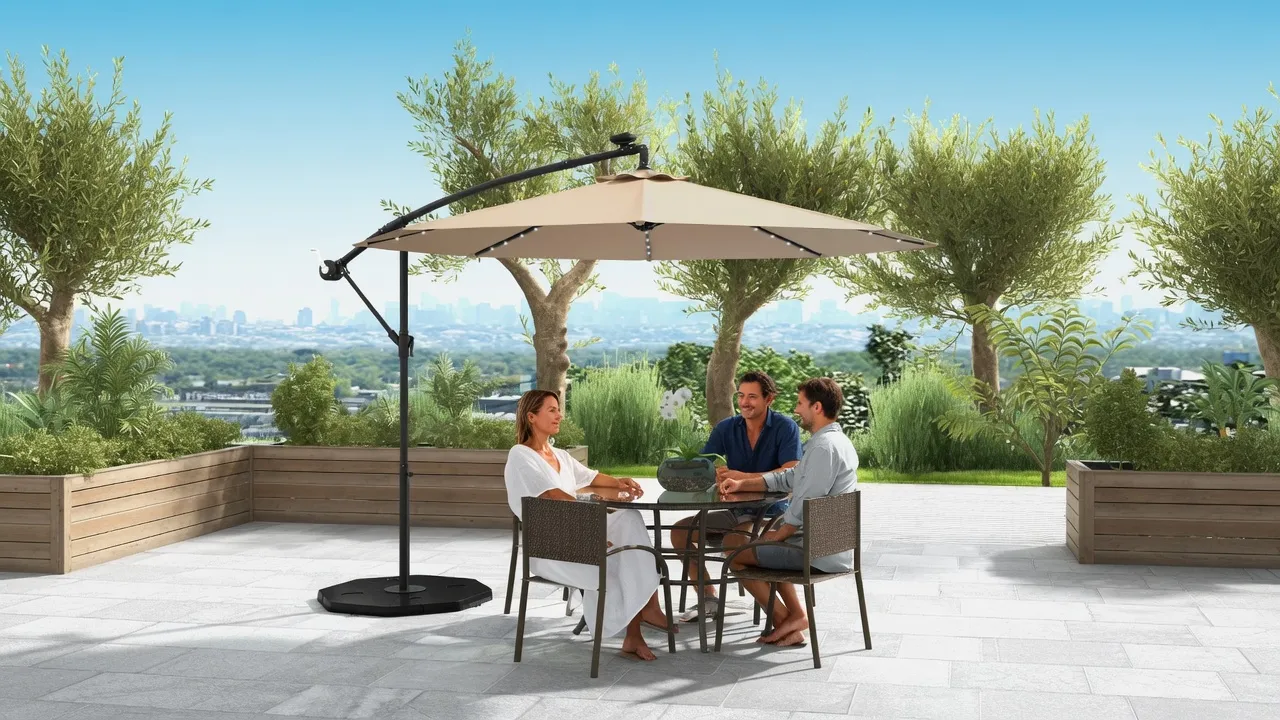
Side-post design with 360-degree rotation and multi-position tilt. Span 2.5m–4m with aluminium or stainless steel mast. Powder-coated frames with crank lift, collar tilt, or auto-lift mechanisms. Ideal for poolside loungers, outdoor dining sets, and hospitality decks.
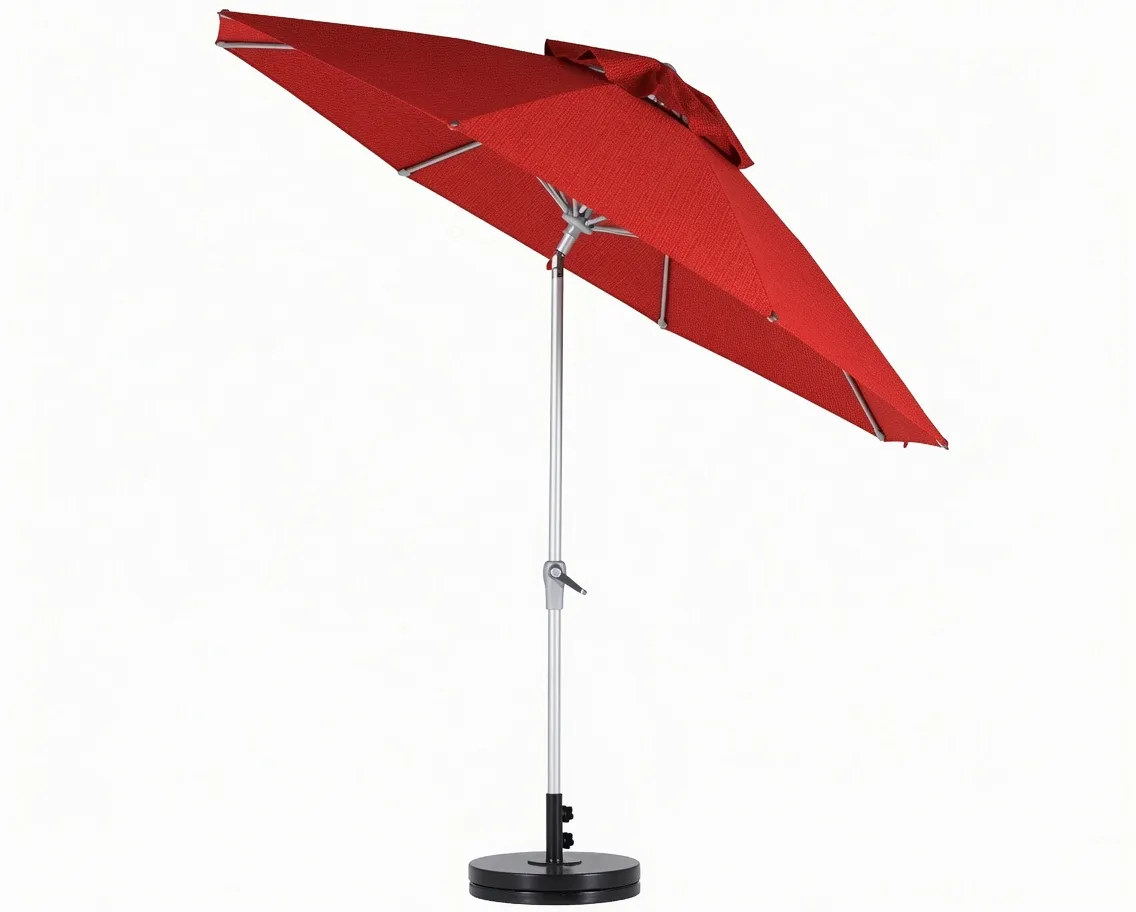
Market / Push-Up Tilt Umbrellas
Centre-pole classic with push-up or crank lift. Canopy diameters from 1.8m to 3.6m. Available in wood-look aluminium, fibreglass ribs, and vented or unvented canopy options. Push-button tilt for all-day sun tracking.
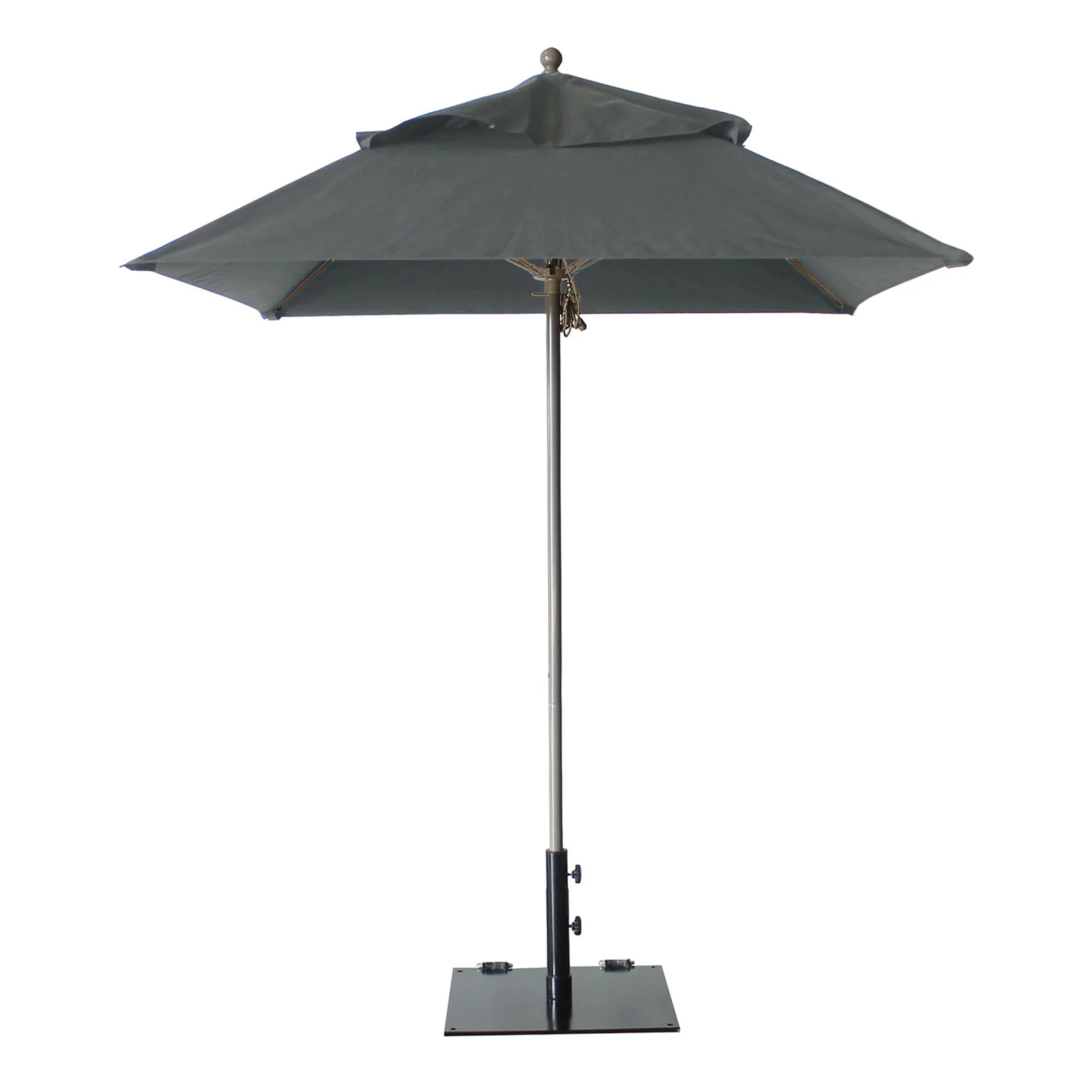
Commercial-Grade Umbrellas
Heavy-duty construction for restaurants, resorts, and high-wind coastal environments. Reinforced hubs, stainless steel hardware throughout, double-layer vented canopies. Fibreglass ribs as standard. Wind-rated to Beaufort 6 (50 km/h).
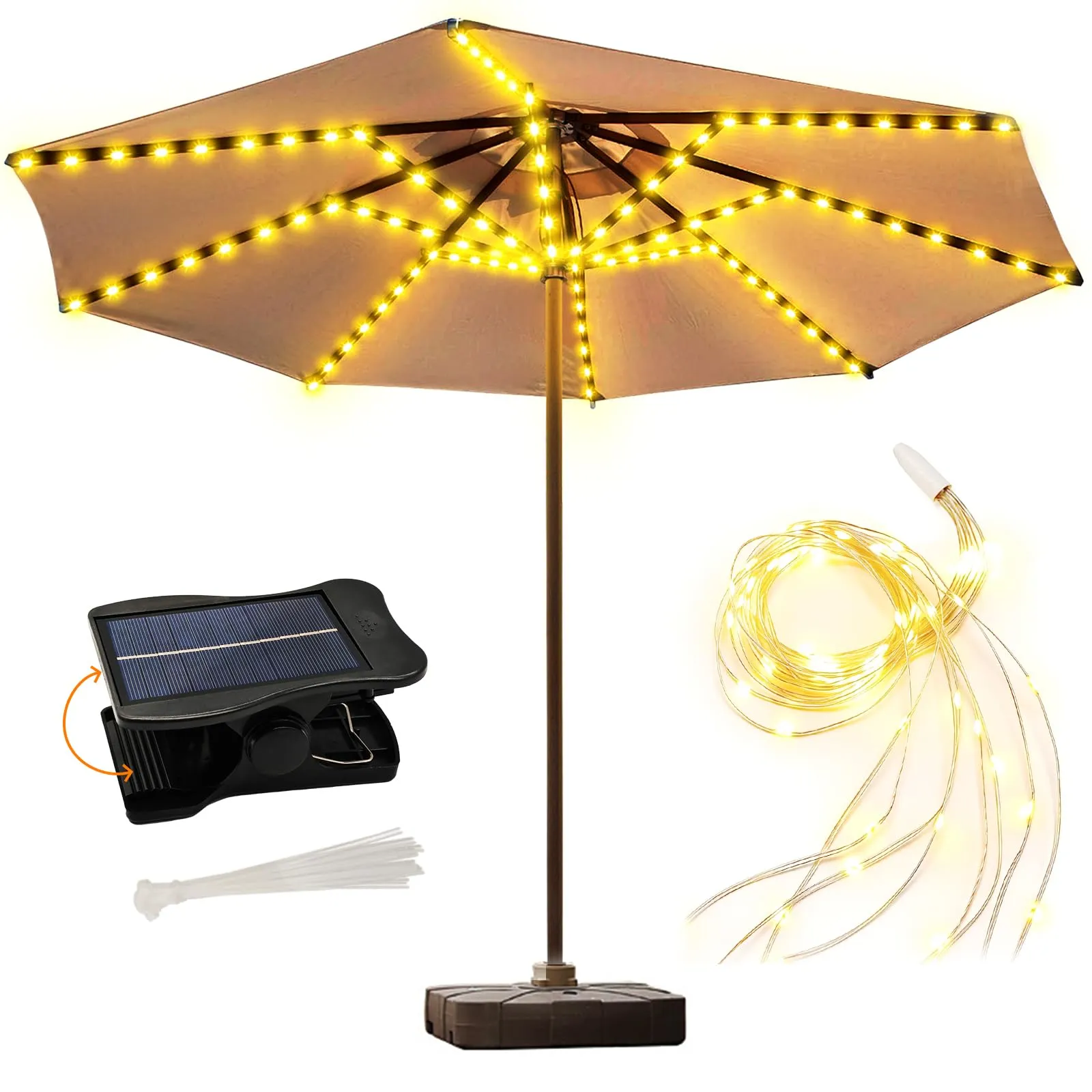
Solar LED Umbrellas
Integrated solar panel powers LED rib lighting with no external wiring. Dimmable via remote control. Available in market and cantilever configurations. Ideal for evening hospitality, residential patios, and premium outdoor spaces.
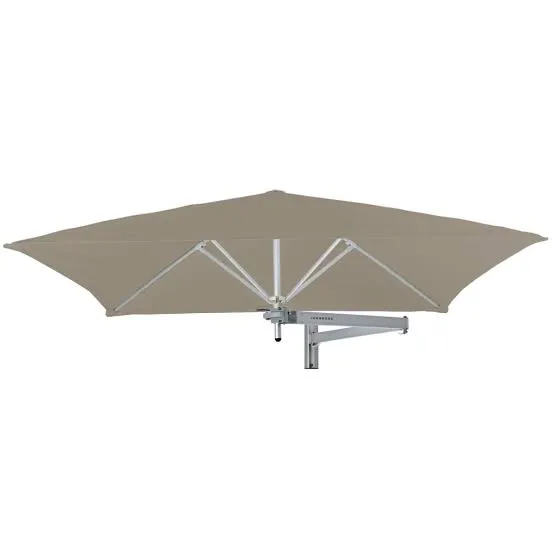
Wall-Mounted Umbrellas
Compact shade for balconies, terraces, and narrow outdoor spaces. Fold-away design with aluminium mast. Projection from 1.5m to 2.5m. Swivel bracket for 180-degree coverage. Ideal for apartments, cafes, and cruise ship decks.
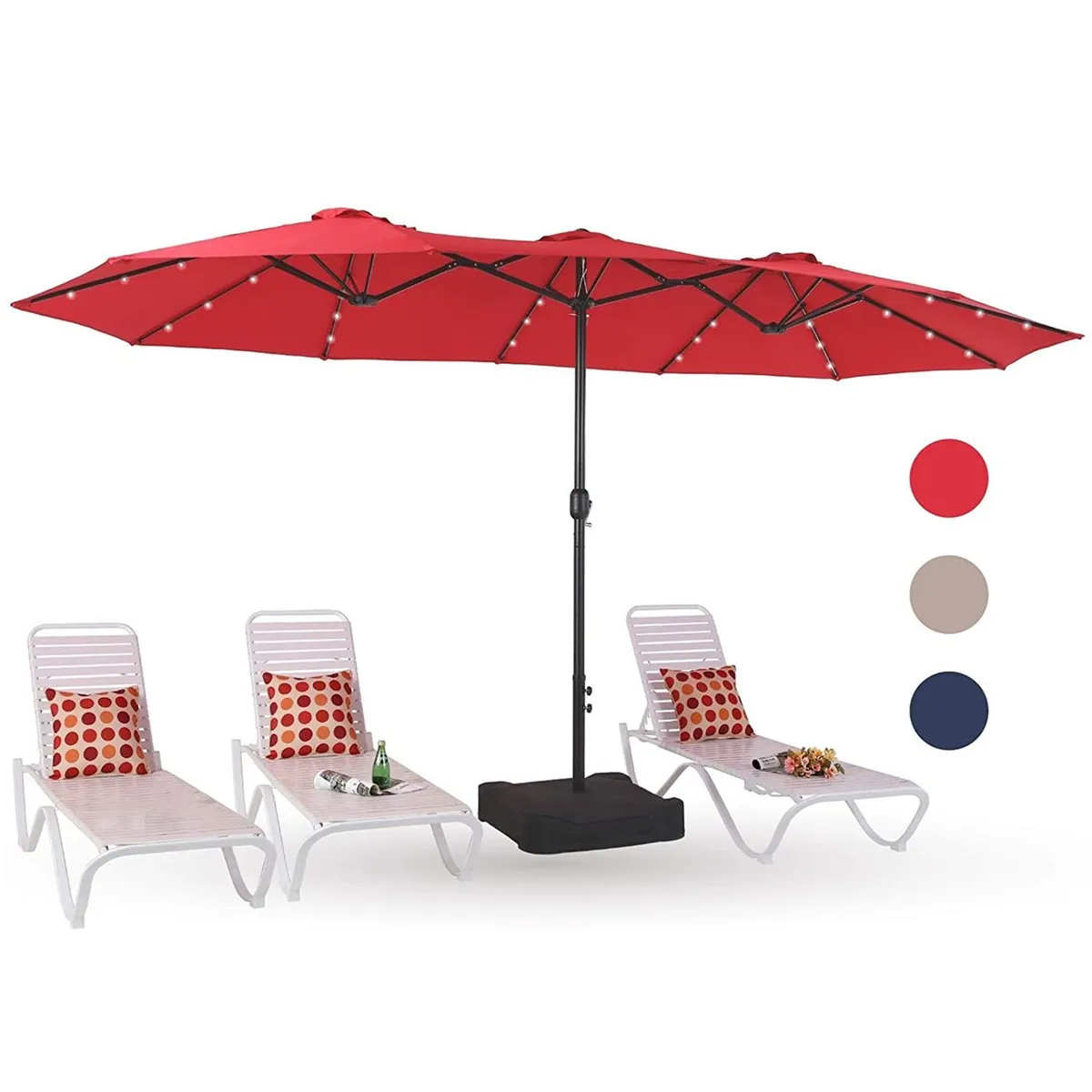
Double-Sided Umbrellas
Oversized rectangular shade for long dining tables and sectional sofa sets. Canopy spans 3m x 4m with dual-mast support. 12 fibreglass ribs with reinforced hub joints. Tension cables for wind stability. Available with LED rib integration.
Beaufort 6. 50 km/h.
Not a Hope. A Specification.
Wind doesn't read your catalogue. It loads the mast in bending, lifts the canopy, and finds the weakest component. We design against it — FEA on every frame, base weight calculated from your span and exposure zone, mechanism tested to 10,000 cycles under load.
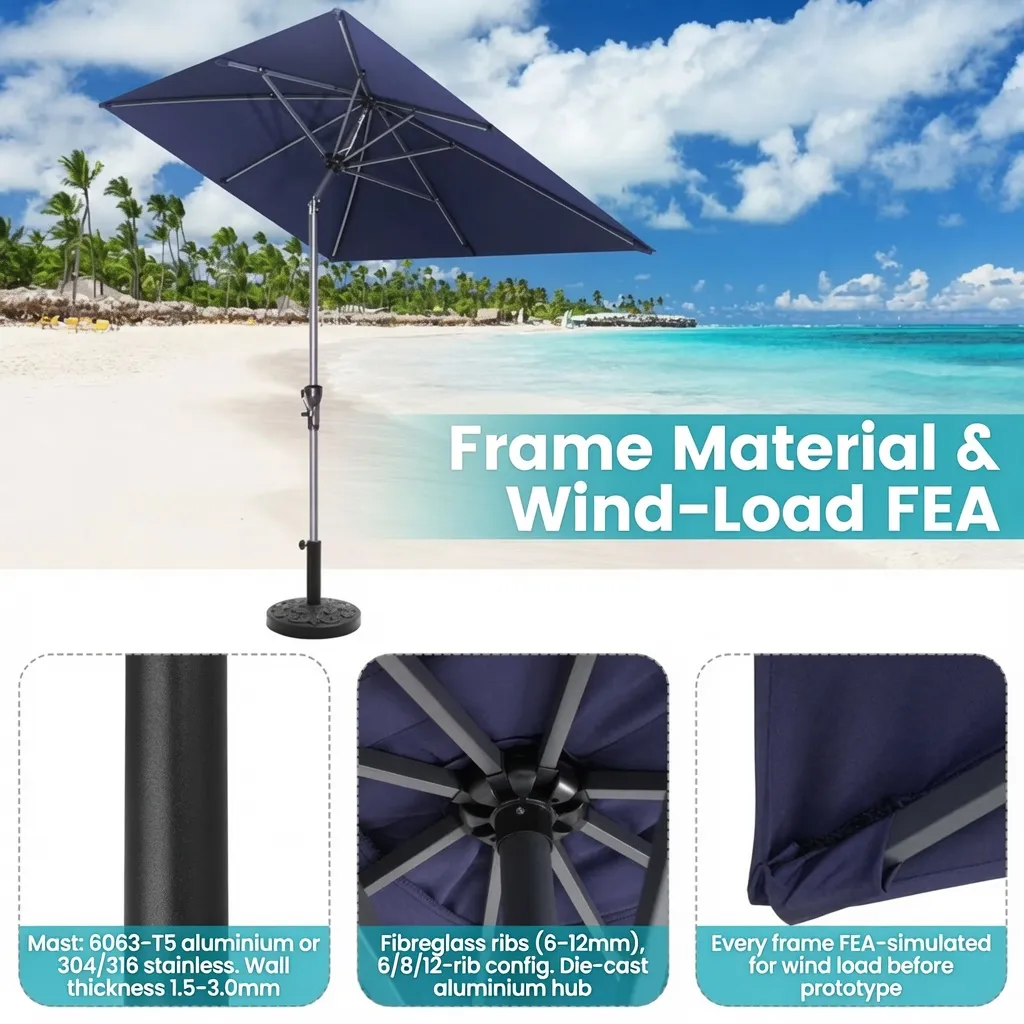
Frame Material & Wind-Load FEA
Mast: 6063-T5 aluminium or 304/316 stainless. Wall thickness 1.5–3.0mm, spec'd to your wind zone — not a generic gauge off the shelf. Fibreglass ribs (6–12mm) as standard; 6, 8, or 12-rib configuration. Die-cast aluminium hub with 304 stainless pivot pins. Every frame FEA-simulated for wind load before the first prototype is built.
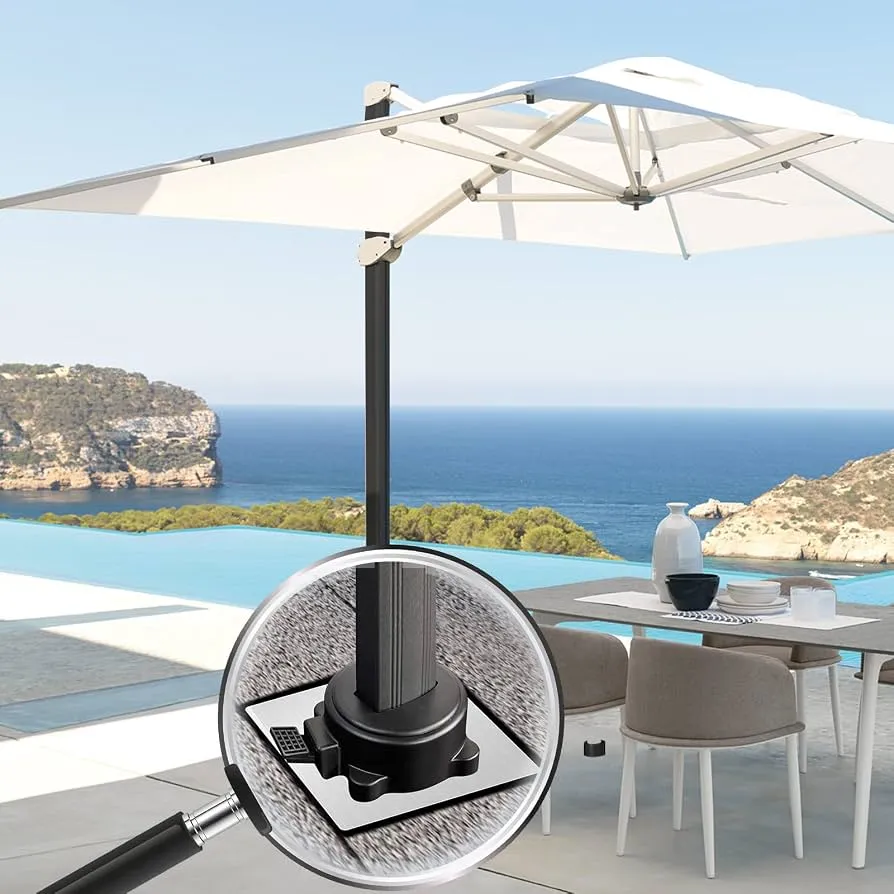
Base & Anchoring System
Base weight calculated — not guessed — from your umbrella span, mast material, and local wind exposure data.
- Cross-base — pairs with 20–30kg weight plates
- Half-base — wall-hugging, for perimeters and narrow spaces
- Granite/resin composite — 25–40kg, no separate weight plates needed
- In-ground anchor — 316 stainless sleeve with locking pin, rated to 80 km/h
Lift Mechanism & Hardware
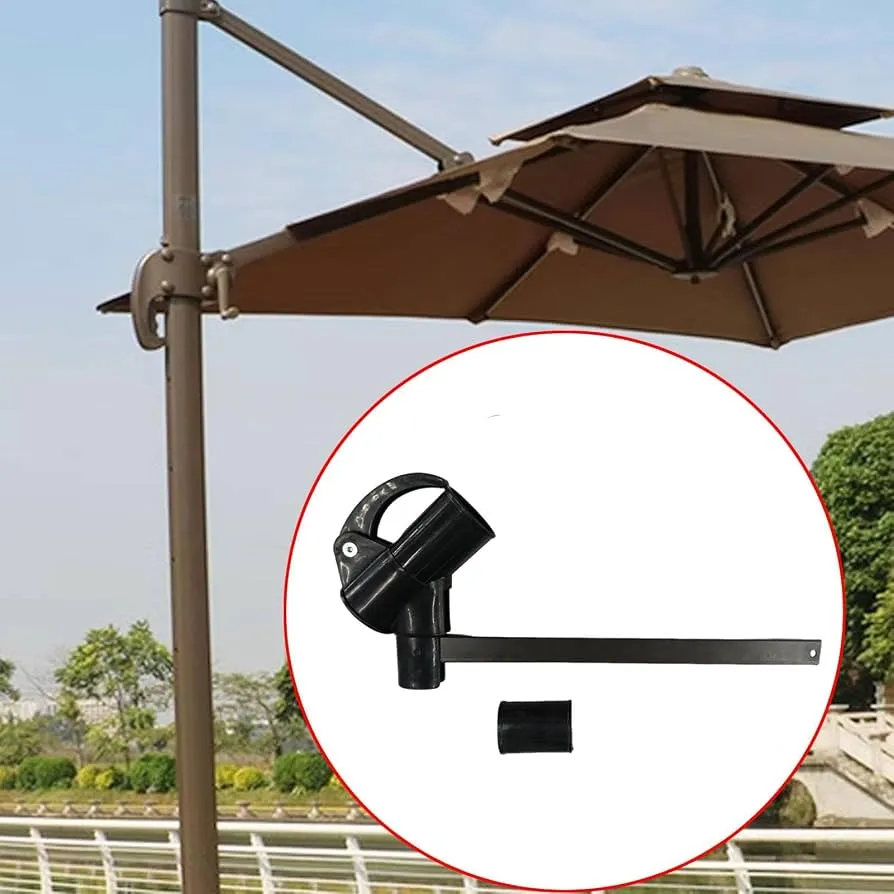
- Lift: push-up / crank / pulley / gas-assisted auto-lift
- Tilt: push-button collar / crank / infinite-position auto-tilt
- Finish: powder-coated to mast colour, or natural stainless
304 stainless pivot pins throughout. Mechanism cycle-tested to 10,000 operations under load. Hub castings inspected for micro-cracking at 5,000 and 10,000 cycle checkpoints.
Frame Material Options
Mast and rib material — choose based on your wind zone, weight tolerance, and cost target.
Modern cantilever and market umbrellas. Lightweight. Excellent strength-to-weight. Zero rust. Default for poolside and coastal.
Higher cost than steel. TIG welding required. Thin-walled tube (< 1.5mm) buckles under sustained wind load.
Permanent installations, luxury hospitality, seaside resorts. 316 grade: zero pitting after years of salt exposure.
Heavy — higher freight cost. Premium material cost. Brushed finish needs monthly freshwater rinse in coastal environments.
Ribs in high-wind and marine applications. Bends before it breaks — absorbs gust energy. UV-stable resin. Chemical-resistant.
Higher rib cost than aluminium. Cannot be powder-coated. Not rigid enough for large cantilever masts — ribs only.
Three Metres of Your Brand.
Make It Unmistakable.
The canopy is the most visible object on any patio — a 3-metre canvas flying your colours. Fabric grade determines UV survival. Colour accuracy determines whether it matches your brand. Logo placement, valance pattern, and even the packaging tell your customer whose product this is.
Canopy Fabric & Colour Matching
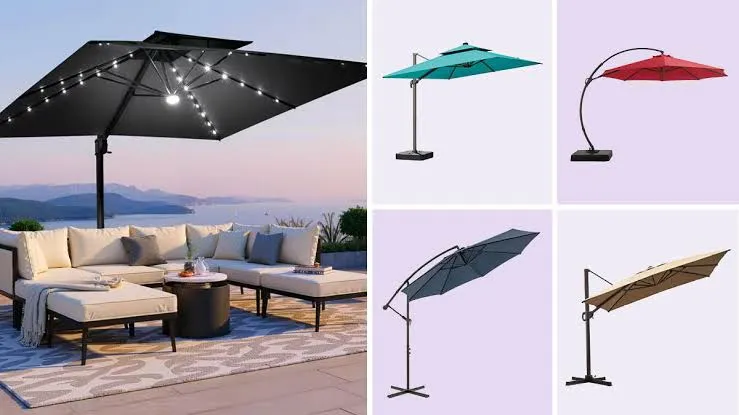
Three fabric grades, all solution-dyed — pigment inside the fibre, cannot peel or flake. 200+ in-stock colours. Custom colour matching with spectrophotometer verification under D65 lighting — ΔE ≤ 1.5 per production lot. Every canopy in your batch cut from the same fabric roll.
- Solution-dyed acrylic — Sunbrella-grade, 280–320 g/m², 5-year UV warranty, 1,500+ hr ASTM G154
- Solution-dyed polyester — 60% of acrylic cost, 3-year UV performance
- Olefin — budget option for seasonal retail, 2-year UV
Solar LED Integration
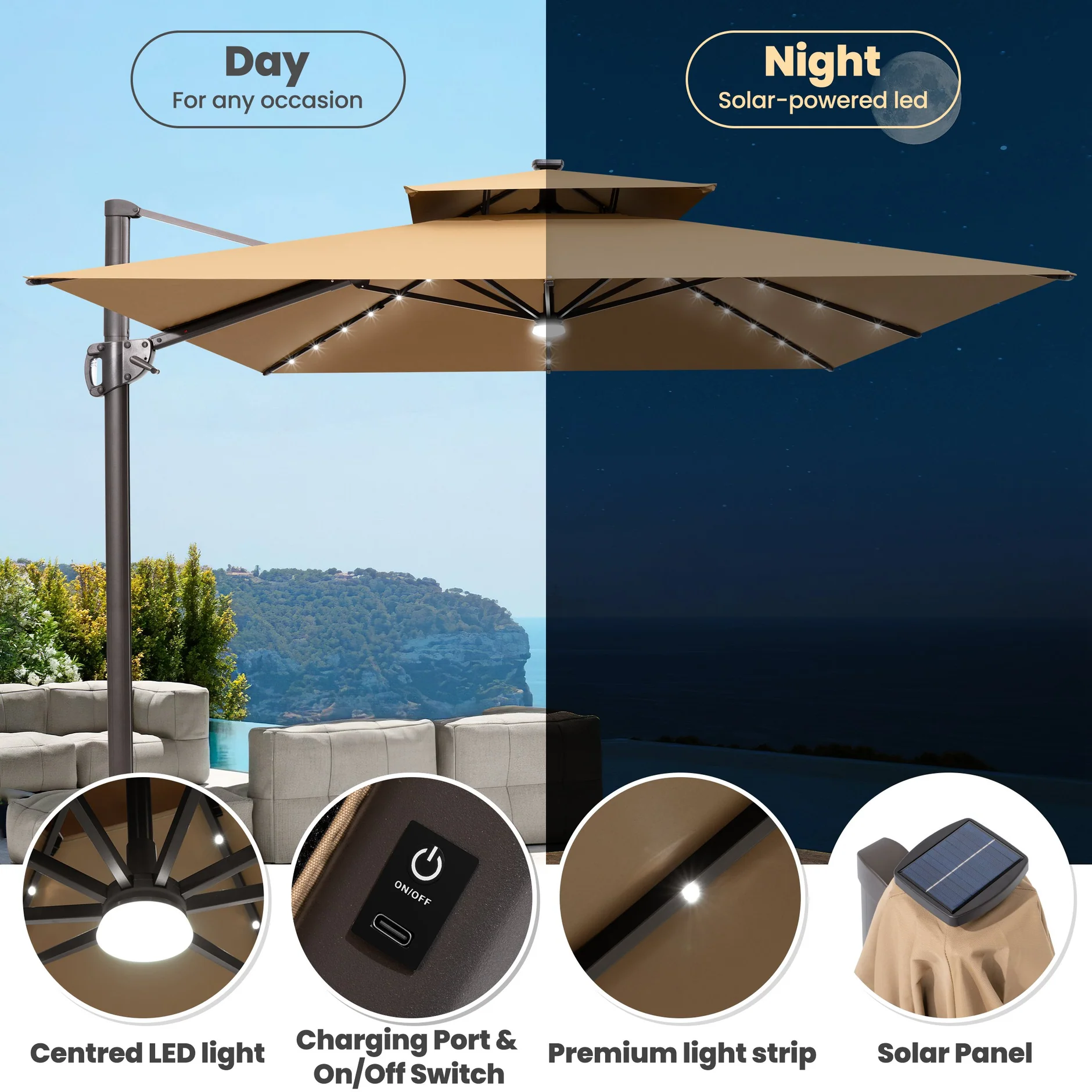
Monocrystalline solar panel in the canopy hub powers 24–48 warm-white LEDs (3000K, 80+ CRI) embedded in rib pockets. No external wiring.
- 6–8 hr runtime on full charge — 4–5 hr overcast
- Li-ion 18650 battery, 2,000+ charge cycles, field-replaceable
- Remote: on/off, dimming, 2/4/6 hr timer
- USB-C backup charging on hub
- IP65 water-resistant, silicone-sealed panel-to-hub connection
Branding, Valance & Packaging
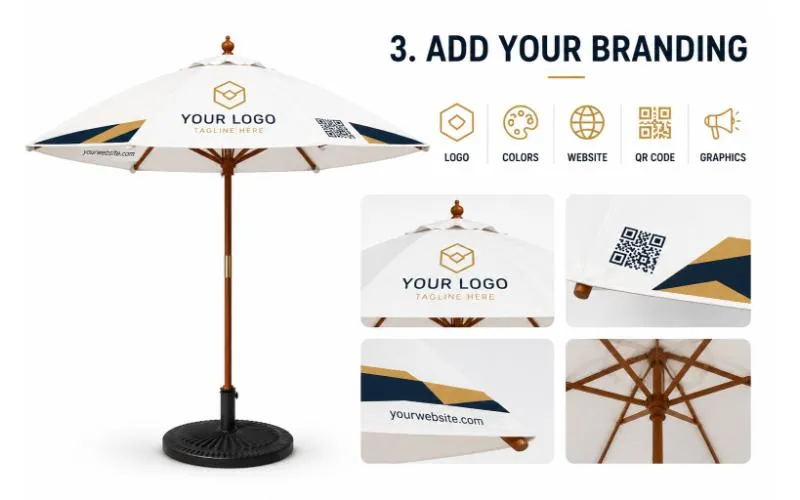
Your umbrella arrives looking like your product — not a generic import.
- Canopy: screen-printed logo, embroidered patch, or custom-printed valance pattern
- Hardware: hot-stamped or laser-engraved logo on mast base, hub cap, or crank handle
- Carton: custom-printed with your brand identity, not a brown box with a shipping label
- Collateral: branded assembly guide in your language, custom hangtags, barcode-level SKU traceability
70% of the World's Umbrellas.
One 50km Radius.
The aluminium tube, the acrylic fabric, the fibreglass ribs, the powder coat — every component comes from suppliers within an hour of our factory floor. This concentration isn't marketing. It's the physical reason sampling is faster, colour matching is same-day, and freight consolidates into one container.
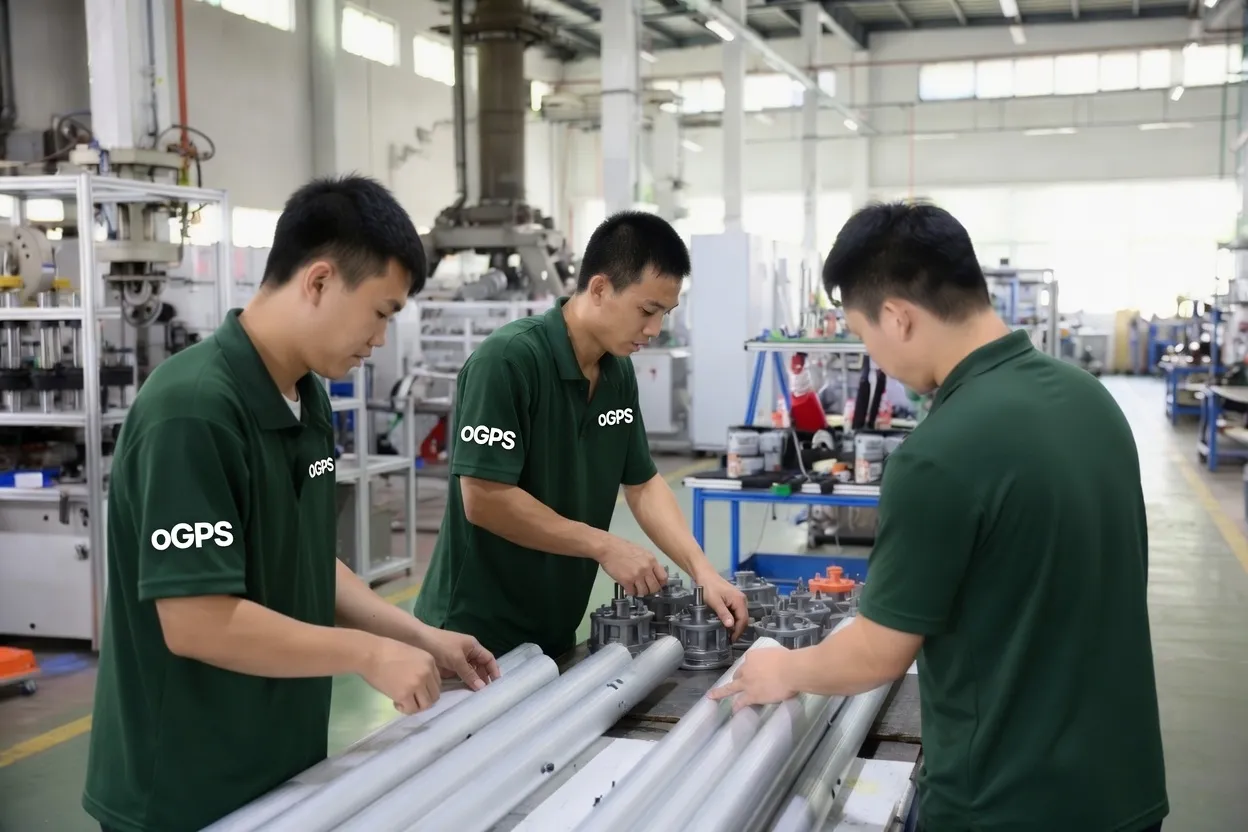
When something changes during production — a mast tube needs a thicker wall, a hub casting needs a tighter tolerance — the supplier who makes that part is local. Extrusion plants, fibreglass workshops, sewing lines, and powder-coating booths all operate within Guangdong's industrial zone. A revised component arrives the same day, not the same week.
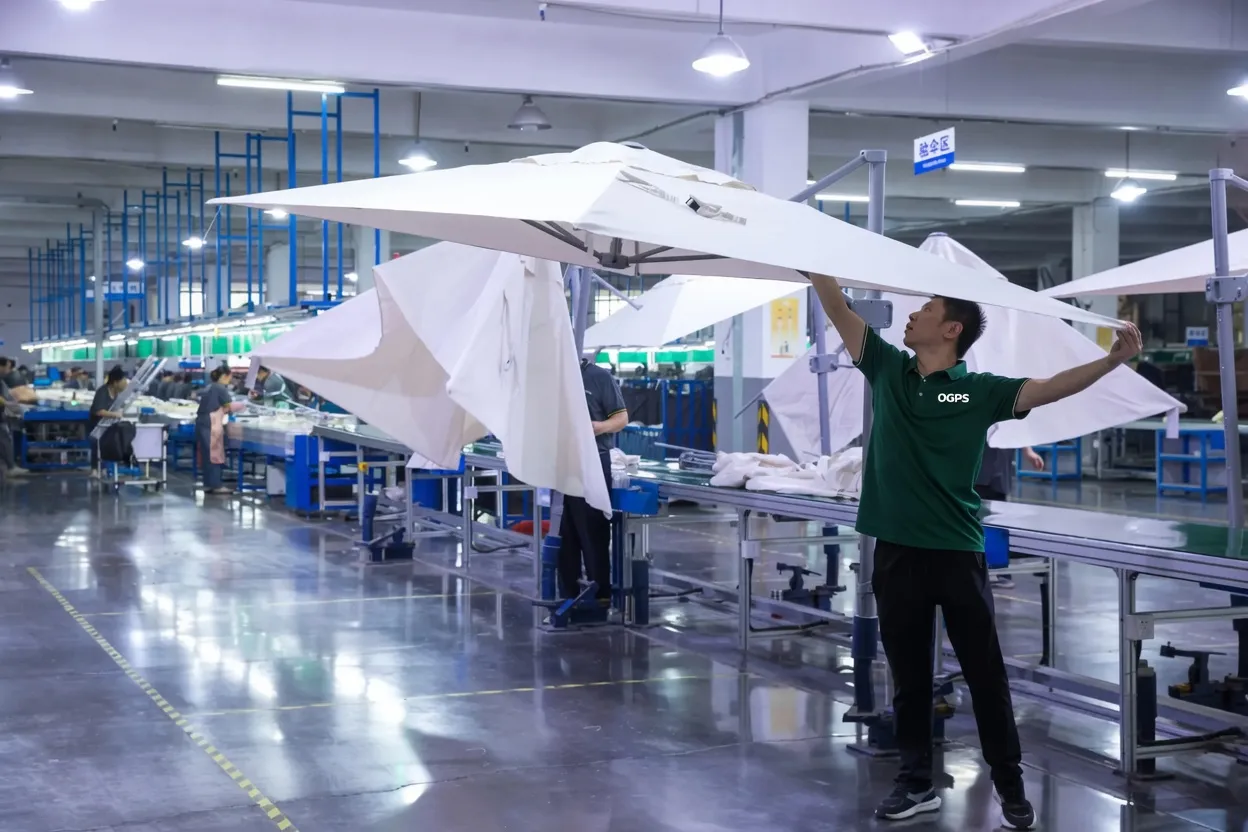
Welding aluminium mast joints to spec. Sewing double-stitched canopy seams. Applying powder coat to the specified thickness. These are specific trade skills concentrated in this region — not general-purpose factory labour. Your production line is staffed by workers who have built umbrellas for years, not weeks.
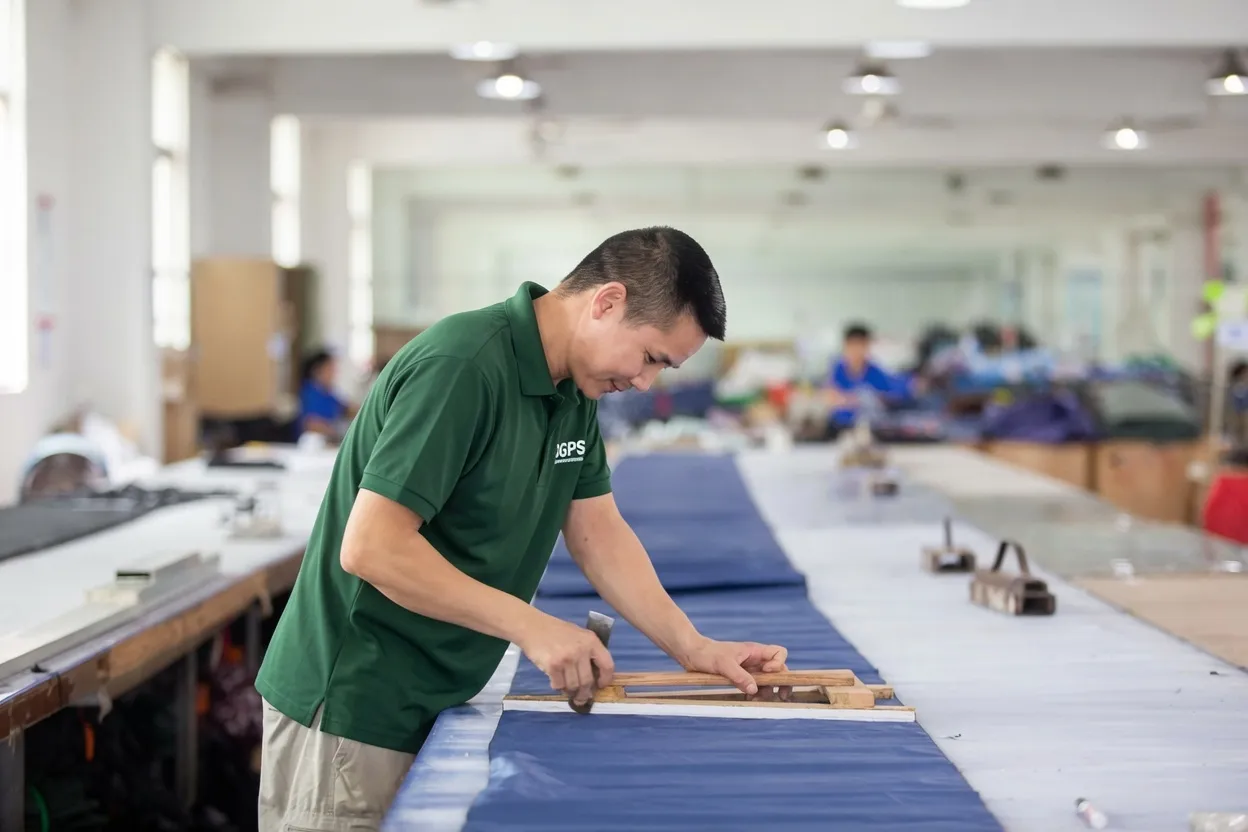
When every supplier in your supply chain operates in the same industrial zone, physical samples move between facilities in hours. The iteration cycles that consume weeks of international courier and customs clearance between distant suppliers collapse into a single working day per cycle here. This is a structural speed advantage — not something bolted onto a service agreement.
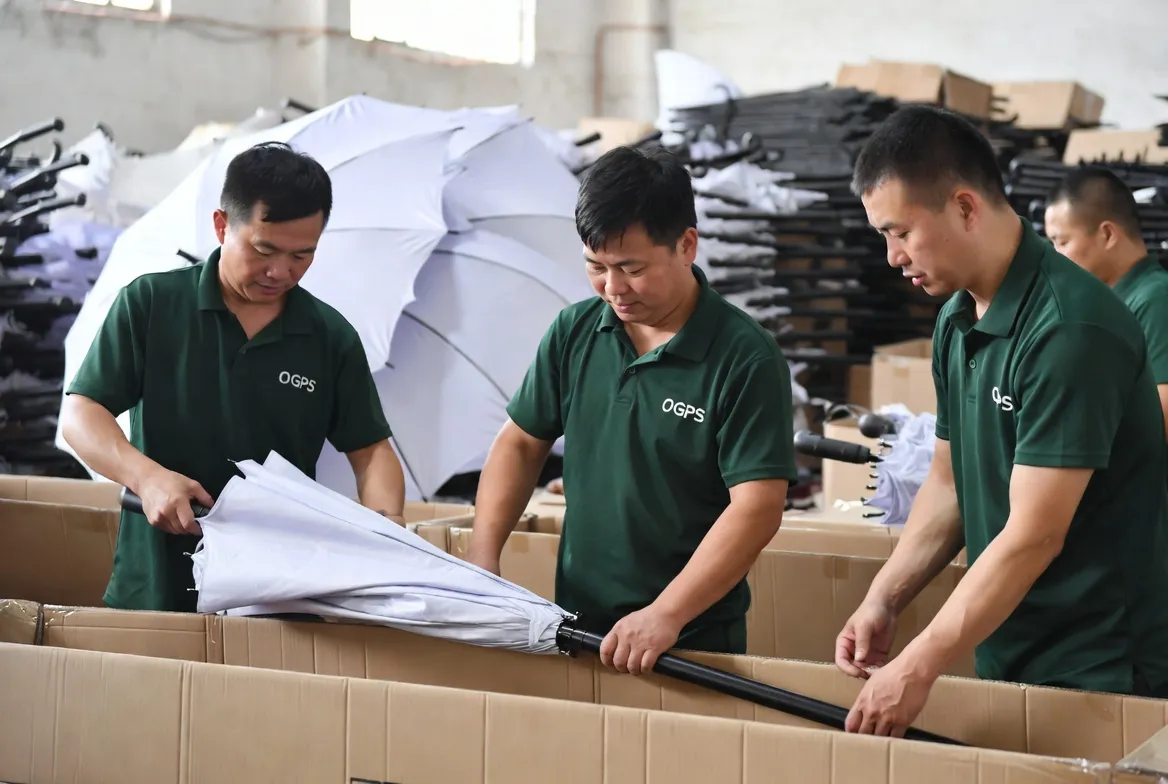
Your umbrellas share a 40HQ container with other OGPSGroup-managed product lines — grills, furniture, accessories — all produced within the same region. One container, one customs clearance, one arrival. This is consistently cheaper and simpler than coordinating LCL shipments from scattered factories across multiple provinces.
Four Gates. No Shortcuts.
Every Batch. Every Time.
Product specs are in the sections above your scroll. This is the process that ensures what you approved is what gets loaded into the container.
Every aluminium and stainless steel batch scanned with handheld XRF spectrometer at receiving. Alloy composition cross-referenced against mill certificate. Mismatch = rejection. 30 seconds per batch. Zero wrong-alloy incidents in 5 years.
One complete umbrella built to your exact specification — your fabric, your frame, your finish. Inspected against your design brief under D65 lighting. Production does not start until you approve the sample in writing. This sample becomes the reference standard for every unit in your batch.
Welds checked at frame station. Canopy stitching inspected at sewing station. Powder coat DFT measured at finishing station. Mechanism cycled at assembly station. Defects caught at source — not discovered at final inspection. Operator ID logged per station for full traceability.
Random sample pulled per ISO 2859-1 Level II. Inspected against the approved pre-production sample. Packaging validated: 17-drop test, vibration simulation, mast-to-rib separation. QC report with timestamped photos in your container dossier. Transit damage rate across all umbrella SKUs: under 0.3%.
One column describes how most of the market works.
The other describes how we work.
| Trading Company | OGPSGroup Factory Floor |
|---|---|
| Pricing: You receive a unit price. You don't see aluminium cost per metre, fabric cost per panel, labour per station, or the margin stacked on top. The number looks competitive because you have nothing to compare it against. | BOM-level line-item quote. Mast extrusion. Canopy fabric. Hub casting. Powder coat. Sewing labour. Packaging. Each cost component separated. Compare against your current supplier line by line — not unit price against unit price. |
| Engineering: Your spec sheet goes to whoever bid lowest this quarter. Whether that factory understands wind load on a 4-metre cantilever with a double-layer vented canopy is not something the trading company verifies. | Wind-load FEA on every frame design before prototyping. Mast wall thickness, rib count, and base weight calculated from your canopy span and exposure zone — not pulled from a standard spec sheet. Same engineering team reviews every batch. |
| IP & Exclusivity: Six months after your first order, a "similar" umbrella appears in the trading company's catalogue under a different brand. Your canopy pattern, your frame geometry — now part of their sample line. | NNN agreement before any file is shared. Your tooling under lock. Extrusion dies, hub moulds, stitching jigs — stored in access-controlled storage, not on an open shelf. We don't build your design for anyone else. One brand, one canopy pattern, one factory floor. |
Two Programmes. Real Numbers.
Not Marketing Claims.
Salt air along the Adriatic coast destroys standard umbrellas. We went through three suppliers — same outcome every time. OGPSGroup was the first one who asked what wind speeds we actually get on the terraces, not just what size umbrella we wanted. They specced 316 stainless on all the pivot points and put an e-coat layer under the powder coat. Said it would add a bit to the unit cost but we wouldn't be replacing frames every season.
84 cantilevers and 120 market umbrellas across nine properties. 18 months later, they still look new. Haven't placed a replacement order since the install.

Last spring, first time launching umbrellas as a branded line — not just an accessory buy. The burgundy kept me up at night. It runs across the entire outdoor collection and if the umbrella canopy came out a different shade than the chair cushions, it would look cheap.
OGPSGroup ran everything off one dye lot — all three sizes, same roll. Photos of the swatches against our cushion fabric under D65 before a single panel was cut. When the containers landed, the colour matched. Actually matched — not "close enough for outdoor furniture."
82% sell-through by July. Two returns all season. Adding a solar LED SKU next year.

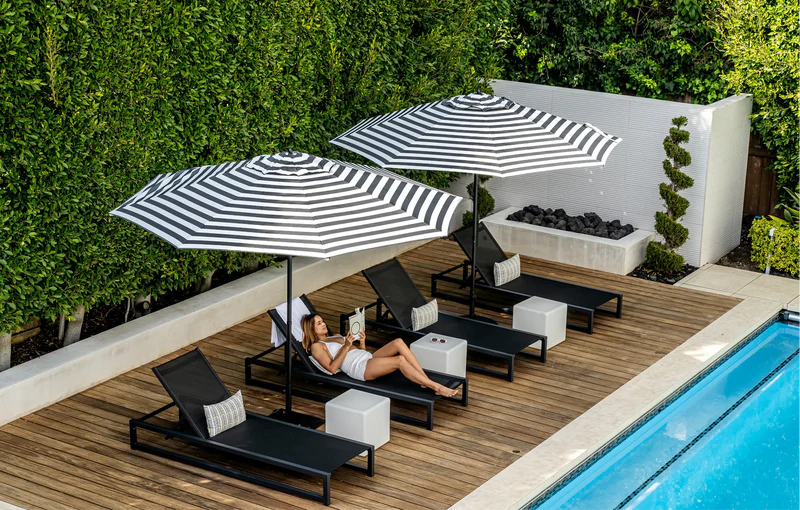
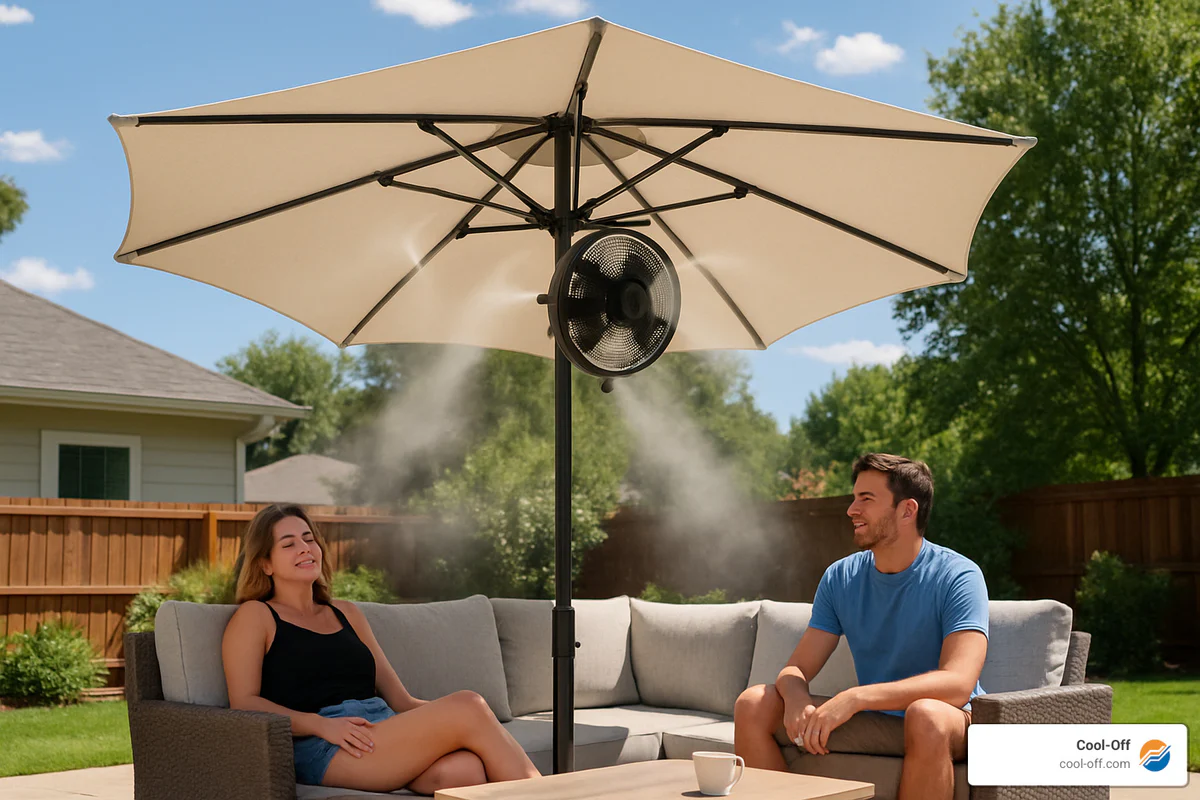
Where These Umbrellas
Actually Live.

Wind. Colour. IP. Lead Time.
What Buyers Actually Need to Know.
Standard commercial umbrellas: Beaufort 6, 39–49 km/h sustained. This is a tested rating — every frame design runs through wind-load FEA before prototyping. For high-wind or coastal exposure zones, we engineer the frame accordingly: thicker mast walls, 12-rib configuration, vented canopy, and a base weight calculated from your specific wind data. Cantilever umbrellas are inherently more wind-sensitive than centre-pole — the offset load creates a moment arm at the base — so the engineering requirements differ by configuration. We'll recommend the right spec for your exposure.
It means you can test a new umbrella design with a pilot batch of 50 units before committing to volume. We don't amortise tooling across only 50 units — that would make your per-unit cost unreasonable. Instead, we structure phased production: 50-unit pilot for market validation using semi-production tooling, then 200+ units with hardened production tooling for scaled runs. This approach lets you validate designs with real customers before the full tooling investment.
Yes — custom colour compounding is available. The minimum order for an exclusive colour is 1,000 linear metres of fabric, which covers roughly 250–300 standard canopies depending on size. The process: you provide a Pantone or RAL reference, our dye lab produces a lab-dip sample (1 week), you approve it, and the full dye lot runs. Colour accuracy is verified by spectrophotometer against your approved lab dip — ΔE ≤ 1.5, same standard as our stock colours. The custom colour is exclusive to your brand. We don't add it to our stock range.
Yes. The umbrella is a visible brand asset — the canopy is 3 metres of your identity in your customer's backyard. Logo can appear on the canopy, valance, and hardware. Even the packaging is branded — your carton, your assembly guide, your hangtags. We don't put our name on your product. The specifics of what goes where are decided during sampling. What matters is that the end customer sees your brand on every touchpoint.
6–8 weeks from design freeze to FOB. Week 1–2: sourcing and preparing raw materials — fabric rolls, aluminium tube, hub castings, hardware. Week 2–3: pre-production sample build (your canopy, your frame spec, your finish) — shipped to you for review and sign-off. Week 4–7: production run — canopy cutting and sewing, frame fabrication and welding, powder coating, assembly, QC checks at each station. Week 7–8: packaging validation (ISTA 3A), final AQL 2.5 inspection, container loading. Rush programmes available for 4-week turnaround on re-orders or programmes using existing tooling. Contact us with your timeline and we'll tell you what's feasible.
NNN agreement signed before any design file is shared — enforceable in Chinese courts. Your physical tooling (moulds, dies, jigs) is stored in access-controlled storage with unique ID tracking — no other client's production touches it. Your design files, BOM, and QC standards are segregated in our system. The practical result: we don't build your umbrella for anyone else, and we don't offer "similar" designs to other buyers. Your canopy pattern stays exclusive to your brand.
The technology is mature. We use monocrystalline panels and lithium-ion 18650 battery packs rated for 2,000+ charge cycles. Real-world expectation: 3–5 years of nightly use before the battery needs replacement. The battery is housed in the hub and is field-replaceable — no need to dismantle the umbrella. Common early-generation failure points (corrosion at panel connections, wire fatigue at hinges, battery overheating) have been engineered out. LED strips are IP65 water-resistant. USB-C backup charging on the hub for cloudy climates. If the system fails under normal use within warranty, we replace it.
That's how most of our clients operate — a full umbrella programme across multiple sizes, types, and price points. We structure multi-SKU programmes as a single engagement with a master production schedule. Each SKU gets its own pre-production sample and QC standard, but production is coordinated across all SKUs. Pricing improves with total programme volume — 12 designs at 50 units each (600 total) gets better per-unit pricing than one design at 600 units because we can batch fabric procurement (one dye lot for all canopies) and optimise line scheduling across SKUs.
One Umbrella or One Hundred.
Same Engineering. Same QC.
Send us your canopy dimensions, wind zone, fabric preference, and target price point. You'll get a DFM analysis with tooling estimate and production timeline — within 24 hours. No cost. No commitment.
MOQ 50–100 units. ISO · BSCI · CSA · CE certified facility.