
Scale Faster With A Custom Charcoal BBQ Grill Supplier.
Factory-Direct. Container-Ready.
OGPSGroup manufactures charcoal BBQ grills on owned production lines in Guangdong, backed by an audited partner-factory network — no trading-agent markup. From compact tabletop units to large-capacity offset smokers, every grill is fired and inspected before it leaves the line, with full CE/CSA/REACH documentation packed in the container. Charcoal grills are one line inside our wider garden product programme.
- Costed plan
- 48h
- On-time delivery
- 98%
- Vetted factories
- 60+
- Export markets
- 75+
- SKUs under management
- 300+
Six Charcoal Platforms.
One Programme. One Container.
Every grill on this page burns charcoal — a fired-and-tested range that runs from small tabletop units up to heavy-gauge offset smokers. It sits inside a wider programme that also covers gas grills and kamado grills, so one brand can run several categories on shared QC and a single consolidating load.

Charcoal Kettle Grill
The backyard workhorse — porcelain-enameled bowl and lid with a hinged grate for easy fuel access.
- Charcoal fuel
- Porcelain-enameled bowl & lid
- Hinged cooking grate
- 225–700°F

Portable Tabletop Grill
A camping and small-space grill that folds flat, locks shut, and is ready to cook in minutes.
- Charcoal fuel
- Folding leg system
- Integrated lid lock
- Under 5-min setup

Kamado Ceramic Grill
Thick-walled ceramic body with a felt-gasket seal for moisture retention and precise vent control.
- Charcoal fuel
- Thick ceramic wall
- Felt gasket seal
- 225–750°F

Offset Smoker Grill
A dedicated smoker with a separate firebox and tuning plates for even heat across the chamber.
- Charcoal fuel
- Offset firebox
- Tuning plates
- Thermometer port

Hybrid Gas-Charcoal Grill
A dual-fuel platform — independent gas burner bank plus a charcoal tray in one full-size cooking area.
- Gas + charcoal
- Stainless steel burners
- Electronic ignition
- Warming rack

Barrel Charcoal Smoker
Heavy-gauge barrel smoker with an offset firebox and removable grates for easy cleaning.
- Charcoal fuel
- Steel barrel body
- Offset firebox
- Removable grates
Which charcoal platform fits your line?
| Platform | Fuel & airflow | Heat control | Structure | Best for |
|---|---|---|---|---|
| Kettle | Charcoal; open bowl, adjustable damper | Direct / indirect zones | Pressed steel + porcelain enamel | Entry-to-mid retail ranges, high-volume SKUs |
| Kamado | Charcoal; thick ceramic, top & bottom vent | Tight, multi-hour heat hold | Ceramic wall + felt gasket | Premium & specialty BBQ brands |
| Offset smoker | Charcoal / wood in a separate firebox | Indirect low-and-slow across the chamber | Heavy-gauge steel chamber | Enthusiast & smoker-led brands |
5 Charcoal-Grill Failure Modes.
Solved at the Factory.
Charcoal grills fail differently from gas — sustained high heat, reactive ash, and heavy cast components all take a toll. These are the five failure points we engineer out on the line, backed by factory audits and a single consolidation programme.
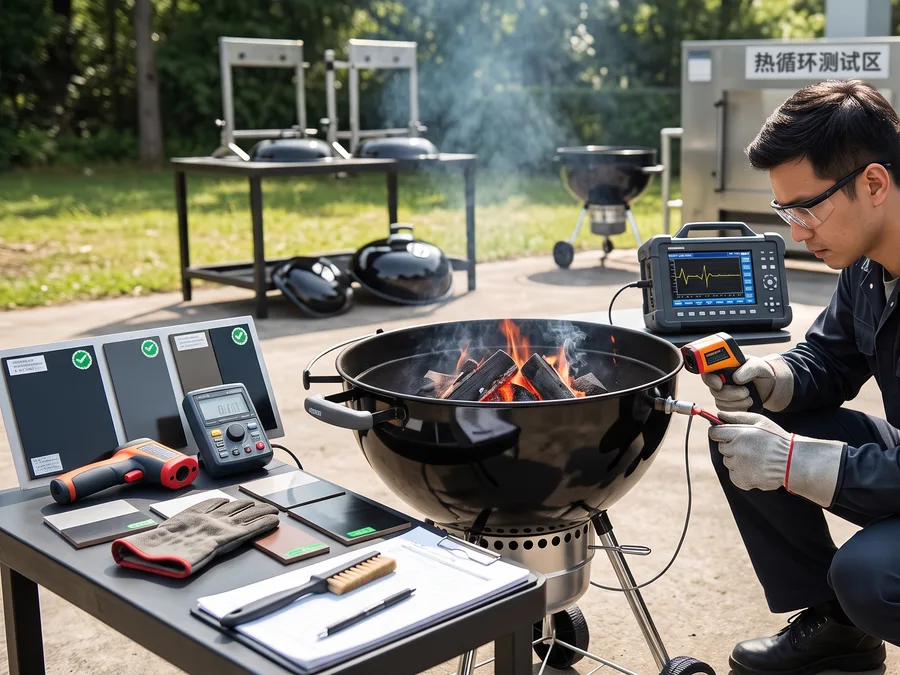
Enamel & Coating Breakdown
Risk: Porcelain enamel and powder coats blister and flake where sustained charcoal heat meets reactive ash — the first thing a buyer sees on a returned grill.
Fix: Multi-stage phosphate pre-treatment and controlled firing cure, with heat-cycle testing on every coating batch before it enters production.
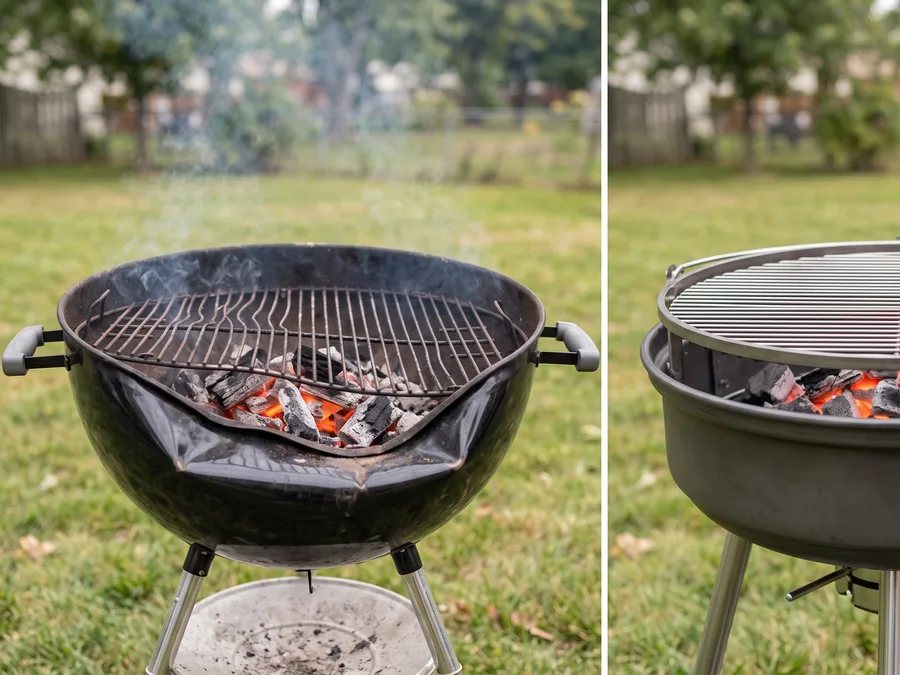
Firebox & Grate Distortion
Risk: Thin-gauge fireboxes creep and warp at searing temperatures, grates bow, and fuel slumps to one side — heat control is lost exactly when you need it.
Fix: Wall-thickness and material-grade specification, with fire-cycle validation of the firebox and grate geometry before mass production.
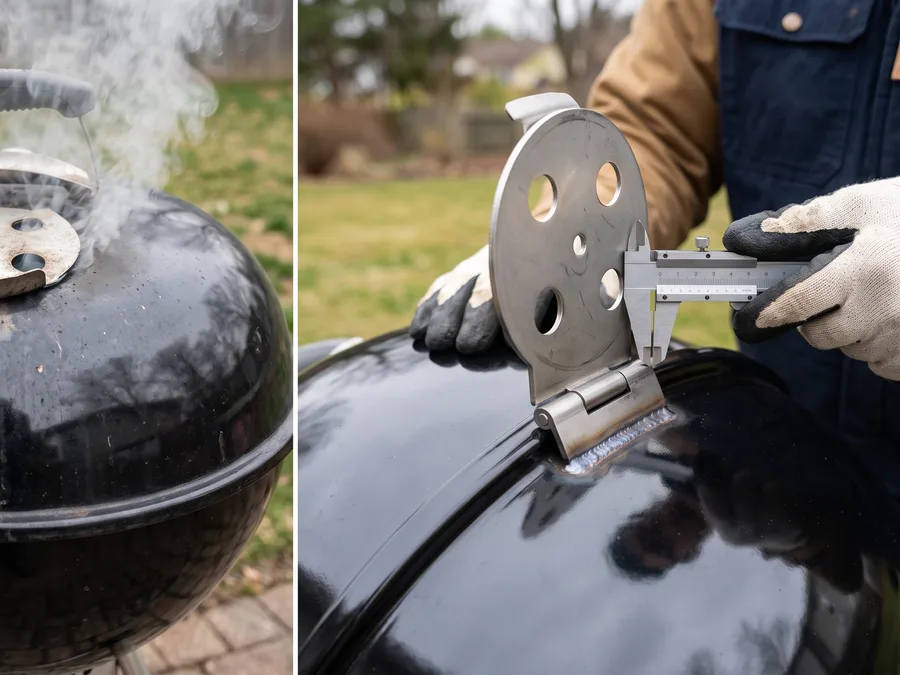
Vent & Damper Seal Leakage
Risk: Lid and vent seals degrade, airflow control drifts, and holding 225°F for a low-and-slow cook becomes impossible within a season.
Fix: Hinge and vent-durability specification, with seal tolerance verified at the welding station before the unit moves on.
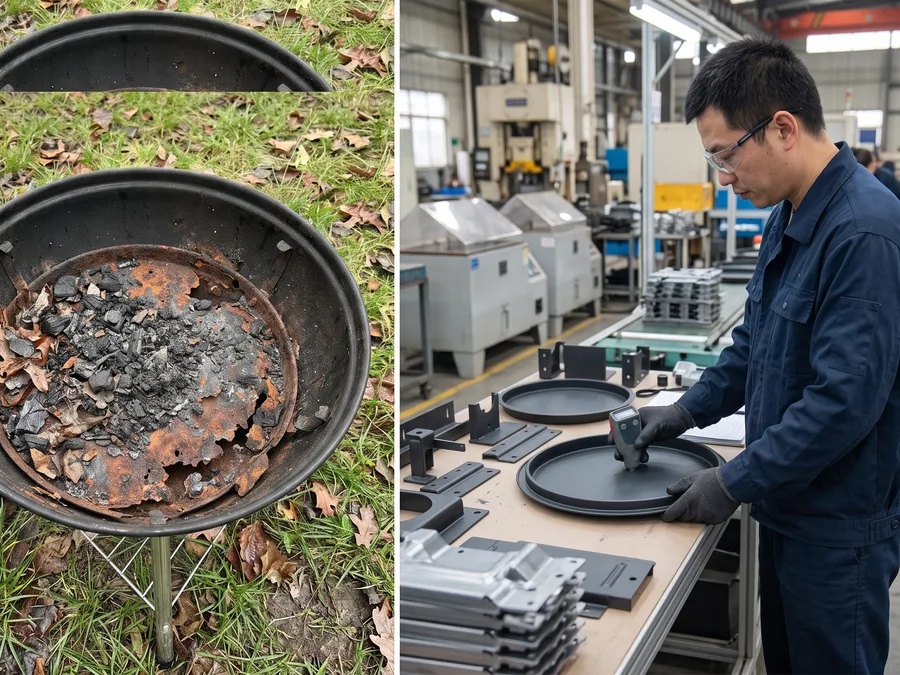
Ash-Zone Corrosion
Risk: Charcoal ash is corrosive. Ash pans and firebox floors that are under-coated rust through within a single damp season.
Fix: Coating and thickness specification for every ash-contact surface, salt-spray rated for the wet-use reality of a backyard grill.
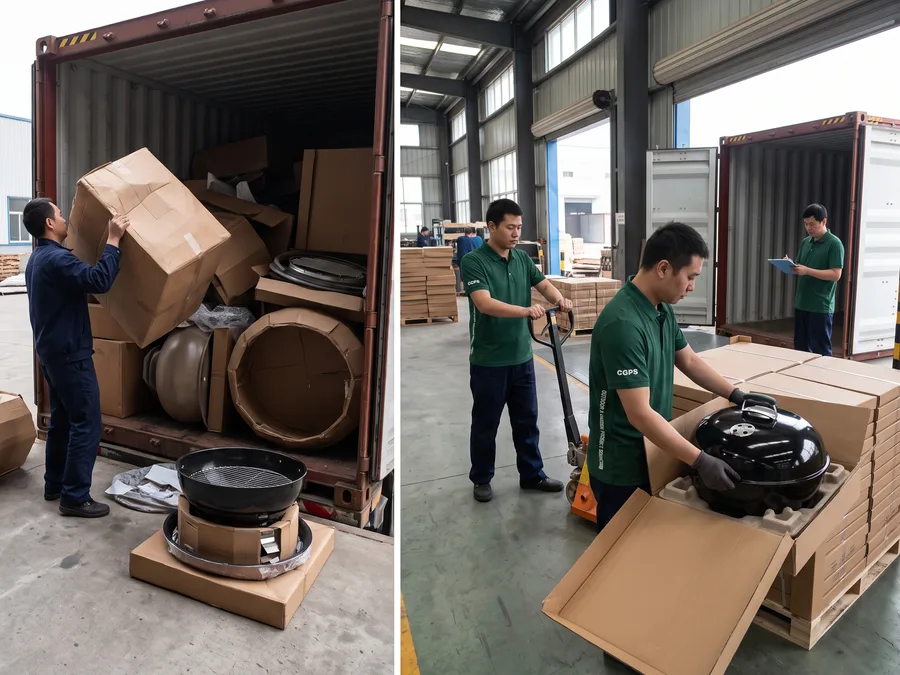
Transit Damage to Enamel & Ceramic
Risk: Enamel chips and ceramic bodies crack when a 40HQ is hand-loaded, stacked wrong, or rehandled as LTL on arrival.
Fix: A loading plan that keeps heavy fireboxes as base ballast under flat-packed bodies, with the finish-critical parts braced where they are weakest.
From Fuel Spec
to Loaded Container.
Every charcoal BBQ programme follows the same structured path — from technical specification lock-in to 100% combustion-tested units ready for loading. For the cost maths behind tooling and unit pricing, see our breakdown of grill tooling costs and our guide to the main types of BBQ grills.
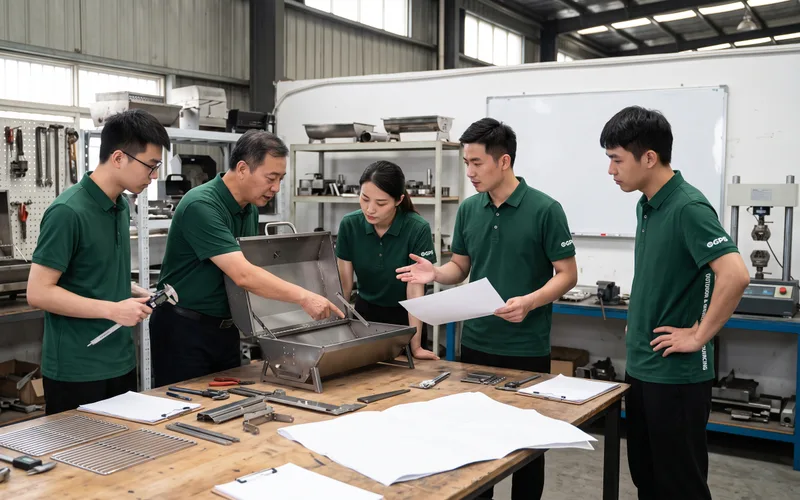
Technical Specification Lock-In
Our engineers converge three domains — combustion performance (airflow geometry, firebox capacity, grate area), structural integrity (wall thickness, coating system, hinge durability), and destination-market compliance (CE, REACH, CPSC). Early alignment means confident tooling investment.

Prototyping & Industrial Design
Industrial design, 3D CAD modeling, and prototype fabrication run in parallel. Thermal imaging validates heat distribution. Branding assets — logos, color-matched finishes, packaging artwork — developed alongside the product. Design freeze only after performance data confirms every target.
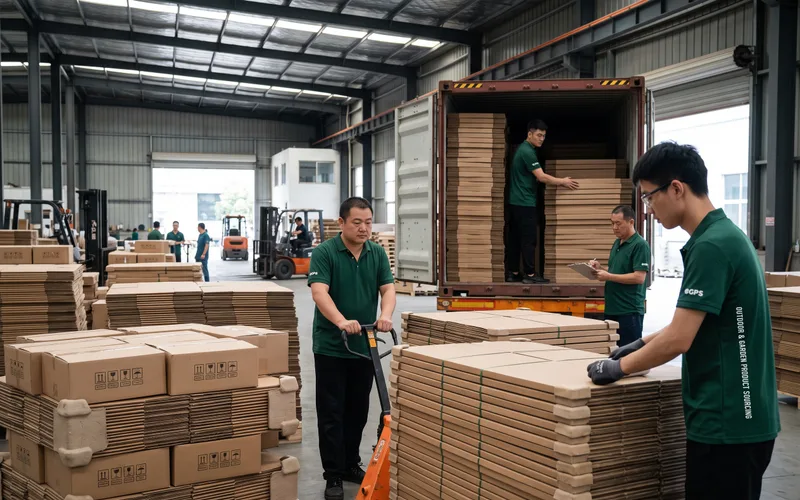
Flat-Pack Engineering & FCL Optimization
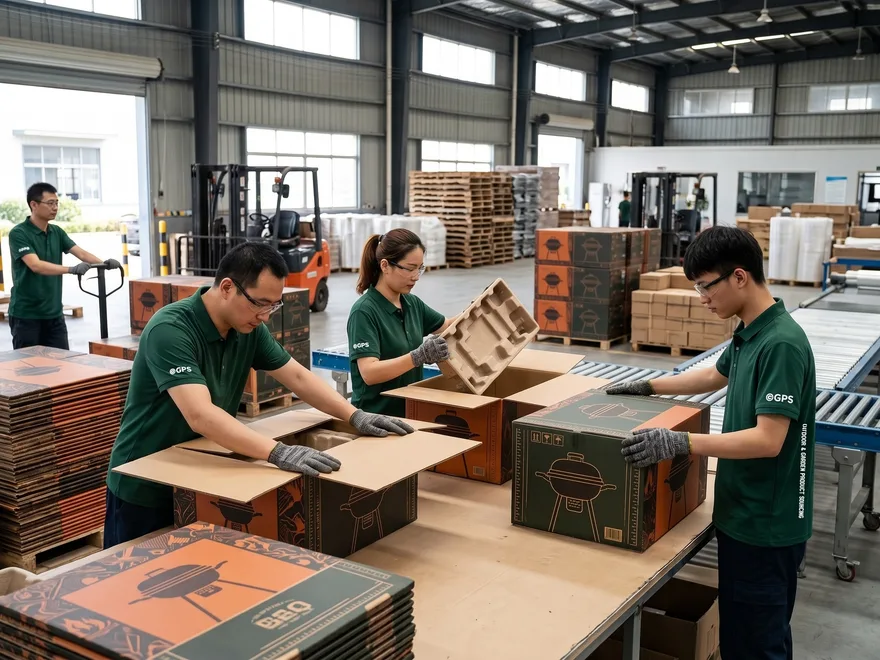
Bulky grill bodies and fireboxes are re-engineered into compact flat-packs, then refined through drop testing until each packed unit survives a full handling cycle. Heavy fireboxes anchor the base load; flat-packed bodies fill the remaining cube, cutting freight cost per unit.

Mass Production & Batch Traceability
Critical materials and capacity are reserved upfront, so a peak season never stalls a run. Production moves in traceable batches, and every unit is logged against its run, its shift, and its material lot before it is packed — so a claim filed months later still points back to the exact batch.
Tested to CSA & EN 1860.
Dossier in Every Container.
Combustion safety is non-negotiable. Every charcoal grill is tested and certified to the standard for its destination market (see the table below), and the full dossier — signed burn-test report, food-contact passport, chemical declaration — is packed inside the container, not promised by email. New to the paperwork? Start with our BBQ certification guide and the CE-mark walkthrough.
| Category | Testing Standard | Deliverable |
|---|---|---|
| Combustion Safety | CSA 1.6 / EN 498 | Burn test report + emission data |
| Structural Integrity | EN 1860-1 | Load-bearing + stability cert |
| Material Safety | LFGB / FDA 21 CFR | Food-contact material passport |
| Chemistry | REACH / RoHS | Heavy metal analysis + SVHC declaration |


Four QC Gates.
Every Charcoal Grill Fired.
Most factories batch-test at the end of the line. We embed four sequential gates into production, each aimed at how charcoal grills actually fail — and every gate must clear before the next begins. The full method sits in our quality control programme and AQL standards for grills.
Precision Engineering.
From Bare Steel to Fired Grill.
Charcoal BBQ manufacturing is materials science as much as fabrication. Three core capabilities run under one roof — no subcontracting delays, no quality gaps between vendors. Material choice decides most of the outcome: see how 304 and 430 stainless compare, and how we then protect the finish in grill packaging.

Precision Metal Fabrication
CNC laser cutting, robotic MIG/TIG welding cells, and hydraulic press forming feed one continuous line. Firebox geometry and material thickness are held to a defined tolerance band per SKU, with the same welding and QC standard applied across every production run.

Porcelain Enameling & Coating
Porcelain enamel lines for grill bowls, lids, and fireboxes — multi-stage phosphate pre-treatment, electrostatic powder application, and high-temperature curing. Coating adhesion and salt-spray performance are tested to the specification agreed for each destination market.

Combustion Testing Protocol
Every grill is test-fired before it ships, with grate-position temperature checks and damper control verified against the agreed protocol. Airflow and heat distribution are confirmed on the assembled unit — not just on a drawing.
Real Charcoal Grills.
Shipped and Selling.
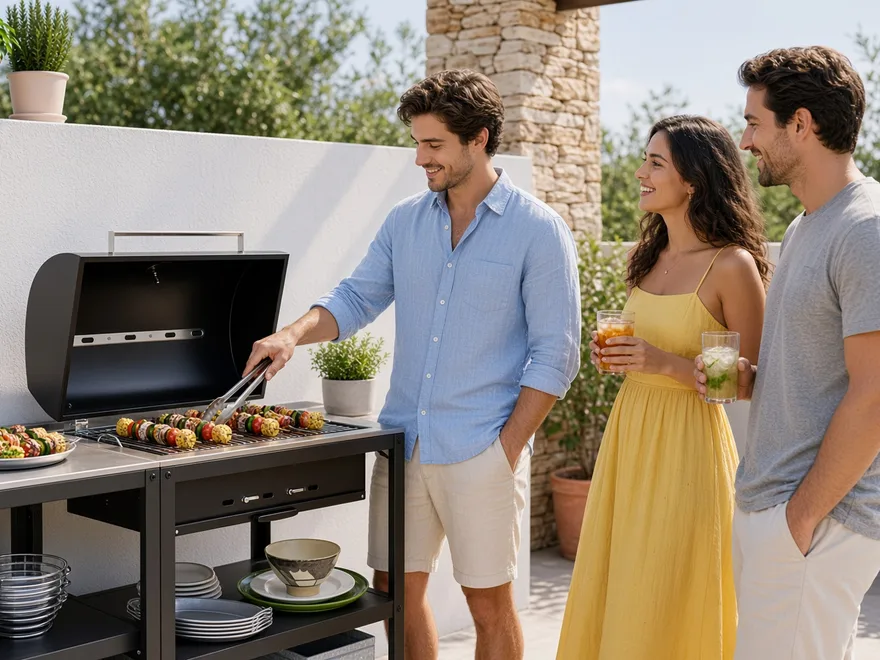
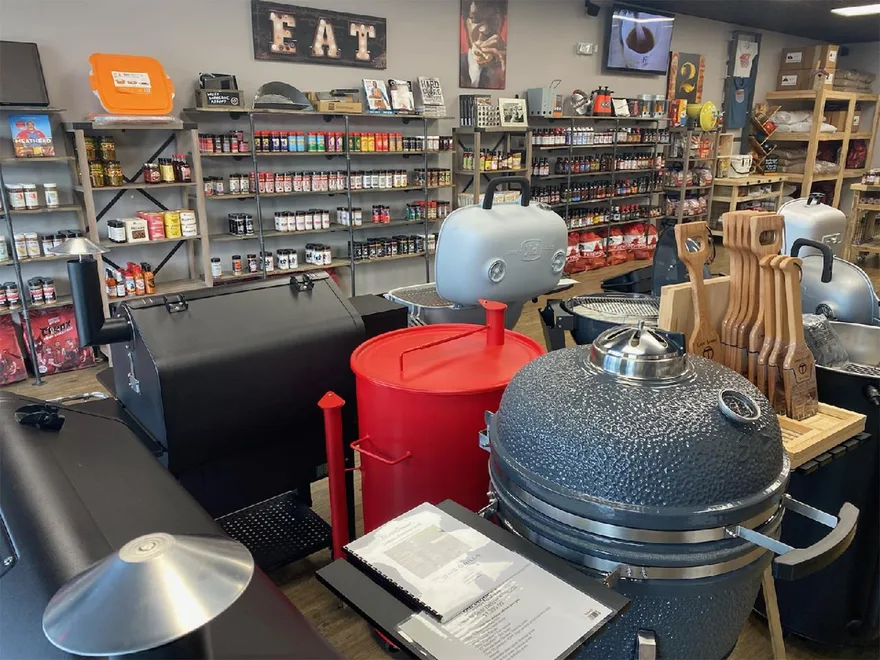
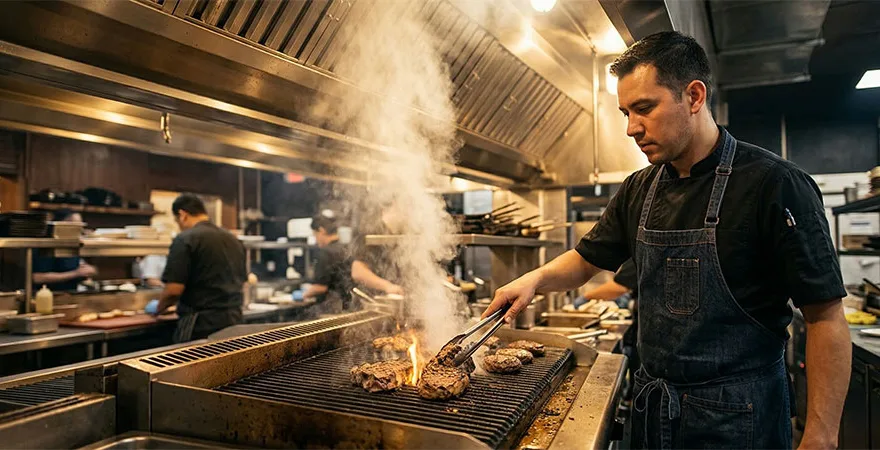
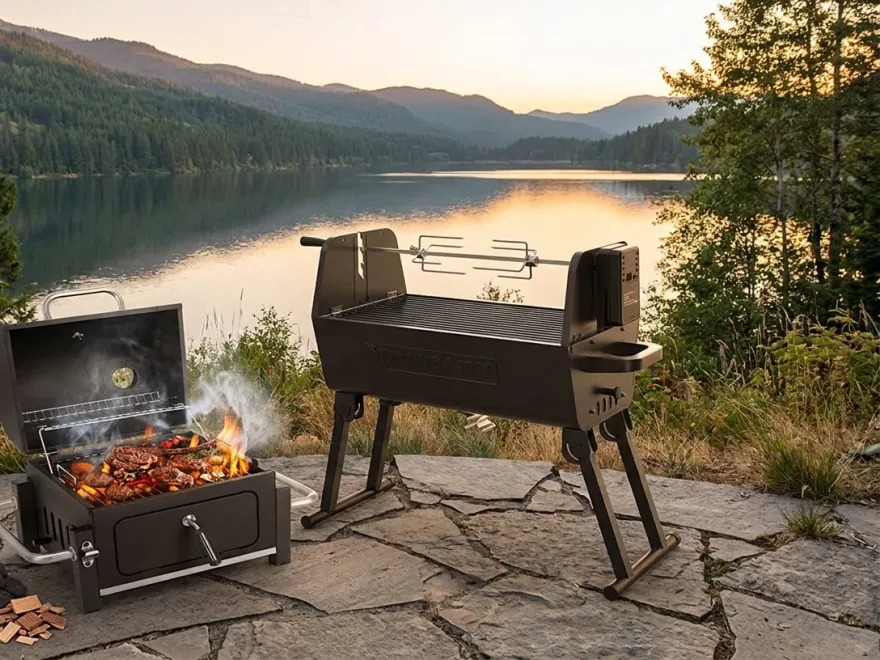
Every grill we manufacture is already in the market — in backyards, on patios, and on retail shelves. For the wider programme view, browse our case studies or take the factory tour.
Trusted by Charcoal Grill Brands.
In Their Own Words.
Hear from the brands who rely on OGPSGroup for their charcoal BBQ grill manufacturing.
We used to split our charcoal line across seven Chinese suppliers. Seven finish standards, seven lead times, and nobody who owned the result when something went wrong.
OGPSGroup pulled it into one programme — a single purchase order, a monthly 40HQ, and one QC protocol that runs from the first sample to container loading. Welds, coatings, and hardware kits are checked before loading, not after arrival.
For the first time the whole range ships under one finish standard, and my team is not chasing seven factories to find out what changed.

Our problem was never price. It was timing — we had missed two grilling seasons because sampling and certification kept slipping past the retail cut-off.
OGPSGroup re-planned the entire calendar with us: charcoal smoker sampling in October, kamado sign-off in December, CE/UL submission in January, containers by February.
Every SKU landed retail-ready and sold straight off the pallet — no repacking, no relabelling, and no launch-season returns.

What Buyers Ask
Before the First Container.
Straight answers to what procurement teams ask us most. For fuel-type comparisons, see charcoal vs gas; for space-constrained ranges, look at the portable grill programme.
What is the minimum order quantity for custom charcoal BBQ grills?
Private-mold charcoal grill programs typically start at 500–1,000 units per SKU, depending on tooling complexity. For brands launching a new platform, we structure a phased ramp: a pilot batch of 200 units for market validation, then scaled production. Existing-platform programs can start at the same low end. Our engagements are built for established brands running a serious annual programme.
How does OGPSGroup ensure consistent BBQ grill quality across thousands of units?
Quality is built in at each stage rather than inspected in at the end. Materials are verified on arrival, welding and assembly are checked at the station, and no unit is packed before it has been fired and signed off.
What certifications do your charcoal BBQ grills carry?
Every order ships with a full compliance dossier rather than a summary certificate: a signed burn-test report for combustion safety, a food-contact material passport (LFGB / FDA), and a chemical declaration covering REACH and RoHS. The dossier travels with the goods — nothing gets chased down after arrival.
Can you support mixed-container shipments — BBQ grills plus other outdoor products?
Yes. This is one of OGPSGroup's core advantages. Our density-optimized FCL consolidation allows you to combine heavy BBQ grills with bulky flat-pack items — patio furniture, pergolas, garden sheds — in a single 40HQ container. Typical freight savings range from 15–25% versus fragmented LCL shipping across multiple suppliers. One purchase order, one shipment, one point of contact.
Which standards apply to charcoal grills in the US versus the EU?
Charcoal grills sold in the US and Canada are tested to CSA 1.6 for combustion safety; for the European Union the governing standard is EN 1860-1 (charcoal grills and barbecue fuel). We test to the destination standard and pack the signed burn-test report with the container, so retail intake never waits on paperwork.
Do you drop-test the packaging, or only the product?
Both. Knock-down and flat-pack units are drop-tested to ISTA 3A, and the packed carton is opened and checked before loading — carton strength, labels, and accessory completeness. Enamel and ceramic finishes get the most attention, since transit is where they chip.
Do you supply spare parts and after-sales support?
Yes. A spare-parts kit — grate, vent, hinge, ash pan, and hardware — can be loaded with the first production container, and we hold batch-level production records so any later replacement matches the original build, tooling, and finish.
How do your charcoal programs differ from your gas and kamado programs?
All three run on the same QC and consolidation rails, so the difference is the product, not the process. Charcoal grills are built around airflow and ash management; gas grills around burner banks, ignition, and leak testing; kamado grills around thick-walled ceramic and gasket sealing. Because they share one programme, a single mixed container can carry all three.
Is the packaging ready for Amazon FBA or retail shelf?
Yes. We engineer branded cartons, multi-language assembly manuals, and FBA-compliant flat-pack dimensions, and barcode and label checks are part of the packaging gate. Unboxing is the first physical impression of your brand, so we treat packaging as a product, not a box.
Can I visit the factory or appoint my own inspector?
You are welcome to visit during production, and many of our clients appoint a third-party inspector such as SGS, Bureau Veritas, or Intertek for pre-shipment inspection — our QC team coordinates directly with their inspector on site and works to the same checkpoints.
Stop Managing Fragmented Grill Suppliers.
Start Owning Your Charcoal Programme.
Connect with our dedicated BBQ manufacturing team. Tell us what you need to build — we will map your product roadmap, lock in private-mold tooling, and deliver a custom program proposal with transparent pricing within 24 hours, no obligation.
Minimum annual procurement volume: $400K+. Enterprise engagements only.