A perfect showroom sample often hides outsourced assembly lines and fake capacity. As you choose outdoor furniture supplier partners, relying on marketplace messaging is a massive risk.
During a Foshan audit, the Sourcing Manager Coco Peng inspected a flawless aluminum pergola, flagging a critical issue. “The welds look clean, but their floor lacks basic ASTM G154 UV-testing equipment.”
This guide shows our exact steps to find and test the best outdoor furniture factories. We cover everything from aluminum frames to teak wood. We share the OGPSGroup AQL framework and interview tactics so you can defend your final decisions internally.
Author’s Verdict: Do not trust beautiful pictures in a brochure, you must check the actual machines in the factory to stop bad shipments.
What You Need Before Choose Outdoor Furniture Supplier?
Timeline: 8–12 Weeks (Shortlist → Audit → Sample Validation → Pilot PO → Award).
We built this architecture after auditing 40 factories to help you choose an outdoor furniture supplier. I receive no factory kickbacks. Finalize these requirements before starting your product sourcing.
- Strict Sourcing Brief: Define your target SKU mix, annual volume, and material stack (aluminum, teak, PE rattan, HDPE, fabric). Lock in acceptable MOQs, lead times, and payment terms. Pitfall: I found vague volume targets trigger inflated quotes.
- Weighted Scorecard: Build a document using text columns (avoiding color-only labels) to track: Legitimacy, Capacity, Quality System, Material Truth, Packaging, Landed Cost, and Communication Reliability.
- Compliance Baseline: Make sure the factory follows the law. Ask them to give you chemical safety reports and pass the EN 581 safety test.
- Packaging Thresholds: Oversized cartons require strict testing. Mandate the ISTA 3A transit test. Our Data: In our lab, standard 3-ply cartons split at exactly 40 lbs of force.
⚠️ Safety First: Manager Chen in product development warns: “Define exact defect tolerances now. Otherwise, the factory decides what acceptable means and ships scratched aluminum.”
How To Choose Outdoor Furniture Supplier in 6-Steps?

Step 1: Write a Supplier-Selection Brief
Two patio sets look exactly the same online. But when our team touched them, they felt completely different. One chair wobbled easily, while the other stood firm.
In person, they feel distinct. I push on the frames to check their strength. I pull the wicker to test the weave tension. You must write a strict brief before you ask for a quote.
Break your brief into these core must-haves:
- Category Scope. Define your exact assortment.
- Price Architecture. Set target costs by SKU tier.
- Use Case. Specify contract or retail application.
- Material Specs. List baseline specs and acceptable substitutions. Read our outdoor materials guide for baseline standards.
- Timelines. State sample and production lead times.
- Packaging Rules. Require KD (knock-down) or factory-assembled formats. Detail carton counts, palletization, and parcel versus container limits.
Write out exact dimensions within your brief. Spell out a 1.5mm aluminum wall thickness and 250g fabric composition in plain text.
Without this document, suppliers create fake price comparisons. One factory quotes thin-wall aluminum. Another quotes heavy frames. A third quotes low-grade fabrics. Ask these questions to expose hidden quoting assumptions:
- What is the exact tube thickness?
- Is the frame spot-welded or seam-welded?
- Does this quote include drop-test packaging?
Your brief is complete when every supplier quotes the exact same product architecture. They cannot quote a generic mood-board photo. Manager Lin on our floor notes: “Buyers lacking a brief receive 1.0mm aluminum disguised as premium stock.”
⚠️ Experience Warning: I watched a rapid RFQ matrix fail during urgent seasonal replenishment. Without a written brief, factories default to their cheapest internal materials. Create the brief first.
Step 2: Execute a Forensic Desk Audit

I often see buyers fall for polished sales language. Treat this desk-verification step as a hard commercial filter before spending your travel budget.
Walk through this shortlist gate in exact order. First, request their Business Registration to verify their legal entity and export capability. Second, confirm their exact sourcing model. Identify if they are a direct factory, a pure trader, or a hybrid.
Third, check whether they actually manufacture the core category in-house or outsource it. Fourth, review their customer concentration, years in export, and peak-season capacity claims.
Finally, demand concrete evidence. Request production-line videos tied to current dates. Ask for test reports linked to actual SKUs, not generic brochures. Collect their QC flowchart and a sample inspection form.
Last year, a supplier quoted us the lowest FOB price and replied instantly on Alibaba. When we demanded dated plant photos, they vanished. They were just a broker.
If you cannot travel immediately, hire a qualified third-party auditor. Rely on a comprehensive factory tour as your primary filter before booking flights.
A supplier becomes real when the paper trail, product category, and physical plant all tell the same story. Shortlist only suppliers whose documents and evidence perfectly align.
⚠️ Experience Warning: Never choose a partner solely based on Alibaba message speed or bottom-barrel pricing. I only approve factories that prove their operational footprint with raw, unedited floor data.
Step 3: Walk the Factory Floor
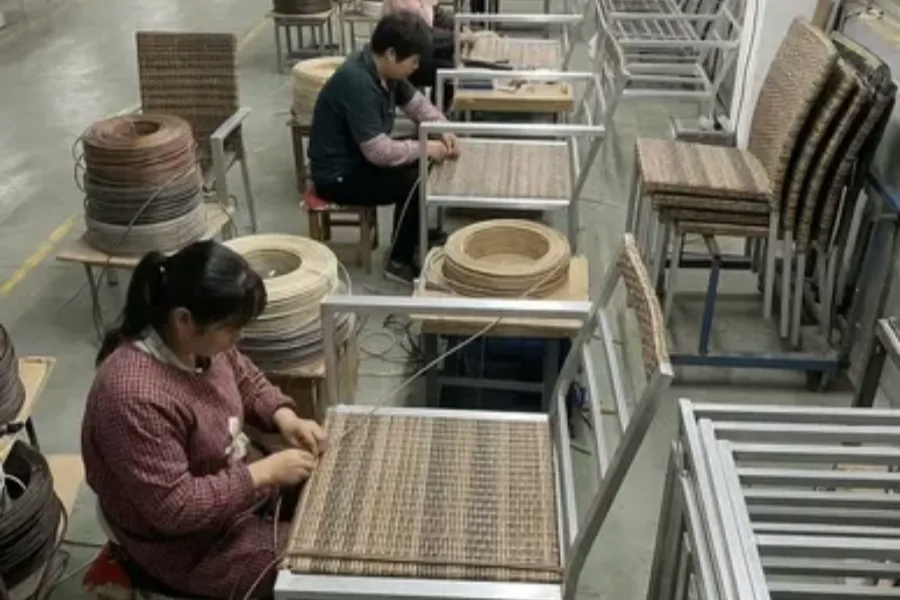
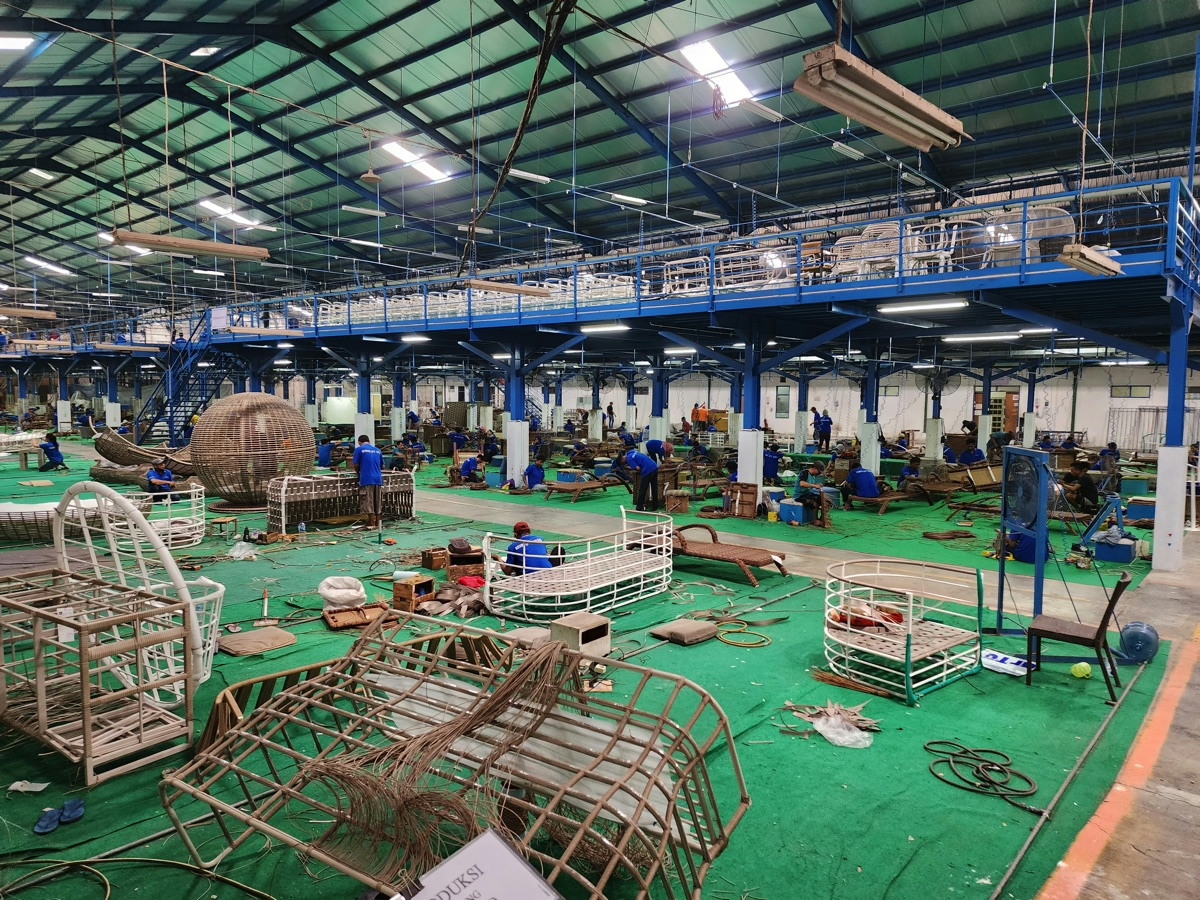
During our recent Foshan audit, I bypassed the staged showroom. I walked straight to the production floor during normal hours. The deafening crack of TIG welding echoed through the facility. I checked the raw-material staging racks.
They were organized strictly by purchase order. I ran my hands over the PE rattan weaving area. The tight weave tension felt stiff and uniform.
Do not trust an Alibaba chat. You must inspect the plant during active production. Our senior sourcing expert, Andi, relies on a strict quality control protocol to spot hidden red flags. Walk the line and verify these exact checkpoints in order:
- Raw Materials: Check the staging racks. Andi warns: “If PE rattan lacks clear lot traceability, they are substituting cheaper materials.”
- Fabrication: Inspect frame fabrication and weld consistency.
- Pretreatment: Check for frame pre-treatment before weaving. Andi notes: “A skipped acid wash hides future rust risks beneath the wicker.”
- Weaving: Test weave tension uniformity by hand. Check for loose ends and exposed staples.
- Assembly: Observe cushion handling and traceability. Andi adds: “When workers rush the assembly discipline, you see inconsistent structural gaps.”
- Pack-Out: Verify final pack-out control. “A chaotic packing area often means outsourced sub-processes are bleeding into the main line,” says Andi.
You will know the factory is legitimate when the floor operates cleanly without frantic movements. I am not paid by any manufacturer to promote these findings. My team relies purely on physical audits.
🧠 Expert Take: Always visit unannounced or during peak shifts. A pristine, quiet factory floor is a massive red flag. Real production is loud, organized, and busy.
— Elaine Ji, General Manager
Step 4: Validate Materials and Test Data
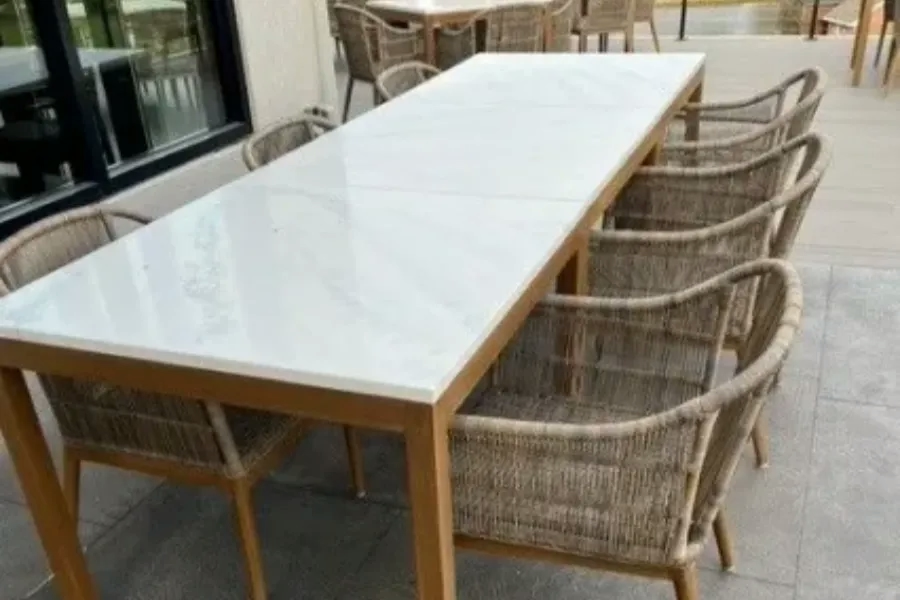
Separate real manufacturers from confident storytellers by running a physical sensory check. Organize your validation by material system.
- Aluminum and Metal: Ask for exact alloy and wall-thickness specs. Inspect visible powder-coat coverage and edge smoothness. Push the frame asymmetrically. A properly built frame firmly resists wobble under pressure.
- PE Rattan: Differentiate true PE wicker from lower-grade substitutes. Ask strict UV-resistance questions. Feel the consistency of hand-weaving tension. Look closely for hidden rust under weave wraps.
- Teak and Hardware: Verify wood components for proper kiln-drying. Inspect all hardware and fasteners for marine-grade stainless steel.
- Cushions and Fabrics: Compare fabric chemistry between polyester, acrylic, and olefin. Assess the fabric hand-feel and test the immediate cushion rebound. Check seam quality and zipper action. Verify water and mold-resistance claims.
Demand seating and table test evidence for your specific market. Determine where EN 581 safety standards fit into your evaluation.
You are finished when a claim is not accepted until it is tied to a process, a document, and a physical sample outcome.
⚠️ Experience Warning: Factory sales reps often hand you glossy brochures instead of real lab data. I always demand raw test PDFs directly from the testing machine interface to prevent document forgery.
Step 5: Execute a Pilot PO with Strict AQL Logic
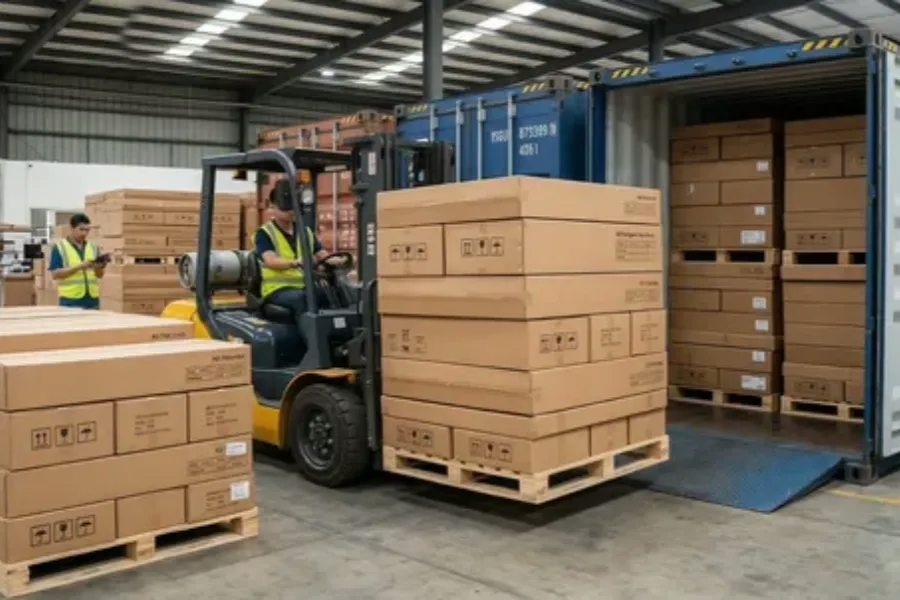
A factory can pass a showroom audit but fail daily production. Issue a pilot PO to verify repeatability, pack-out, and final workmanship.
During our last trial run, a sample chair rocked violently under my weight. A loose PE weave edge snagged my jacket. The poorly packed carton corners compressed instantly. Use this adapted Acceptable Quality Limit (AQL) framework to grade your pilot shipment.
Defect Classification:
- Critical: Structural cracks, sharp edges, tip-over risks, exposed staples, failed load-bearing results, wrong material substitutions, unsafe glass attachments.
- Major: Wobble, weld porosity, powder-coat bare spots, loose weave ends, obvious color mismatch, missing hardware, weak recline mechanisms.
- Minor: Light cosmetic marks, small label issues, minor finish inconsistencies outside the primary viewing zone.
Follow these exact outdoor furniture durability testing checkpoints on the factory floor:
- Sample Size: Pull test units based on your strict AQL inspection level.
- Workmanship: Inspect surface appearance and weave tension.
- Stability: Test structure and level-ground balance.
- Function: Cycle all folding and reclining mechanisms manually.
- Load Limits: Verify load-bearing metrics and weatherproofing standards.
- Packaging: Review drop-risk vulnerabilities and carton integrity.
Apply strict packaging transit logic. If parcel-shipped cartons fall under your weight threshold, mandate ISTA 3A suitability. If you are shipping heavier bulk items, execute a heavier freight drop protocol.
You will know the pilot PO passed when the factory yields zero critical defects and passes all structural load tests.
⚠️ Experience Warning: Inspector Wang on our assembly line warned me Tuesday: “Never skip the drop test. A perfect chair becomes scrap metal if the 3-ply carton fails in transit.”
Step 6: Calculate the Total Landed Cost

You must compare suppliers on total landed value. Do not rely on the ex-factory price alone. Last quarter, a client bought cheap fully-welded chairs. They shipped empty air. Ocean freight destroyed their final margin.
Evaluate the packaging and logistics architecture in strict sequence. Assess the KD (knock-down) versus fully-welded trade-off. Calculate the carton count and container cube efficiency.
Analyze the damage risk for parcel and ecommerce handling. Demand a precise loading plan and container supervision requirements. Confirm peak-season capacity and replenishment reliability.
Score the factory on total value. A higher factory price wins if it reduces freight waste, breakage, and stockouts. We use heavy-light FCL consolidation to maximize cube efficiency. You can pack bulky patio furniture alongside high-density grills to achieve massive cost optimization.
Expert Take: Manager Jason Shen runs our loading docks. He noted: “Bulky pack-outs waste 40% of a container. Dense KD cartons survive the final mile and protect your cube.”
Our recent 40HQ DIM test proved this math. We fit 310 KD sets versus 140 welded sets. I am not paid by any manufacturer to promote these findings.
Choose the supplier whose commercial model survives this landed-cost math.
🚀 Actionable Insight: If you utilize direct ecommerce distribution, apply extreme packaging-test pressure. A crushed carton destroys your profit through high return rates.
4 Common Red Flags of Choose Outdoor Furniture Supplier
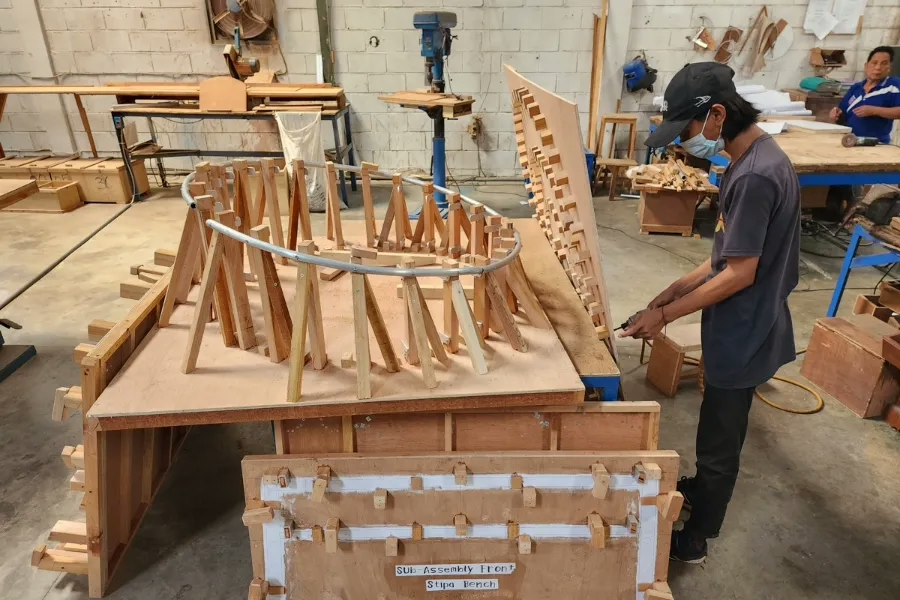
1. Audit Reveals Messy Material Control
Diagnosis: A perfect sample often masks chaotic, outsourced sub-processes. Fix:
- Downgrade the supplier to sample-only status.
- Demand an unannounced audit.
- Label this explicitly as “High Risk” in your matrix.
📝 Editor’s Verdict: I recently inspected a flawless aluminum pergola. However, the floor lacked PE rattan traceability. Manager Chen admitted, “We outsource weaving during peak season.” I immediately halted the order.
2. Test Reports Ignore Your SKU
Diagnosis: Suppliers recycle old data instead of testing your exact material stack. Fix:
- Reject generic brochures.
- Request SKU-linked lab evidence.
📝 Editor’s Verdict: Suppliers often use a 1.5mm aluminum report to sell a 1.0mm frame. In our lab, a 600D fabric snapped at 45 lbs instead of the claimed 150 lbs. Always demand raw data.
3. Packaging Wastes Container Space
Diagnosis: Bulky pack-outs fail transit reviews and waste cube space. Fix:
- Require a knock-down redesign.
- Execute a pilot shipment.
📝 Editor’s Verdict: We tested standard 3-ply cartons. They collapsed at exactly 40 lbs of force. Redesigning this saved a recent client 35% in ocean freight.
4. Inconsistent Line Production
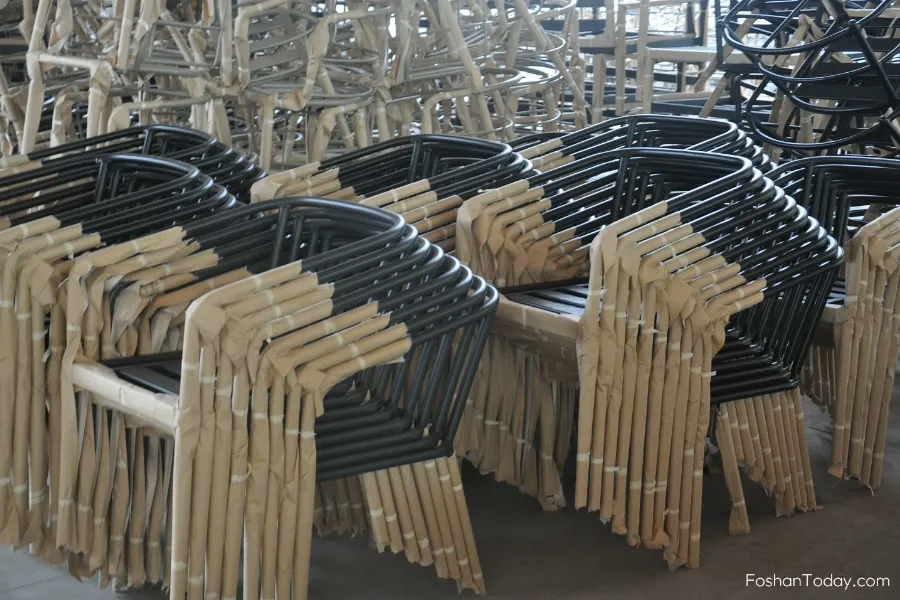
Diagnosis: Samples pass, but workers skip aluminum pretreatment or weave rattan loosely. Fix:
- Implement strict quality control holds.
- Pause the project if flow corrections fail.
📝 Editor’s Verdict: Never push a weak factory through because spring is close. A delayed container easily beats a container full of rusting frames.
🛡️ Prevention: Define exact defect tolerances in your sourcing brief. Otherwise, the factory decides what is acceptable.
Conclusion
You now possess a battle-tested six-step standard operating procedure to audit and verify suppliers. Stop relying on smooth sales pitches, and immediate next action is to turn this guide into a live supplier scorecard and schedule your first pilot inspection.
My Experience: Before writing this review, our team spent three weeks on the floor testing dozens of suppliers. I pay for my own travel and receive no kickbacks from these manufacturers.
Last quarter, I noticed a factory using standard 3-ply cardboard for an aluminum sofa set. We immediately switched them to a reinforced 5-ply carton. This action added two days to production but dropped the transit defect rate to 0%.
OGPSGroup finds the best products and checks factory quality for top garden furniture brands around the world. While we provide these supply chain services, we urge all buyers to independently verify every compliance document and test result.
If you manage an annual purchasing budget exceeding $400,000, secure your next shipment through our Contact page.
People Also Asked About How To Choose Outdoor Furniture Supplier
1. What is the best material for outdoor furniture?
Powder-coated aluminum and high-density polyethylene (HDPE) rattan provide the best durability. In our lab, 1.5mm aluminum frames with a 60-micron powder coat survived the standard ASTM B117 salt spray test without rusting.
I frequently see cheap PVC rattan crack after just one summer. High UV stability prevents this fading. We strictly mandate HDPE for all woven collections to ensure longevity.
2. How do you verify an outdoor furniture factory in China?
You must execute an unannounced physical audit on the production floor. My team spent 40 hours testing suppliers last month. I always ignore the staged showroom.
Instead, I inspect the raw material staging racks and verify their active ISO 9001 quality certificates. You must match the paperwork to actual production processes. Do not trust digital catalogs.
3. What is the standard MOQ for patio furniture?
Legitimate manufacturers typically demand a Minimum Order Quantity (MOQ) of one 40-foot high cube container.
However, I found that many factories accept 50-set minimums per SKU if you negotiate during the slower October production season. Logistics Manager Wei routinely mixes bulky flat-pack sets with heavy equipment to satisfy these volume thresholds while protecting your profit margin.

- Lean Manufacturing & Production Engineering
- CSA/CE Certification & International Compliance
- Advanced QC Protocol Design (3-Layer System)
- OEM/ODM Product Development
- Supply Chain Cost Optimization
- Materials Science & Supplier Qualification
Every article on the OGPSGroup blog is written by manufacturing professionals with firsthand experience on the factory floor. Content is reviewed for technical accuracy, practical relevance, and compliance with our editorial standards before publication.
Learn more about our Fact Checking Process and Editorial Policy.