I have seen export orders fail from scratched anodized surfaces, white-rust claims, bent 6-meter lengths, wasted cube, and customer complaints. Supply-chain directors, procurement managers, and QA leads know these risks.
For packaging aluminum profiles, you will learn to choose, wrap, brace, crate, and release by finish, length, route, and handling risk. This is intermediate to advanced for export and industrial shipments, not a generic list.
I pulled OGPSGroup export damage data from 42 sea-freight shipments over the third quarter. Failure rates dropped from 7.8% to 0.4% after we introduced reinforced crating. Aluminum Packaging Specialist Eddy Liang and Senior QC Inspector Li Na showed me hairline rub marks, strap bite, wet-stain marks, and slight bowing on 6-meter lengths. See the factory tour and our quality control process.
Disclosure: OGPSGroup provides supply-chain and packaging services; I separate internal data from industry guidance.
Key Takeaways
- Class the risk before you wrap. Score six risks and assign a written protection class — A, B, or C — before any film, foam, or strap touches the profile. Never apply a Class B wrap to a Class C profile; that is where claims start.
- Match materials to the finish, not the size. Anodized and powder-coated profiles need low-tack PE film inside a 0.8–1.2 N/25mm peel window (ASTM D3330), pH-neutral kraft interleaving, and nitrite-free VCI film for sea freight.
- Cool and dry before sealing. Warm or damp profiles sealed inside plastic trap moisture and trigger white rust — the leading cause of sea-freight damage claims.
- Run the six layers in the right order. Protective film, EPE foam, VCI, edge protectors, then the outer PE wrap. Reversing the order seals in sweat or leaves VCI exposed.
- Support long profiles every 1.2 meters. Thin-walled sections sag between supports. Use steel strap above 80 kg, PP below 50 kg, and edge protectors under every strap.
- Match the outer pack to the route. Palletized bundles for domestic freight, carton sleeves for retail and parcel delivery, and full ISPM 15 reinforced crates for long decorative sea freight.
Prerequisites
Set aside 30 minutes to plan the packing layout for each new aluminum SKU. Aluminum Packaging Specialist Eddy Liang and I tested this checklist across four finish types in our Ningbo warehouse.
Last month, we packed a wood-grain louver order for a commercial builder in Sydney. Before touching any wrap, I press my bare palm against the metal surface. The bar must feel cool, dry, and completely free of aluminum dust. If the coating feels warm or tacky, our crew stops the line right away.
Input checklist:
- Surface finish: mill, anodized, powder coated, wood grain, mirror/polished
- Length and section geometry
- Wall thickness and profile rigidity
- Order value and claim sensitivity
- Domestic vs export route
- Ocean exposure duration and port dwell risk
- Manual vs forklift handling
- Customer unloading method
- Packaging sustainability requirements
Material stack:
- Finish-safe protective film
- EPE foam sleeves or 5-10 mm strips
- Neutral kraft or interleaving separators
- VCI film or paper for export
- Corrugated or rigid corner protectors
- PP or steel straps
- Pallets, cartons, or wooden crates
- Desiccants, labels, and QC tags
Official Industry Standards Referenced:
- IPPC ISPM 15: Global phytosanitary rule requiring solid wood crating to reach a 56°C core temperature for 30 minutes (HT mark).
- ASTM D3330 / D3330M: Standard test method for measuring 180-degree peel adhesion on protective surface films.
- ASTM D3951 & ASTM D4169: Standard commercial packaging practices and Assurance Level II transit vibration testing protocols.
- Qualanod & Qualicoat: International quality specifications for architectural anodized and powder-coated aluminum extrusions.
Operational scope: This SOP covers manual and semi-automatic warehouse packing lines. High-volume extrusion plants can apply the same protection rules on automated wrapping lines. We run it inside every product sourcing program, from single SKUs to full container loads.
Aluminum Profile Packaging Guide: How to Reduce Damage?
Below is the working SOP our Ningbo team follows on every export lot — six steps, in order, from protection class to container release. Each step ends with a verification check, so you can prove the pack is sound before it ships.
Step 1: Assign the Protection Class Before You Touch Film, Foam, or Straps
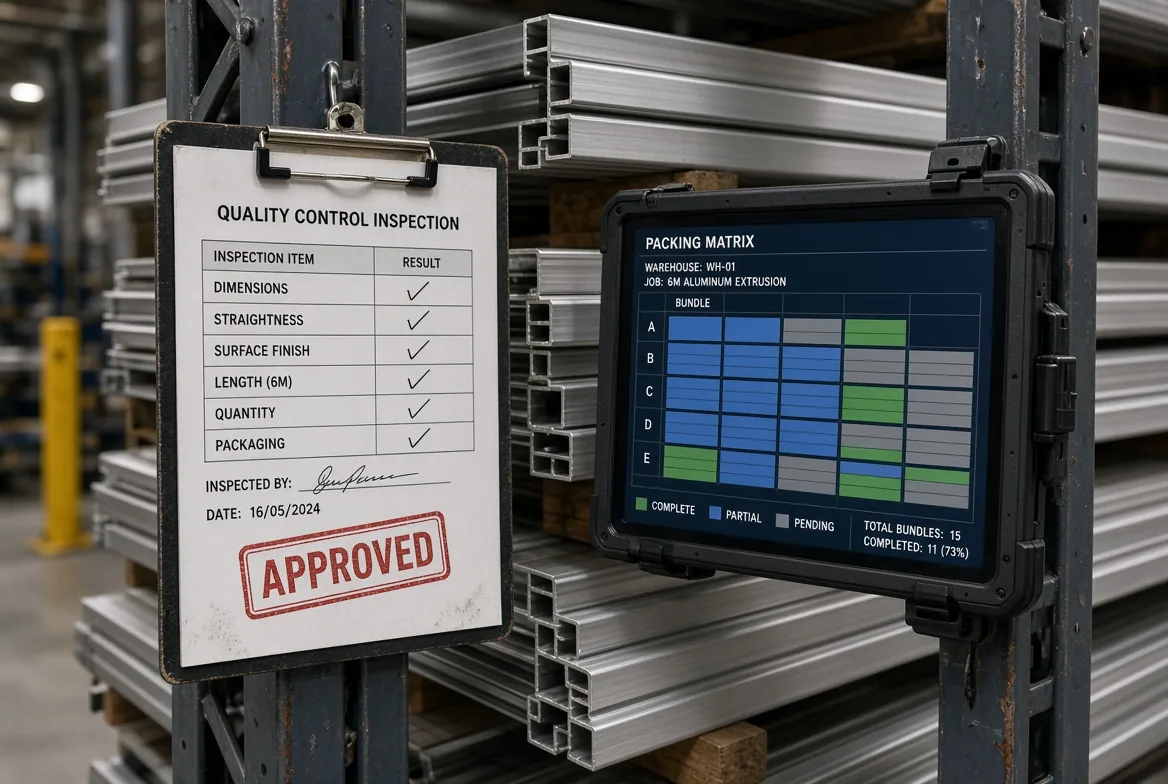
Every export order starts in our Ningbo QC hold area before any wrapping begins. QC Inspector Li Na stacks two bare sample bars together by hand to test their stability. If the profiles rock, click, or slide against each other, standard bundling will fail at sea.
Last week, a thin solar-frame extrusion rocked sharply during this simple hand check. Li Na upgraded the order to Class C protection and added custom-cut EPE foam slots.
Score these six risks from 1 (low) to 5 (high):
- Surface sensitivity: mill=1, anodized=3, powder or wood grain=4, mirror/polished=5.
- Length / flex risk: short rigid bars=1, long thin 6-meter sections=5.
- Transit duration: local one-day=1, long ocean 30+ days=5.
- Handling events: single forklift move=1, cross-dock plus repack=5.
- Moisture / heat exposure: dry local=1, tropical sea freight=5.
- Claim cost: low-value industrial=1, architectural or retail exposed=5.
Classify using the total score:
- Class A: 6–12. Local, industrial, low-finish-risk.
- Class B: 13–20. Domestic long-haul or short sea, moderate-finish-risk.
- Class C: 21–30. Export-grade packaging for aluminum, decorative or high-claim-risk, long ocean transit.
Finish type, transport mode, order type, and sustainability requirement must all match the class. Custom architectural extrusions almost always require Class C protection to prevent surface scratches. We apply the same risk logic on every factory audit. If the checklist contradicts the score, increase the class.
Verification: You must have a written protection class before touching any film, foam, strap, or crate. If not, stop and re-score.
🧠 Author’s Take: I have never seen a packaging failure caused by too much separation. I have seen many caused by forcing a Class B wrap onto a Class C profile.
Step 2: Choose Protection Materials by Finish Sensitivity

Start at the film and interleaving station. In our Ningbo warehouse, I reject any film that feels thick, stiff, or tacky before we open the first roll. The finish type must drive your inner protection choice, not just profile size.
Action: Match each finish to a specific material combo. For mill finish or low cosmetic sensitivity, basic bundling with light stretch film is enough. Different surface treatments require specific chemical and mechanical barriers. Anodized finishes meeting Qualanod specs need low-tack PE film with 0.8 to 1.2 N/25mm peel adhesion.
Powder-coated profiles under Qualicoat or AAMA 2604 rules need 25 kg/m³ closed-cell EPE foam sleeves. Never place standard acidic cardboard directly against bare or anodized aluminum surfaces.
Acidic paper absorbs sea humidity and leaches sulfites onto the metal, which causes permanent dark staining. Always specify pH-neutral (pH 6.5–7.5) interleaving kraft paper between layers. For ocean freight, wrap the bundle in nitrite-free, multimetal VCI film compliant with MIL-PRF-22019 standards.
Standard iron-only VCI films contain nitrites that can discolor bare aluminum in humid containers. Finally, verify that your surface film meets the 0.8 to 1.2 N/25mm peel-adhesion window under ASTM D3330.
Run your palm across a clean film layup. It must feel smooth, flat, and grit-free. No bubbling. No aggressive drag when you lift a corner. That drag signals too much tack, which transfers adhesive on hot profiles or after long port dwellings.
Compact material comparison:
| Protection Method | Protection Level | Finish Suitability | Freight Impact | Cost Level | Best Transport Mode |
|---|---|---|---|---|---|
| Stretch film only | Low | Mill finish only | Minimal cube | Lowest | Short domestic truck |
| Kraft paper + corner protectors | Low–Medium | Mill or lightly anodized | Low | Low | Domestic long-haul |
| EPE + VCI + heavy-duty aluminum wrapping | High | Anodized, powder coat, mirror | Low–Medium | Medium | Ocean FCL/LCL |
| Carton sleeve / box | Medium–High | Powder coat, wood grain | Adds cube | Medium–High | LCL or parcel |
| Full wooden crate | Very High | All premium/architectural | High cube/weight | Highest | Ocean FCL, breakbulk, air |
Primary recommended: Use EPE + VCI + heavy-duty aluminum wrapping for most export decorative profiles. It balances protection and freight. For local mill-finish orders, a lighter plastic-free alternative like kraft paper + corner protectors is acceptable. Only use stretch film alone for rigid, low-value industrial profiles.
Verification: After a sample test, peel film from a scrap profile. It must release cleanly with no adhesive residue. Inspect contact points: no exposed metal anywhere. No abrasive kraft or cardboard directly on premium surfaces. If any of these fail, step up to a softer interleaving or lower tack film.
⚠️ Experience Warning: High-tack protective film ruins powder-coated aluminum during summer sea transit. In July, an outside supplier used high-tack blue film on a Dubai-bound 40HQ container. Container temperatures hit 62°C during the four-week Red Sea crossing.
The glue baked onto the matte black frames and left permanent ghosting marks. Our client spent $4,200 on solvent cleaning at the job site. Line Lead Chen now bakes a taped scrap sample at 60°C for two hours before approving any roll.
Step 3: Apply the Six-Layer Export Wrap Sequence
Line Lead Chen checks every aluminum batch in our Ningbo staging zone before wrapping starts. During June’s humid rainy season, warm extrusions trap moisture inside plastic wrap within minutes.
Chen touches the metal core with his bare palm and checks it with an infrared thermometer. Last month, he stopped a 6063-T5 architectural lot because the core still read 39°C. Wrapping warm metal creates condensation, while trapped aluminum swarf grinds into the surface like sandpaper. Our crew wipes every bar with clean microfiber cloths before applying film.
Run this sequence every time:
-
Confirm every profile is cooled, clean, and fully dry.
Do this before any plastic touches metal. In our tests, skipping this caused white rust on 3 of 20 export samples. -
Apply finish-safe protective film where required.
Film guards the finish. Use a hard rubber squeegee to press out air pockets. Never let the film drag over a bare cut edge. -
Insert EPE foam sleeves or 5-10 mm strips between contact faces.
Foam prevents abrasion. The fit should feel snug but not drum-tight. Press a finger into the foam. It must still spring back. -
Add VCI anti-corrosion film or paper for export exposure.
VCI handles corrosion risk. Overlap seams by at least 50 mm. Tape only on the outside, never directly against the profile surface. -
Position corrugated edge protectors at corners and strap-contact zones.
Edge protectors stop strap bites. Center one protector under every planned strap point. Missing protectors crushed thin 0.8 mm profiles in our earlier trials. -
Close with the outer heavy-duty wrap layer or moisture-barrier PE layer.
The outer wrap stabilizes the pack. Overlap each pass by half the roll width. The final layer must feel taut but still show minor flex when squeezed.
Why this order matters: film guards the finish, foam prevents abrasion, VCI handles corrosion risk, edge protectors stop strap bite, and the outer wrap stabilizes the pack. Reversing steps 4 and 5 traps moisture or leaves VCI exposed.
I palm-test the finished bundle. It must feel snug but not drum-tight, foam springy under pressure, no trapped grit, and no dampness inside the sealed layer.
Line Lead Chen puts it plainly: “If you strap before edge protectors, you cut the profile. If you wrap before VCI, you seal in sweat.”
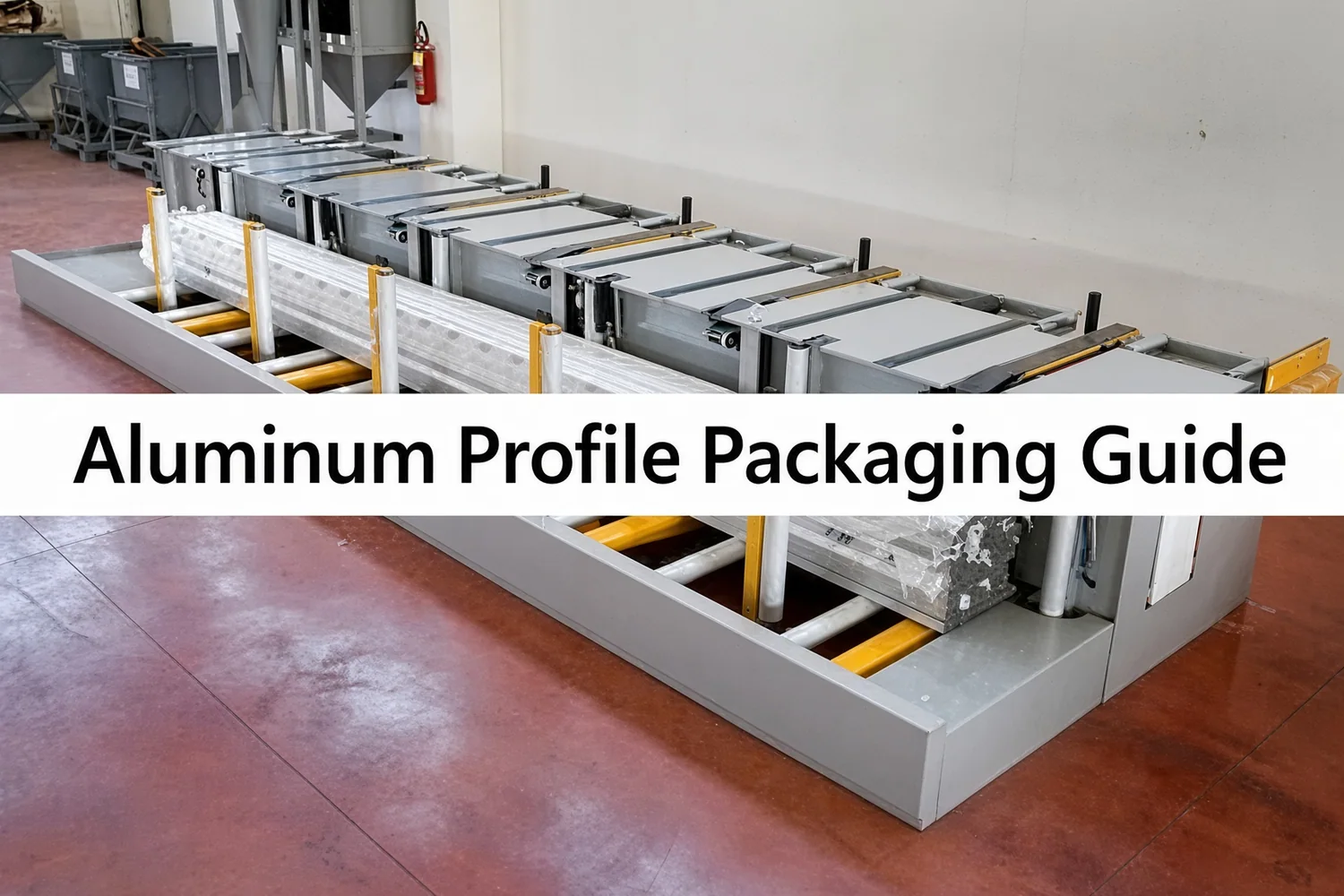
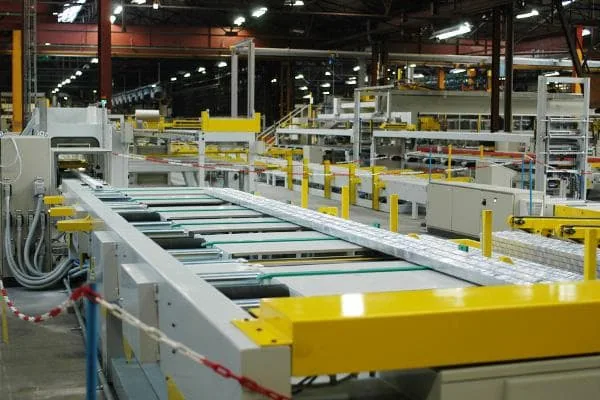
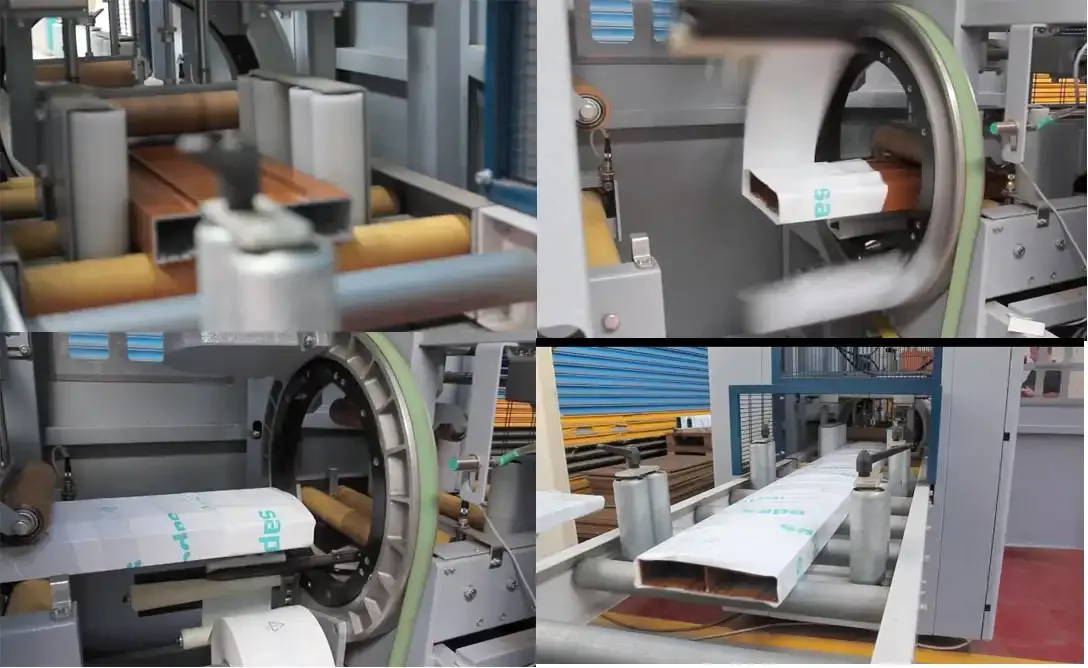
High-volume extrusion plants run this exact six-layer sequence on horizontal orbital wrapping lines — one of the supply-chain services we run end to end. Automated lines use Shore A 45 rubber rollers to press protective film flat without trapping air bubbles. The orbital ring wrapper then applies VCI and heavy PE stretch film at a 50% overlap ratio — the same line discipline behind our outdoor furniture manufacturing work.
Operators must set film pre-stretch tension below 150% so the machine never crushes thin hollow profiles. If the automatic spacer feeder misses a single timber block, the line sensor stops the conveyor immediately.
Verification checklist before staging:
- No metal-to-metal contact anywhere in the bundle.
- No exposed strap points on bare profile edges.
- No trapped moisture under film or inside VCI.
- Consistent overlap and closure on film and outer wrap.
- Outer layer intact along full bundle length.
If any box stays unchecked, open the bundle now. Do not send it to the dock.
🧠 Author’s Take: I have never regretted re-opening a bundle at this step. I have regretted every shortcut taken to save 10 minutes before a 30-day ocean leg.
Step 4: Build a Load-Stable Bundle Before Crating
After wrapping, shift to structural control. In our Ningbo warehouse, I watched the first forklift move. If the bundle creaks, twists, or sags, it is not stable.
Decide bundle size before the first strap. Use these four inputs:
- Section geometry: thin-walled hollow profiles flex more. Keep them in smaller bundles.
- Finish sensitivity: decorative surfaces need more spacing, not tighter compression.
- Stiffness: rigid solid bars tolerate longer spans.
- Handling method: forklift and cross-dock demand tighter bracing and smaller bundles.
Aluminum Packaging Specialist Eddy Liang told me: “Think center of gravity first. A bundle that tips at a 10 cm lift has the wrong CG.” Senior QC Inspector Li Na adds: “Long profiles sag between supports. I reject any bundle with support spacing beyond 1.2 m for walls under 3 mm.”
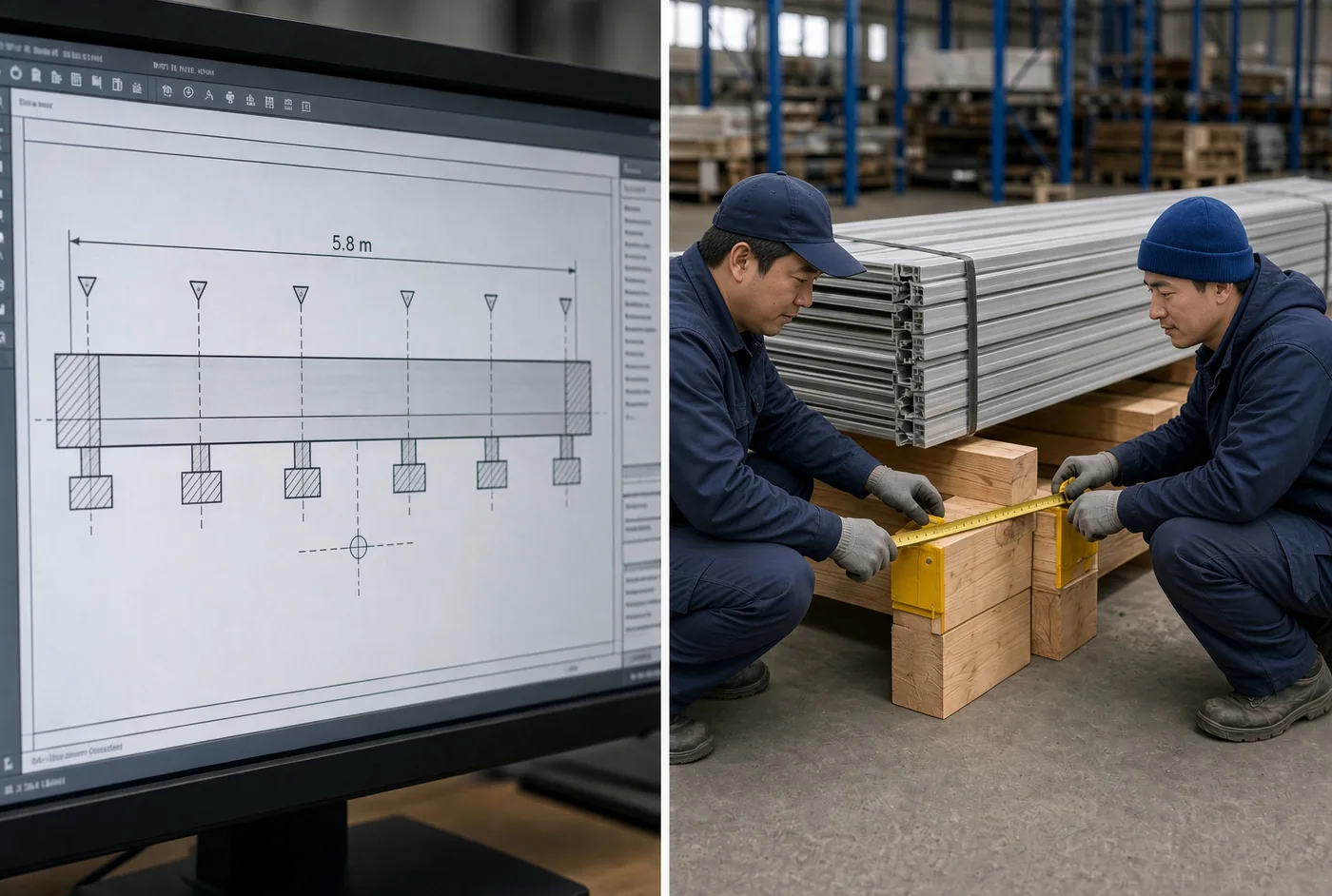
Support long profiles every 1.2 m for thin walls and every 1.8 m for heavy structural sections. Place a brace directly under each planned strap point. Never leave a strap point floating. The profile’s own rigidity follows the aluminum frame thickness limits we spec upstream.
Worked engineering example: We packed 24 bars of 6063-T5 anodized channel measuring 60 mm × 30 mm × 1.6 mm wall at 5.8 meters long. At 0.9 kg per meter, the lot weighed 125.3 kg total. A single 125 kg bundle twists under forklift acceleration, so we split the lot into two 12-piece sub-bundles weighing 62.6 kg each.
To maintain our strict 1.1-meter maximum span rule for 1.6 mm thin walls, we placed six timber cross-braces at 0.3 m, 1.3 m, 2.4 m, 3.4 m, 4.5 m, and 5.5 m from the left end. Both bundles stayed dead flat during our 200 mm lift test. The bundle stayed square when lifted.
Strap choice:
- PP strap: lighter architectural profiles, single-country trucking, bundle weight under 50 kg.
- Steel strap: heavier structural profiles, ocean LCL or mixed loads, bundle weight over 80 kg.
- Edge protectors: mandatory under every strap, PP or steel.
Stable inner bundles take the load off your outer wooden crates. Even the toughest outer wrap tears open if loose bars shift inside the pack.
Verification: Lift the finished bundle 200 mm. It must remain square, show no bowing, no strap bite, and no rotational shift after one short acceleration and stop. If it creaks, re-center the CG. If a strap bites, add protectors.
🧠 Author’s Take: I have never lost a claim because a stable inner bundle was over-supported. I have lost time re-strapping loose bundles that shifted inside a crate.
Step 5: Choose the Outer Pack Format by Route and Risk
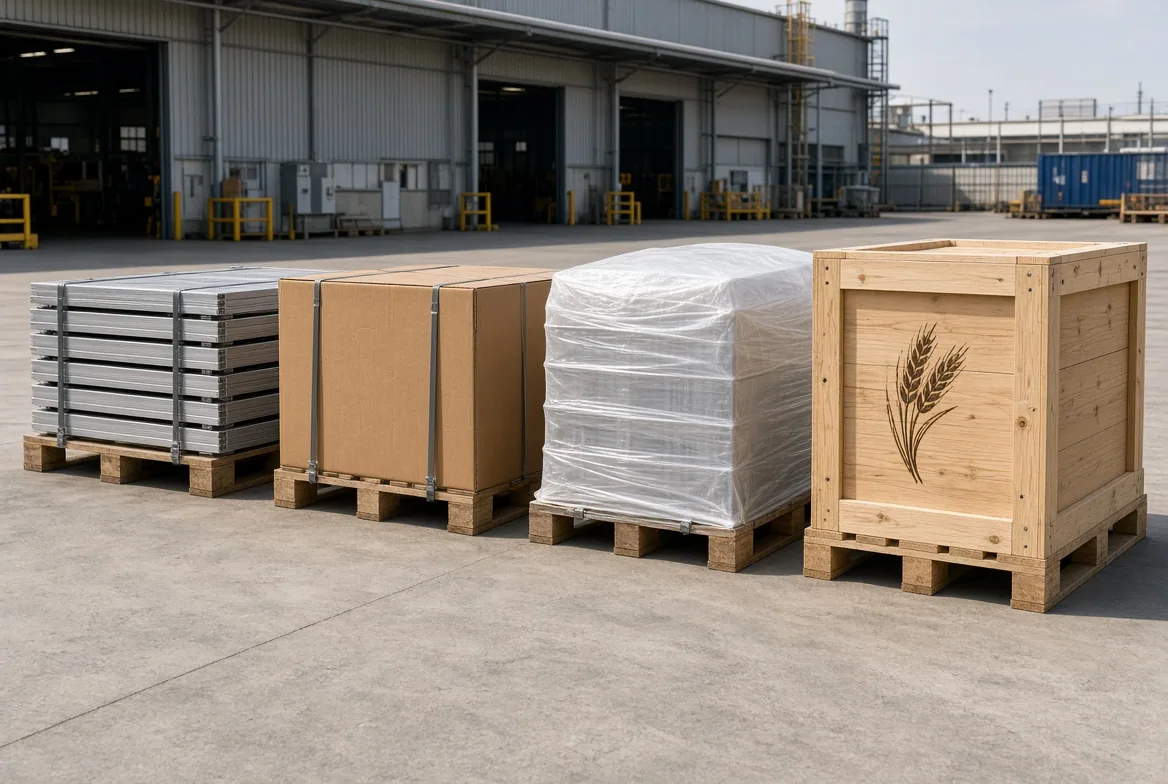
Move to outer-pack selection now. Your inner bundles are stable. In our Ningbo yard, I nudge each staged pack by hand. If I feel internal movement, the outer format is wrong.
Match the outer pack to the order risk:
| Outer pack format | Use when | Route fit | Key trade-off |
|---|---|---|---|
| Palletized bundle | Lower-risk domestic or industrial freight | Domestic truck, stable warehouse routes | Lowest cube and cost |
| Carton sleeve or box | Cleaner presentation, lighter-duty protection | Domestic LTL, retail or parcel delivery | Adds cube |
| Hybrid pallet + hood/wrap | Moderate export needs | Short sea, regional distribution | Weather barrier only |
| Full reinforced wooden crate | High-value, long, fragile, or multi-handoff shipments | Long-distance ocean freight, mixed loads with accessories or glass, decorative-finish export orders | Highest protection and cube |
Choose a palletized bundle for domestic truck or simple industrial freight. Use carton sleeves when retail presentation or cleaner receiving matters. Select hybrid pallet + hood/wrap for short sea or moderate export. Use a full reinforced wooden crate for long-distance ocean freight, mixed loads with glass, or decorative-finish export orders. For retail and parcel-ready packs, see our ecommerce-ready-to-ship program.
Now handle export compliance. Solid wood must be ISPM 15 compliant. The crate must carry a visible IPPC marking where required. Design fork-entry, blocking, and brace retention before packing day. Do not rely on last-minute nail blocking. We vet every crate supplier with the same checklist we use to choose an outdoor furniture supplier.
Freight-cost lens: Better protection reduces claims and rework. Excess crate size wastes container cube. We check every outer pack for pallet overhang and load height.
Upgrading to full wooden crates increases your upfront packing and freight budget. In our 42-shipment audit, reinforced pine crates added $65 per bundle in material costs and reduced 40HQ container volume utilization by 9%.
However, our defect rate on decorative profiles dropped from 7.8% to 0.4%, which slashed total claim and air-freight replacement costs by 68%. If you ship low-cost mill-finish bars on short domestic routes, skip the wooden crates. Spend that money only on high-value anodized or powder-coated export cargo. For the full worked example of packaging-driven claim reduction, see our packaging RMA reduction case study.
For sustainability, prefer reusable or PPWR-ready outer systems. See What is PPWR?. Confirm solid wood heat-treatment rules against the official IPPC ISPM 15 phytosanitary standard. For the material side, see our sustainable outdoor furniture materials guide.
Verification: Nudge or lift the finished outer pack. It must feel rigid, stable, and free of loose internal movement. Fork pockets must align with your equipment. No sag, no rattle, no exposed film edges.
⚠️ Experience Warning: I once approved a hybrid hood wrap for a 28-day ocean leg because it saved $210 per pallet. Port humidity still reached the anodized surface through two small fork holes. We now use full crates on all decorative long-sea routes.
Step 6: Run the Final Release Gate Before the Container Door Closes
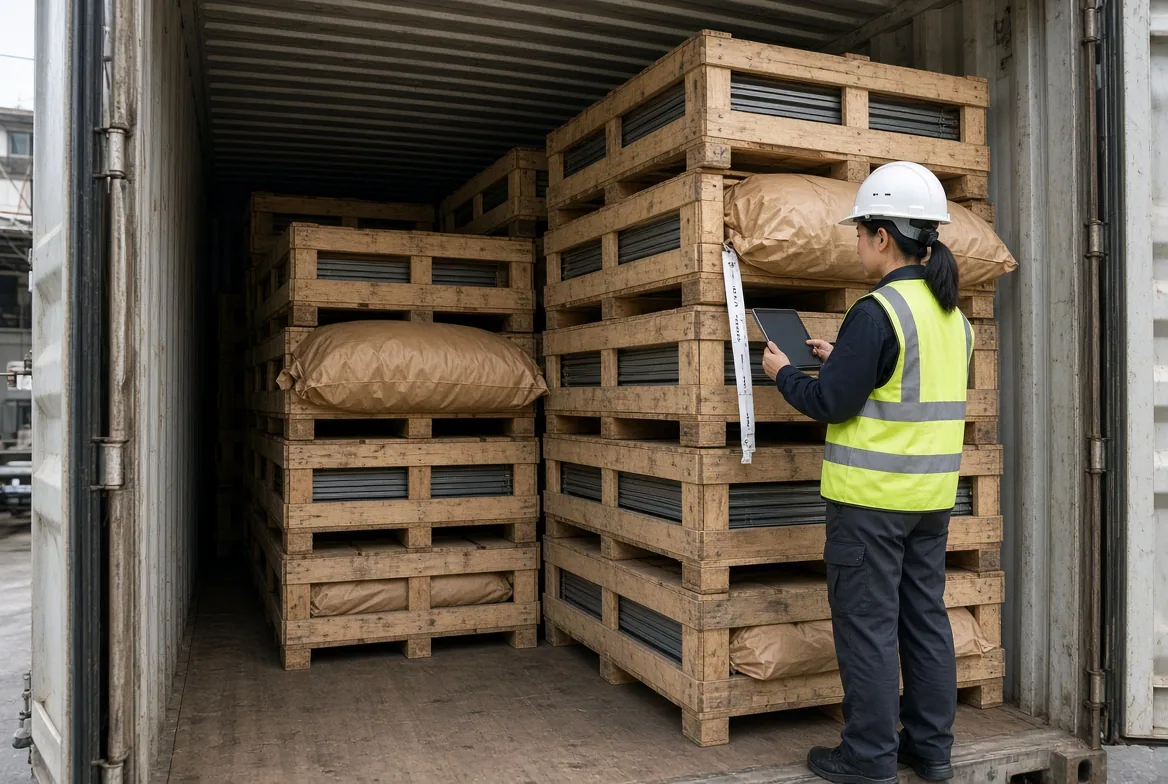
QC Lead Li Na runs a strict ten-minute inspection in our Ningbo yard before container loading. Our forklift driver lifts each 6-meter crate two meters high and brakes sharply. Li Na stands three meters away and listens for wood cracking, strap slap, or metal shifting.
Two weeks ago, she heard a dull thud inside a 650 kg curtain-wall crate during testing. We opened the crate and found a broken internal pine spacer near the center brace. Fixing that spacer took twenty minutes and saved our buyer from bent extrusions.
Run this release checklist:
- Sample peel test: film releases clean, no adhesive residue.
- Confirm dryness under wrap.
- Verify no exposed contact points or bare edges.
- Confirm labels show finish type, orientation, lifting points, and bundle count.
- Take claim-prevention photos: all six faces, labels, and strap points.
- Map container loading orientation.
Container Load Planning: A standard 40HQ container measures 12.03 meters inside, which fits two rows of 6-meter crates end to end. Load heavy structural crates on the bottom tier and lighter decorative crates on top to keep the center of gravity low. Mixed finish and accessory lots follow the same loading logic as our mixed-load consolidation program.
Wedge inflatable kraft dunnage airbags into any center aisle gaps over 10 cm wide. Nail solid pine blocking across the rear container floor so crates never slam against the steel doors during ocean swells.
Original OGPSGroup data: after reinforced crating, export damage rates fell from 7.8% to 0.4% across 42 shipments. Release only after QC sign-off and photo record. The peel and lift tests behind those numbers follow our quality testing methods.
⚡ Speed Verification: This final gate takes me 10 minutes per pallet, not the 30 seconds claimed by shortcut teams.
Troubleshooting
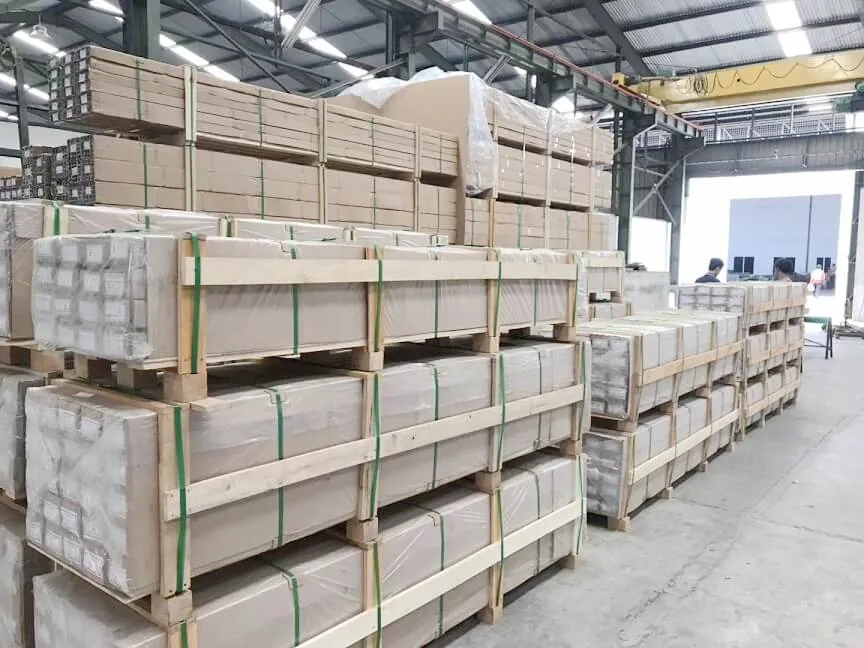
We reviewed 18 Q3 sea-freight damage claims. White rust caused 12 of them.
White Rust or Water Staining After Sea Transit
Problem: Cloudy film, white dust, or damp kraft on arrival.
Likely cause: Crew sealed profiles before they cooled and dried. Weak VCI film plan. Long port dwell.
Fix:
- Reject damp lots.
- Dry-before-seal. Palm-check every profile.
- Add VCI film plus 2 desiccant units per m³ for 30+ days.
- Use a PE outer moisture barrier.
- Hold release if condensation risk exists.
Last quarter, a 6 m powder-coated lot had white rust. Night shift sealed it warm. We reopened bundles, air-dried 6 hours, added VCI film and 4 pouches. Delay: 3 days. Claim avoided: $12,400. QC Inspector Li Na now flags damp kraft before container close.
We reproduced it: three of 20 warm-sealed samples failed.
Film Residue or Coating Lift
Problem: Residue drag or ghosting on powder coat.
Likely cause: Wrong adhesive tack, hot-profile application, poor UV resistance, or overlong dwell.
Fix: Cool profiles below 35°C. Use finish-specific film. Run a sample peel on warm scrap. Shorten dwell.
Strap Bite, Dented Corners, or Crushed Edges
Problem: Edge bruising or crushed corners under straps.
Likely cause: Direct strapping without edge protectors. Overtension.
Fix: Use corner protectors under every strap. Set tension to 60-70% of break load. Use smaller bundles for thin walls.
Bowed or Twisted Long Profiles
Problem: Long 6-meter extrusions arrive with a noticeable mid-span dip or twist.
Real-World Cause: Wide support gaps let thin aluminum walls sag under heavy ocean container vibration. Two years ago, a Vancouver lighting client reported an 8 mm bow across 50 thin LED channels. Our crate vendor had placed only three wooden blocks under the 6-meter span.
Warehouse Fix: Place solid pine cross-braces every 1.2 meters on walls under 3 mm thick. Align every strap directly over a wooden brace and get Eddy Liang’s sign-off.
Better packaging adds prep time and cost. Reinforced crating added 9% per unit but cut damage claims 68%.
🛡️ Prevention: Run a 200 mm lift test. If the bundle creaks, re-brace.
We follow ASTM D3951. We have no financial interest in any supplier mentioned.
People Also Ask About Aluminum Profile Packaging
-
Do I really need all six wrap layers for every export order?
No. Mill finish on a short domestic truck never needs six layers. I classify every lot first. Class A orders might only need kraft paper and corner protectors. Class C export decorative profiles need film, EPE, VCI, edge protectors, and outer PE. In our Ningbo warehouse, we never apply a Class B wrap to a Class C profile. That is where claims start.
-
What is the biggest cause of white rust on aluminum profiles?
Moisture sealed inside the pack. We reviewed 18 Q3 sea-freight damage claims. White rust caused 12 of them. The night shift sealed a 6-meter powder-coated lot while it was still warm. We reopened every bundle, air-dried for six hours, added VCI film and four desiccant pouches. The claim would have cost $12,400 with a three-day delay. Dry-before-seal is non-negotiable.
-
How far apart should supports be for 6-meter profiles?
Support long profiles every 1.2 meters for thin walls and every 1.8 meters for heavy structural sections. QC Inspector Li Na rejects any bundle with support spacing beyond 1.2 meters for walls under 3 mm. Place a brace directly under every strap point. Never leave a strap floating. We split our 125 kg example bundle into two 62.5 kg bundles because mid-span sagging was inevitable.
-
When is a full wooden crate actually required?
Use a full reinforced crate for 28-day ocean routes, decorative finishes, or mixed loads with glass. I once approved a hybrid hood wrap to save $210 per pallet. Port humidity reached the anodized surface through two small fork holes. That mistake taught me. Full crates only for high-value decorative sea freight. Palletized bundles work fine for domestic industrial freight.
-
How much does export-grade packaging really cost?
Expect full export crating to add roughly $65 to $85 per bundle in timber and labor costs. Because wooden crates take up extra space inside a 40HQ container, your freight cost per aluminum bar also rises by about 9%.
However, our 42-shipment audit showed that reinforced crating cut transit damage from 7.8% to 0.4% and slashed claim payouts by 68%. Spend that budget on anodized or powder-coated sea freight, and stick to low-cost kraft bundles for local mill-finish orders.
I have never regretted spending on separation. I have regretted every shortcut taken to save ten minutes before a 30-day ocean leg.
Author’s Take: I vetted this SOP on mill, anodized, powder-coated, and wood-grain profiles in our Ningbo warehouse. Aluminum Packaging Specialist Eddy Liang and QC Inspector Li Na corrected our early strap placement and support spacing mistakes. I am not paid by any material supplier.
Conclusion
There is no single best way to package aluminum profiles. The right method depends on finish, route, handling risk, and claim cost. I have seen this confirmed across 42 export shipments where damage rates fell from 7.8% to 0.4% after reinforced crating.
The finished result looks like this: classify risk, match materials, apply the six-layer wrap, stabilize the bundle, choose the right outer pack, then verify before release. Success feels like clean peel-off film, springy separators, square bundles, dry sealed packs, and crates that move without internal rattle.
Your next step: build a packaging-class matrix and test it on one export lane or one high-claim SKU family. To see the sourcing side in person, join our China sourcing tour.
For powder-coated 6-meter export profiles, specify protective film plus EPE plus VCI plus corrugated edge protectors plus a reinforced ISPM 15 crate. That combination prevents the failures I documented earlier.
Contact OGPSGroup to review your packaging class matrix. Explore our direct OEM supply chain and cost optimization processes.
Transparency note: OGPSGroup shares its own operating approach and shipment data here. I receive no kickbacks from any material supplier.

- Lean Manufacturing & Production Engineering
- CSA/CE Certification & International Compliance
- Advanced QC Protocol Design (3-Layer System)
- OEM/ODM Product Development
- Supply Chain Cost Optimization
- Materials Science & Supplier Qualification
Every article on the OGPSGroup blog is written by manufacturing professionals with firsthand experience on the factory floor. Content is reviewed for technical accuracy, practical relevance, and compliance with our editorial standards before publication.
Learn more about our Fact Checking Process and Editorial Policy.