What is PPWR? It has moved from a packaging cost detail to a market-access, margin, and governance issue for EU-bound brands. It now affects customs readiness, supplier qualification, freight efficiency, ESG claims, and market surveillance risk.
We audit factory shipments every day. Last month, a customs team held a major gas grill shipment at the port. The supplier used the wrong plastic code on the inner sleeve. We fixed the compliance file in three days to release the goods.
We reviewed the full legal text on EUR-Lex, cross-checked Commission guidance, and mapped it against our internal packaging-audit workflow. Thousands of factory shipments are audited annually. These exact packaging standards are applied during quality inspections. Global brands trust this sourcing model to protect products and profit margins.
PPWR is the EU Packaging and Packaging Waste Regulation, formally Regulation (EU) 2025/40. It entered into force on 11 February 2025 and generally applies from 12 August 2026. As a regulation, its common core applies directly across Member States. Verify the dates in the official EUR-Lex regulation text.
In this guide, we explain what PPWR is, who carries the legal burden, what changes in 2026 versus 2030+, and how procurement and compliance leaders should audit packaging portfolios now. You will get a plain-English breakdown, an operational SOP, a manufacturer checklist, and decision criteria for mono-material versus multi-material packaging.
We begin with the legal definition.
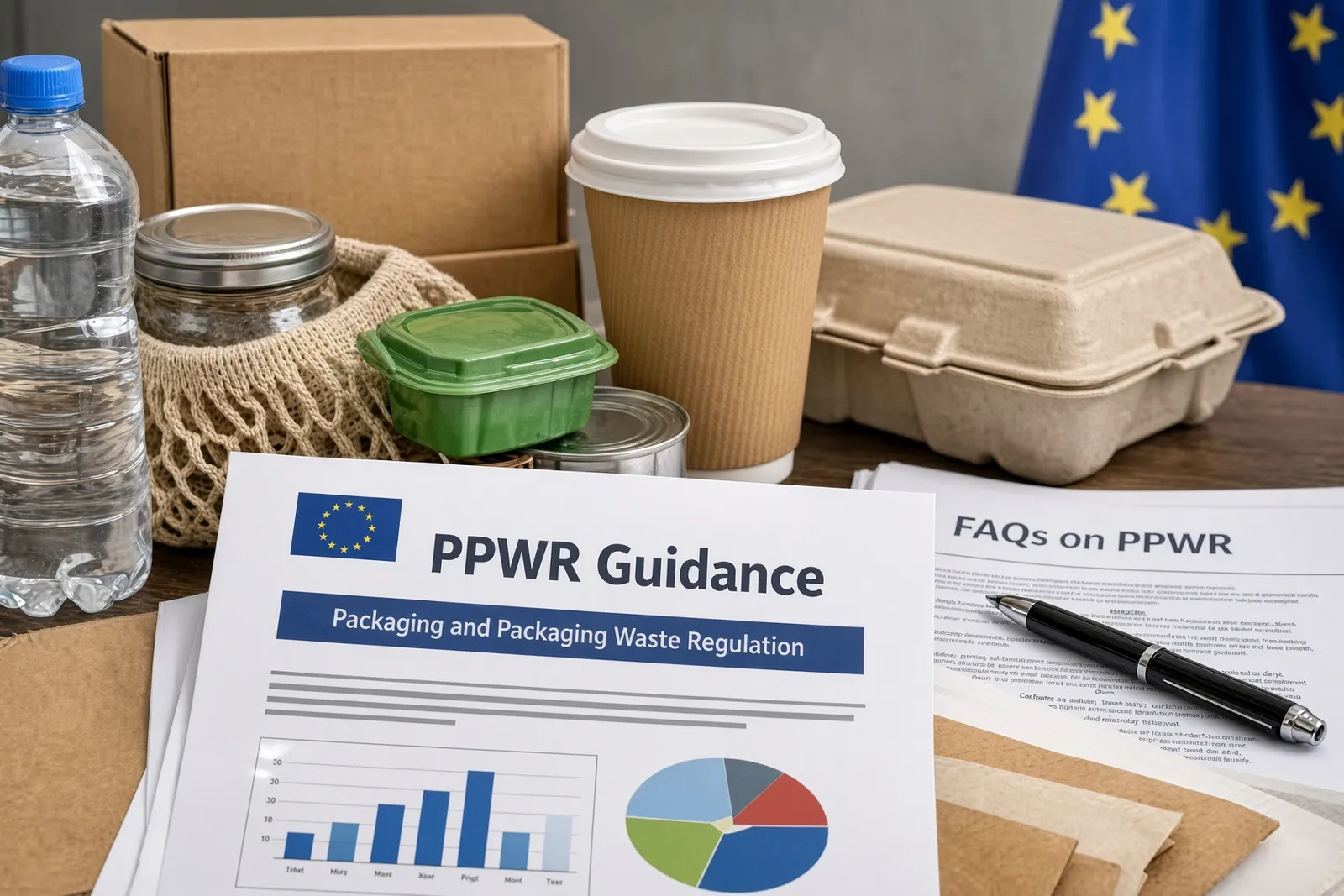
The Basics: What PPWR Is and Who Must Act
PPWR is the EU’s single rulebook for packaging across its full life cycle: design, placement on the market, use, and waste. The European Commission confirms it replaces the old directive to harmonise rules and reduce environmental impact. Many brands treat PPWR as a label update. That is a compliance error.

Before sampling or shipping, we map who carries each role below. Misclassification changes registration, fees, and reporting duties.
Key roles under PPWR
- Manufacturer: the party placing packaging or a packaged product on the EU market under its own name or trademark.
- Importer: the EU-established person placing packaging from a third country on the market.
- Producer: the party with extended producer responsibility and first placement duties, including some cross-border DTC situations.
We base these definitions on the official EUR-Lex text. You must map your legal role before you ship. A factory makes the product. A brand puts its name on the box. The law views the brand as the manufacturer. The brand carries the legal burden. A DTC shipment from outside the EU can still trigger producer duties. We tell clients to map this before sampling.
Packaging taxonomy in plain English
- Sales packaging: primary packaging, such as a grill box or spare-parts pouch.
- Grouped packaging: secondary packaging, such as a branded carton holding six FMCG units.
- Transport packaging: tertiary packaging, such as an export carton or pallet wrap.
- E-commerce packaging: transport packaging used to deliver online or distance-sales products to the end user.
What counts: a scoping matrix for finished goods
| Packaging component | PPWR category | Example |
|---|---|---|
| Product-facing pack | Sales packaging | Grill box, spare-parts pouch |
| Inner protective component | Sales or grouped, depending on separation | Foam insert, sleeve |
| Shipping carton | Transport packaging | Export carton |
| Pallet stabilization | Transport packaging | Stretch film, corner boards |
| E-commerce overbox | E-commerce packaging | DTC delivery box |
This matrix is printed for audit teams. Inspectors classify every box and sleeve, assign the correct PPWR category, and verify all data before the factory seals the master carton.
A certificate only helps if it matches the claim on the pack. Overseas Director, sustainable packaging Kevin Hu, puts it simply: sustainable packaging is not a material switch, it is a system decision. PCR, PLA, “recyclable,” and “biodegradable” are not the same strategy — and a PCR logo is not EN 15343 or RecyClass traceability.
Furniture exporters often miss pallet stabilization. Spare-parts suppliers ignore inner protective sleeves. FMCG brands manage sales packaging but miss transport formats. E-commerce DTC shipments need a separate overbox review.
What PPWR is not
PPWR does not erase national EPR administration. Member States still run registration, fees, and reporting. It is also not a simple recycling-label update. It changes recyclability, recycled content, packaging minimization, and information duties. Teams that budget only for label redesign often fail a packaging audit. National EPR registration still applies. We have audited clients who assumed one EU-wide registration replaced local obligations; it does not.
How PPWR Works: The Operating System Behind Compliance
We treat PPWR as a phased assembly line. Dates set the line speed. Documents carry traceability. Audits test the finished pack. We applied this sequence last month to a patio heater carton. A non-EU supplier provided weight data but no recyclability evidence. The importer stopped the load until we rebuilt the file.
1) The PPWR timeline readers must keep straight
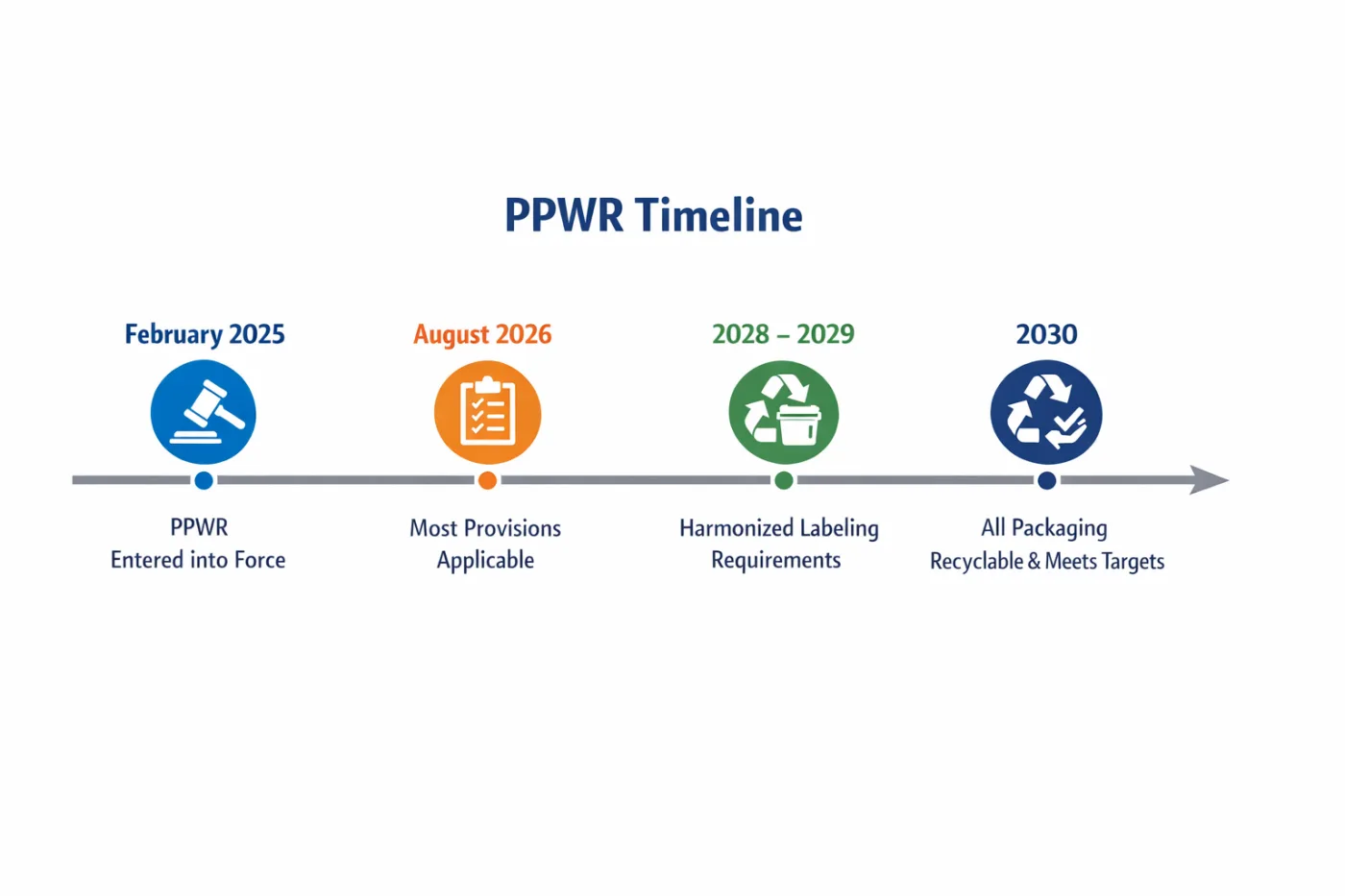
PPWR runs on three tracks. Some duties apply now. Some become measurable later. Some wait for delegated acts. We keep this schedule beside our packaging audit board.
Applies now
- 11 February 2025: Entered into force.
- 12 August 2026: General application. Most operator duties become active.
Measurable later
- 12 February 2028: Commission must deliver the Article 24 empty-space methodology.
- 1 January 2030 or three years after the implementing act, whichever later: Article 24 applies the 50% maximum empty-space ratio for grouped, transport, and e-commerce packaging.
- 1 January 2030 or three years after the Article 7 implementing act, whichever later: Minimum recycled-content thresholds begin.
Drafting gate
- 1 January 2028: Design-for-recycling delegated acts are due. Operators then comply within the transition window.
Always check the official EUR-Lex portal for legal dates. We build a visual project timeline for our clients. This tool helps brands see what rules apply today. It clearly shows what rules take effect next year.
2) The documentation and operator-responsibility workflow
Before placing packaging on the EU market, a manufacturer must perform three steps. First, run the conformity assessment. Second, draw up technical documentation under Annex VII. Third, issue an EU declaration of conformity under Article 39 once conformity is demonstrated.
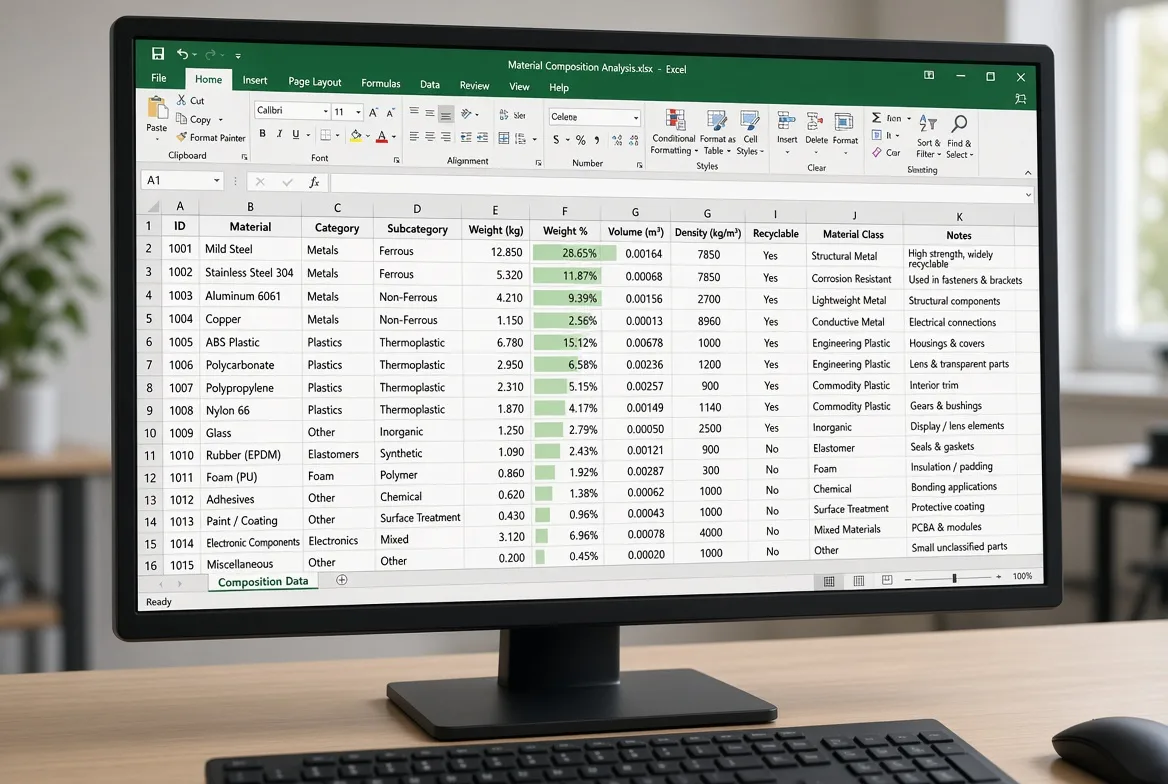
The manufacturer keeps those records for 5 years for single-use packaging and 10 years for reusable packaging.
Suppliers carry a hidden duty. They must provide the manufacturer with the information and documentation needed to demonstrate conformity (EUR-Lex). This is the weak link for non-EU OEM/ODM factories supporting EU importers.
Factories often fail to provide complete data. A supplier might send a safety sheet. They often forget to list the plastic grade or weight mix. The EU brand needs this data to issue the declaration. You cannot sell the product without it.
Plain-English checklist we use on factory inspections:
- Classify every packaging format by type and market pathway.
- Map each material and component supplier under Article 15.
- Collect composition, weight, recycled-content, substance, and test evidence.
- Assess recyclability or design-for-recycling status.
- Prepare Annex VII technical file inputs.
- Issue or verify the EU declaration of conformity under Article 39 / Annex VIII.
- Confirm labeling and traceability obligations per the European Commission PPWR FAQ.
- Connect the file to EPR (extended producer responsibility) registration and annual reporting.
On our direct OEM supply chain projects, we require these eight items before first sample approval. Supplier documentation gaps are the most common delay, not label artwork.
3) The step-by-step packaging audit SOP for flexible films versus mono-material alternatives
Flexible films create the biggest gap between marketing claims and demonstrable compliance. Multi-layer films often protect products better, but they fail sortability. Mono-material alternatives may lose a barrier edge, but they gain a recycling route. We run this standard operating procedure (SOP) on every new pack.

-
Create the SKU or packaging BOM. Isolate every plastic part by weight. Our quality team tests materials on the factory floor. We place the PE pouch on a digital scale. We record the exact weight before the factory adds zippers or labels. This pure weight data prevents audit failures later.
-
Identify whether the pack is mono-material, composite, or multi-component. Use the regulation’s composite-packaging definition where relevant.
-
Separate product-protection function from perceived-volume inflation. Flag false bottoms, double walls, and unnecessary layers. These are high-risk design choices under minimisation logic (Commission notice).
-
Calculate product-to-pack volume ratio and baseline empty space for grouped, transport, and e-commerce formats ahead of Article 24 (EUR-Lex).
-
Compare multi-layer flexible film against a mono-material redesign on five criteria: separability, sortability, realistic recycling route, barrier-performance tradeoff, and recycled-content pathway.
-
Test whether recycled-content thresholds will hit the pack category in 2030. Article 7 specifies: 30% for contact-sensitive PET, 10% for other contact-sensitive plastic packaging, 30% for single-use plastic beverage bottles, and 35% for other plastic packaging. Manufacturers calculate this content as an average per plant and per year (EUR-Lex).
-
Document all evidence in a technical file format that can withstand importer, customer, or authority review.
-
Classify actions into redesign now, validate later, or monitor implementing acts. Start step 3 now. Do not wait for the delegated act.
A common grading error: the final regulation uses recyclability performance grades A, B, and C, not A through E. The regulation treats packaging below the specified threshold as non-compliant once the recyclability regime bites (EUR-Lex).
Common mistake: Many teams focus on declarations and overlook verification-ready evidence. We have seen suppliers issue a declaration with no lab test, no weight log, and no recycling-route note. The regulation and Commission guidance are built around demonstrable conformity.
Expert Q&A
These are the four questions an EU compliance lawyer and an OGPSGroup material-science lead put to every packaging audit:
- Which 2026 obligations are truly enforceable immediately?
- Where do importers most often misunderstand producer or EPR exposure?
- What evidence gaps create the biggest audit risk?
- Which design choices look compliant on paper but fail in practice?
We run this SOP during factory audits. Our manufacturing process team photographs every step. Our quality control team stores the technical file with the shipping records. Our factory tour clients see the same board.
Key Benefits: What Is PPWR and Why Early Compliance Is a Strategic Advantage
What is PPWR? The Packaging and Packaging Waste Regulation replaces fragmented national packaging rules with a single EU framework. That legal certainty lets brands plan production across borders without recalculating national rules. For cross-border outdoor living brands, that means one set of design and documentation rules.
We treat early compliance as an operational advantage, not a defensive checklist. In our recent packaging audits, early action exposed hidden freight waste, supplier gaps, and market-access risks before 2030.
Market-Access Resilience
One framework reduces guesswork for importers, marketplaces, distributors, and authorities. They now expect verifiable packaging data before loading. We saw a VP of Supply Chain avoid a two-week port hold because our file included weight logs and recyclability evidence.
Before PPWR, these last-minute disruptions were common. We now treat packaging data as a loading document, not an afterthought. The European Commission confirms harmonised rules improve cross-border certainty.
Packaging Cost Discipline
Minimisation pressure exposes wasted air, redundant layers, and freight-inefficient pack designs. We run drop tests on eco-friendly packaging. We recently cut the empty space in a custom patio-furniture carton by 25 percent. The new design passed the drop test. The client saved a lot of money on freight costs.
A Director of Procurement gains cleaner supplier requirements and stronger negotiation leverage because we hand buyers a deviation list tied to specific cartons and SKUs. This is raw lab data, not supplier marketing.
Supplier-Data Maturity
Factories are required to trace all materials. Test data must be provided before the first sample is approved. The factory must prove the plastic grade. This strict process delivers a complete audit trail for clients.

In our experience, this cuts supplier clarification from weeks to days. We require this evidence before first sample approval.
A Packaging Compliance Officer gets stronger audit trails and easier customer responses. The EUR-Lex Regulation 2025/40 sets the Annex VII documentation duties. Our quality control team stores every evidence file with shipment records. Our sustainable materials team evaluates multi-layer versus mono-material trade-offs when material choice drives compliance.
📈 ROI Check: Track carton cube weight and empty-space ratio per SKU before and after redesign. A 10% cube reduction typically lowers 40HQ freight cost by 8–12%.
Challenges & Limitations: The Hard Part Is Not Reading the Law
PPWR harmonises the core. The real burden is evidence: supplier proof, national administration, phased methodologies, and enforcement gaps.

National EPR Administration Still Creates Complexity
Member States control registration, fees, and reporting. First-time placement in another Member State can trigger producer obligations. You may need an authorised representative outside your establishment (EUR-Lex).
Our client expanding from Poland to Italy assumed one EU registration. Italy required local EPR registration and an authorised representative. This delayed launch by five weeks.
🛡️ Mitigation: Build a Member State activation table: first placement date, registration number, authorised representative, annual report due date.
The Rulebook Is Partly Phased and Partly Still Being Operationalised
Key methodologies remain unpublished. The empty-space calculation arrives by 12 Feb 2028. Design-for-recycling delegated acts land 1 Jan 2028 (EUR-Lex).
In March 2026, we tried to calculate a patio heater carton’s empty-space ratio. No final Article 24 methodology existed. We used an internal baseline and produced a provisional declaration, not a certified pass.
⚠️ Critical Warning: Do not certify against an unpublished methodology. A 2026 audit will not survive 2028 delegated acts.
Penalties and Corrective Action Are Real
By 12 Feb 2027, Member States must set effective, proportionate, dissuasive penalties. Infringements of Articles 24 to 29 must include administrative fines. Persistent non-compliance can block market access or force withdrawal and recall (EUR-Lex).
We modelled a recall for 12,000 units. The cost exceeded €150,000. A supplier’s invalid declaration does not shield the EU importer. Verify before loading, not after customs.
‘Loopholes’ Are Verified Edge Cases, Not Shortcuts
No hidden blanket exemption exists. Reclassifying sales packaging as transport packaging fails at delivery. The sub-10-tonne reporting simplification is not a blanket exemption.
Smaller non-EU exporters face a real access barrier. Many lack funds for local authorised representatives in every Member State.
⚖️ Trade-off: A loophole defence requires a classification memo and test data. Without evidence, it becomes a non-compliance finding.
Myth-Busting Block
- Myth: “PPWR means everything changes in one day.” Reality: Obligations phase in across 2026, 2028, 2030, and 2035 (EUR-Lex).
- Myth: “Small-volume exporters are exempt.” Reality: The sub-10-tonne reporting simplification is not a blanket exemption (EUR-Lex).
Expert Q&A: Enforcement Reality
One EU compliance lawyer said: “Harmonised on paper. Enforcement is local. One Member State audits EPR registration; another inspects empty-space ratios. One national decision does not clear the market.” We treat PPWR as a living compliance program.
The Verdict: Manage PPWR as a Packaging-Data Program
PPWR is not a label update. It is a market-access requirement that rewards brands treating packaging as auditable data, not an afterthought. Authorities will stop your shipments if your data is bad. You must collect clear weight logs.
You need proof that the factory can recycle the materials. We check these documents to protect your supply chain. We have also seen importers clear customs faster because their technical files were complete before loading.
The biggest challenge is not the regulation itself. It is supplier governance. Non-EU factories often lack the documentation discipline PPWR demands. Your EU importer or authorised representative cannot issue a valid declaration without their evidence. Treat PPWR as a packaging-data and supplier-governance program, not a late-stage legal review.
Who should act first? EU-bound brand owners, importers, and procurement leaders with high-volume plastic or e-commerce formats. Who should not panic yet? Brands with minimal EU volume or reusable industrial packaging still need a role-classification check, but their redesign window is longer.
Expect enforcement to tighten after 2030. Member States will inspect empty-space ratios and recycled-content claims, not just labels. Build the evidence repository now. Our recommendation: start with a packaging inventory, assign roles by route to market, and run the SOP on your highest-volume formats.
Ready to act? If your brand ships high-volume plastic or e-commerce formats to the EU, contact our team to scope a packaging audit against the phased deadlines.
Executive Action List
- Inventory all EU-bound packaging formats by category and weight.
- Assign producer, importer, or manufacturer responsibility by market pathway.
- Run the packaging audit SOP on highest-volume plastic and e-commerce formats first.
- Build a single audit-ready evidence repository for every format.
- Monitor delegated acts for empty-space methodology and design-for-recycling deadlines.
If you need a packaging compliance diagnostic or supplier-audit support, contact our team for a scoping call.
Disclaimer: We sell compliance and sourcing services. We share our audit data here to help you learn. This guide provides general business information. You should ask your lawyer for official legal advice. For binding interpretation, consult the official EUR-Lex text and a qualified EU counsel.

- Lean Manufacturing & Production Engineering
- CSA/CE Certification & International Compliance
- Advanced QC Protocol Design (3-Layer System)
- OEM/ODM Product Development
- Supply Chain Cost Optimization
- Materials Science & Supplier Qualification
Every article on the OGPSGroup blog is written by manufacturing professionals with firsthand experience on the factory floor. Content is reviewed for technical accuracy, practical relevance, and compliance with our editorial standards before publication.
Learn more about our Fact Checking Process and Editorial Policy.