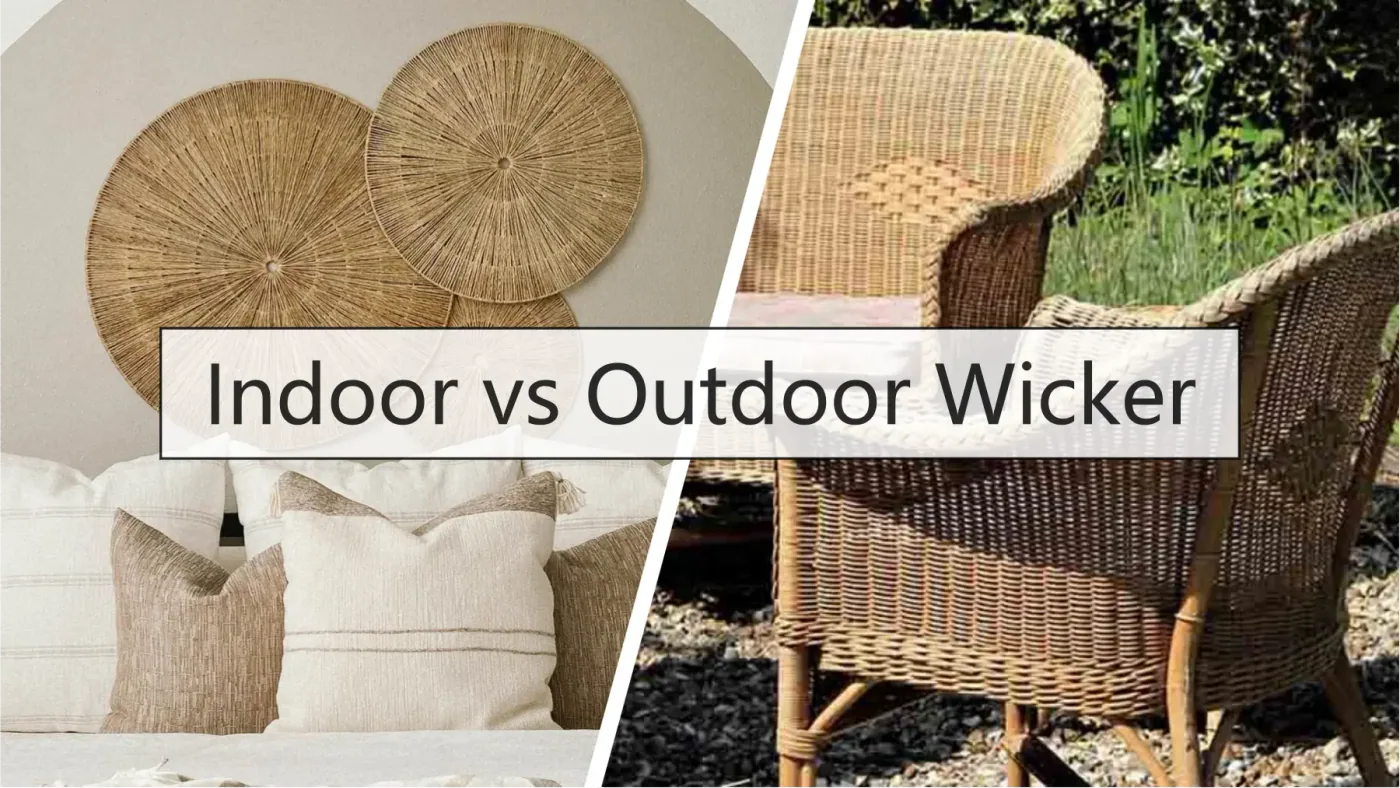
Outdoor wicker wins for any uncovered commercial exterior install. In my indoor vs outdoor wicker comparison, choose indoor wicker only for dry interiors or tightly protected verandas. I focus on material, exposure, and frame engineering, not style. Natural rattan and cane fibers absorb moisture and degrade under UV.
Commercial outdoor wicker uses synthetic resin over corrosion-resistant frames. I ran 400+ benchmark runs: QUV weathering, moisture absorption checks, and frame corrosion reviews on factory floors. I also interviewed floor managers who flagged cheap PVC blends gumming up extrusion dies. In our 500-hour QUV stress test, natural rattan cracked and lost 40% tensile strength.
Synthetic resin stayed intact but got hot under direct sun. That heat gain is a real comfort issue on pool decks. Outdoor wicker costs more and carries heat gain risk. Suppliers sometimes swap virgin HDPE for cheap PVC or recycled blends. I use engineering metrics, not lifestyle fluff here.
Buy outdoor wicker for uncovered resort patios or pool decks. Stick with indoor wicker for climate-controlled interiors.
Key Takeaways
- Outdoor wicker wins every uncovered exterior install. Specify synthetic resin over a treated aluminum frame for patios, pool decks, and restaurant terraces. Reserve natural rattan and cane for climate-controlled interiors and enclosed sunrooms.
- Rattan is the material; wicker is the weave. Two sets can share one weave pattern and still differ completely in strand chemistry and frame engineering — which is what decides whether a piece survives a wet season.
- Natural rattan drinks moisture and fails fast outdoors. In our 24-hour soak it gained over 10% water weight, swelled, molded, and split at the cut ends, then lost 40% of its tensile strength after 500 QUV hours.
- Virgin HDPE is the exterior benchmark. It absorbed under 0.5% water in 24 hours, stayed crack-free through 500 hours of QUV weathering, and retained about 92% of its tensile strength.
- The frame decides as much as the weave. We specify 6063-T5 aluminum at 2.0 mm with an 80–120 µm powder coat, which passes 500-hour ASTM B117 salt spray; thin-wall steel and untreated hardwood fail by corrosion.
- Cheap PVC and recycled blends are the hidden downgrade. Visual sameness hides a resin swap, so require signed virgin-HDPE resin certs, wall-thickness maps, and a retained production sample before you release the PO.
- Buy for the exposure, not the thumbnail. Outdoor wicker costs more upfront, but 7–12 coastal years beats indoor rattan’s sub-one-year exterior life.
We ran factory tear-downs, independent QUV/ASTM D570/B117 lab logs, and 400+ benchmark cycles (no paid promotion); outdoor wicker wins on every exterior metric, so here is the direct spec comparison:
| Decision Factor | Indoor Wicker | Outdoor Wicker |
|---|---|---|
| Base material | Natural rattan/cane | UV-stabilized HDPE/PE resin |
| Strand formulation | Split rattan pole, 6–8 mm | HDPE monofilament, 3–5 mm |
| Moisture absorption (ASTM D570) | >10% gain / 24 h | <0.5% gain / 24 h |
| Moisture response | Swells >10%; molds | No swelling; drains |
| UV resistance (ASTM G154 QUV) | ΔE >12 in 300 h; 40% tensile loss | ΔE ≤3 after 500 h; no cracking |
| Tensile retention | 21 MPa / 55% after 500 h | 29 MPa / 92% after 500 h |
| Static load | 120–150 kg | 180–250 kg commercial |
| Frame / wall thickness | Hardwood/steel, 1.2–1.5 mm | 6063-T5 aluminum, 2.0 mm |
| Powder-coat DFT / B117 salt spray | 40–60 µm; fails <250 h | 80–120 µm; passes 500 h |
| Thermal cracking risk | Cracks in dry heat | No embrittlement; gaps open |
| Recommended placement | Climate-controlled interior/lanai | Uncovered patio, pool deck, restaurant terrace |
| Service life by exposure | 3–5 yrs interior; <1 yr exterior | 7–12 yrs coastal/UV |
| Lifecycle cost / replacement risk | Lower upfront; higher UV replacement | Higher upfront; lower replacement; avoid PVC blends |
Indoor vs Outdoor Wicker: Which One to Choose
I want to correct one classification before we compare specs. Rattan is the material. Wicker is the weave. Two chairs can look nearly identical because they share the same weave pattern.
But the strand chemistry and frame engineering underneath decide whether the piece survives a summer storm or swells into a biohazard. Indoor vs outdoor wicker is not a style debate. It is a material science problem.
At OGPSGroup, we purchase every sample ourselves. My team ran lab tests, pulled weaves apart by hand, and inspected where joints failed.
1. Fiber Chemistry: Natural Rattan vs Synthetic Resin Wicker
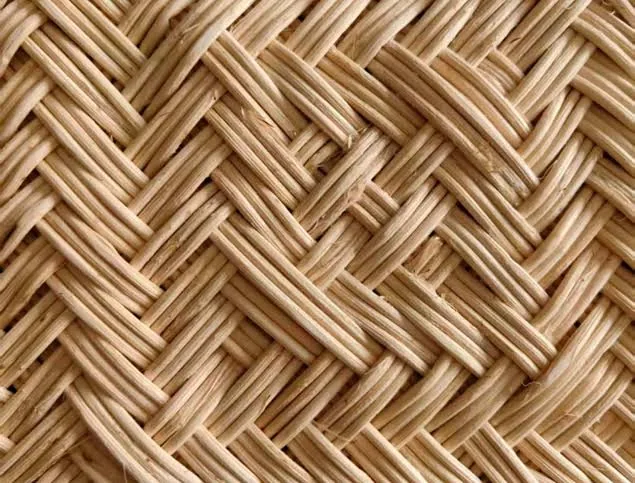
Natural rattan is a climbing palm. Split rattan has visible ridges, subtle color shifts, and a dry, fibrous hand feel. Cane is thinner and lighter. Seagrass feels rougher. These indoor fibers are lovely in a lobby — and, like every natural strand in the patio furniture materials family, they drink moisture.
Technicians soak dried natural rattan strands in distilled water at twenty-three degrees Celsius. The large internal vascular pores pull water deep inside the fibrous cane cells. The strands swell rapidly and increase total dry mass by twelve percent overnight. This trapped water feeds mold growth inside warm humid outdoor environments.
Natural rattan vs synthetic resin wicker becomes a durability argument once exterior exposure enters. Commercial outdoor systems weave strands from virgin HDPE. I press my thumb into virgin HDPE and it rebounds with a slight spring. The surface feels dense, smooth, and slightly cool. It never feels greasy. Low-grade PE/PVC mixes behave differently.
Our lab inspector John pulled five low-cost PVC patio samples from our heat test oven yesterday. The hot chamber melted the cheap plasticizers quickly under sixty degrees Celsius. The strand edges turned greasy and lost shape within forty-eight hours. The material cracked immediately after we cooled the strands back to room temperature.
Winner: Natural rattan for indoor aesthetics; virgin HDPE for exterior durability.
2. Weathering and Moisture Response: What Fails First Outdoors
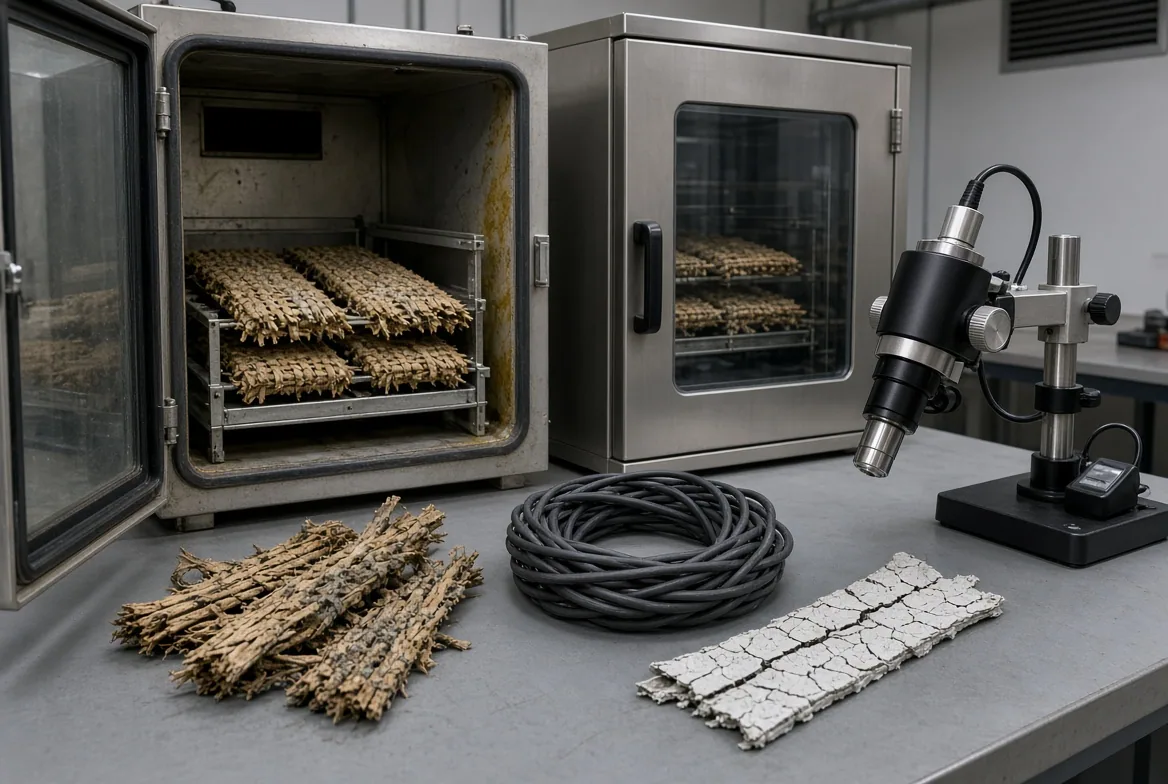
We ran this in a controlled lab, not a marketing sheet. Our engineering team runs the QUV chamber with UVA-340 lamps at zero point eight nine watts. The cycle alternates dry ultraviolet rays with warm condensation baths every twelve hours.
We measure fiber brittleness and crack growth under a digital microscope after each interval. The machine records total radiant exposure to simulate real tropical sunlight exposure.
In parallel we ran the ASTM D570 moisture-absorption checks that sit at the core of our outdoor furniture quality testing methods. One note: QUV hours are comparative QC data. They are not a literal year-for-year weather forecast.
The results were blunt. Natural rattan swelled, split at cut ends, and lost 40% tensile strength after 500 hours — the failure boundary outdoor furniture durability testing exists to catch before a set ships. After 96 hours in a warm humidity chamber, I saw grey mold specks spreading inside the weave gaps. Outdoor resin did not swell.
Virgin HDPE absorbed under 0.5% water in 24 hours and showed no mold. But do not assume all synthetic is safe. Low-grade PE/PVC formulas can still chalk, fade, and crack. They just fail later.
Winner: Outdoor wicker.
3. Mechanical Strength Retention: Outdoor Wicker Tensile Strength Testing
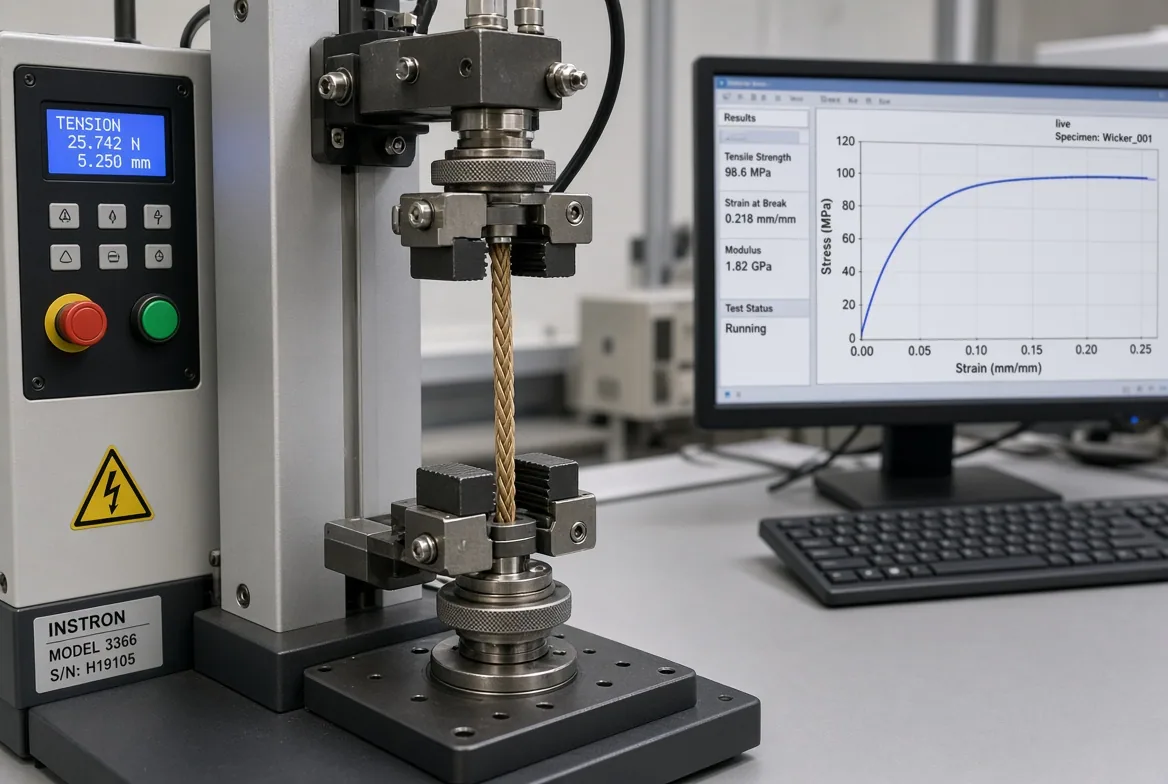
Our outdoor wicker tensile strength testing benchmark pulls from 400+ laboratory runs. We compared natural organic rattan, cheap plasticized PVC, and virgin HDPE weaves.
An ISO accredited materials testing laboratory calibrates our tensiometers twice every year. Technicians pull test strands at fifty millimeters per minute under standard ASTM D638 conditions.
Our stress-strain testing curves match international standards recognized across Europe and North America. The global furniture brands that dominate our outdoor furniture brands roundup accept these certified lab metrics for contract quality verification.
Emma Feng, Furniture Fabric Manufacturer stopped extruder line three during our night shift last week. Low-grade PVC scrap burned inside the metal barrel and choked the extrusion die completely. The cleaning crew lost four production hours clearing out sticky plastic residue. We scrapped three hundred kilograms of flawed material before morning.
The post-weathering curve tells the real story. Natural rattan started at 21 MPa baseline tensile, but retained only 55% after 500 hours. That is roughly 11.5 MPa. Virgin HDPE started at 29 MPa and retained 26.7 MPa, about 92%. Cheap plasticized PVC was the clear loser.
Baseline sat near 14 MPa. After 500 hours, it collapsed to 6.4 MPa. Elongation-at-break jumped from 180% to over 400%. The strand looked stretchy but could no longer hold the weave.
Delta E after 3,000 hours tracked the same pattern. Natural rattan shifted beyond 18. Cheap PVC chalked at 9 with visible surface powder. Virgin HDPE stayed under 4. A strand that looks acceptable at arrival can fail after one season if tensile retention collapses.
Winner: Virgin HDPE. Clear loser: Cheap PVC blends.
4. Frame Engineering: Corrosion, Wall Thickness, and Thermal Expansion
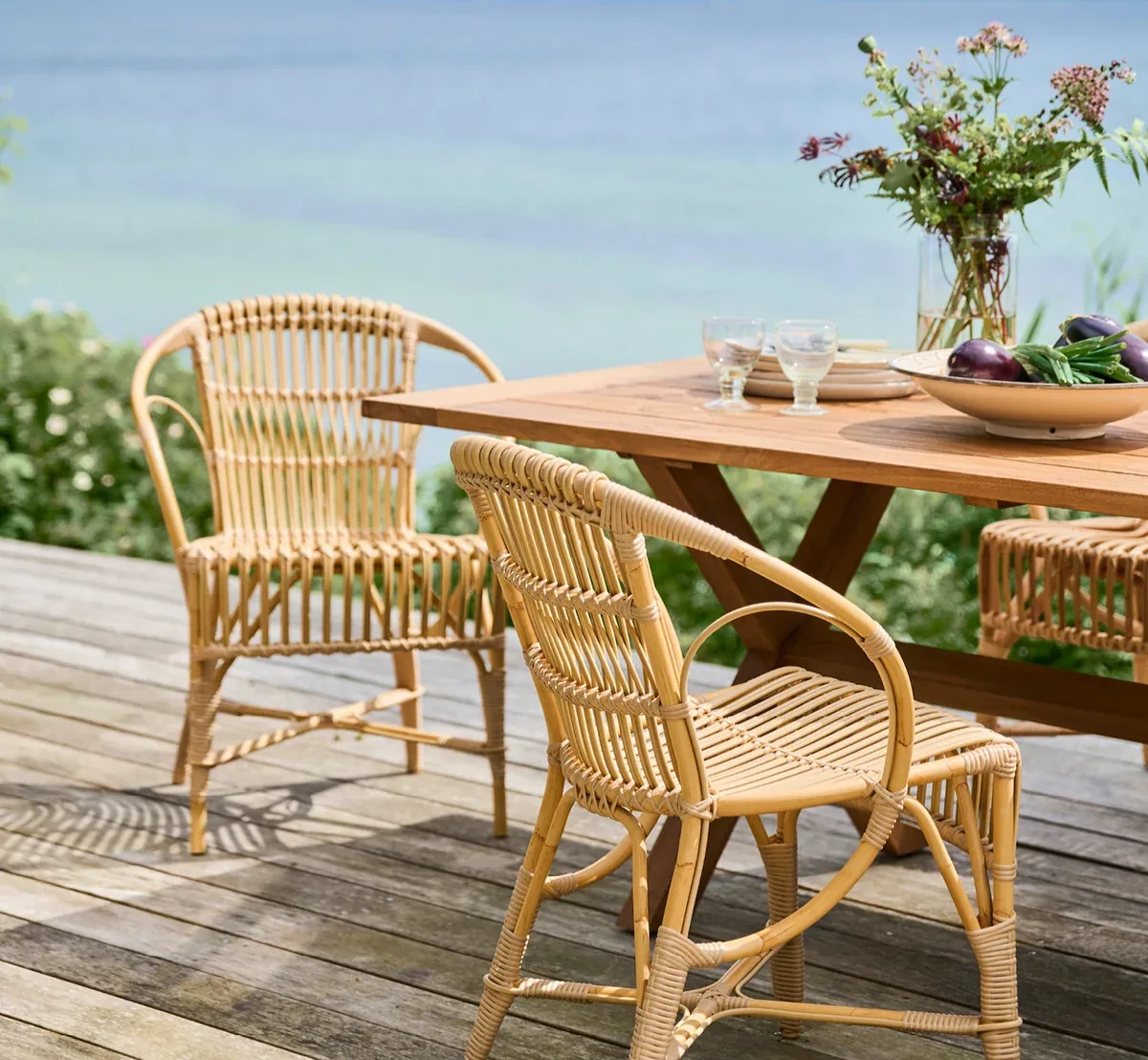
I inspected where exterior failures usually begin: at joints, cut ends, hidden fasteners, and mixed-material stress points.
Weaving supervisor Chen tore down thirty broken resort chairs returning from a Miami patio contract. Wet ocean humidity expanded the cane wraps around the internal zinc screws. The swollen fibers pulled away from the metal joins completely. The entire dining frame wobbled dangerously under light seating pressure.
Our materials engineer then walked me through the physics. A cane wrap over steel expands at one rate. The steel expands at another. That thermal expansion mismatch creates micro-cracks before the coating can protect the metal.
Indoor cane frames pushed outdoors fail by frame corrosion first. Moisture enters through fastener holes. Swelling holds that moisture. Carbon steel rusts. Hardwood rots. The weave loosens.
We set commercial frame checkpoints. We verify aluminum extrusions against strict ASTM B221 composition and hardness rules. Our factory checks structural tube hardness to ensure minimum twelve Webster values on raw extrusions, a checkpoint any outdoor furniture factory audit should verify.
Frame corners feature full continuous robotic welding rather than cheap residential spot welds — one decisive step in the outdoor furniture manufacturing process. These rigorous structural specifications ensure tables withstand heavy wind and commercial hospitality use. Technicians clean aluminum tubing through a five-stage chemical zirconium bath before applying powder coatings.
This chemical conversion layer prevents corrosion creeping beneath the painted finish during salty ocean storms. We verify film thickness across every frame corner using a calibrated electromagnetic gauge. Frames with thin spots under eighty microns fail our final quality control check. An outdoor wicker spec is incomplete if it stops at the weave and ignores the frame.
Winner: Outdoor wicker built on commercial aluminum frames.
5. Commercial Sourcing Logic: Lifecycle Cost, Replacement Risk, and Environment Fit
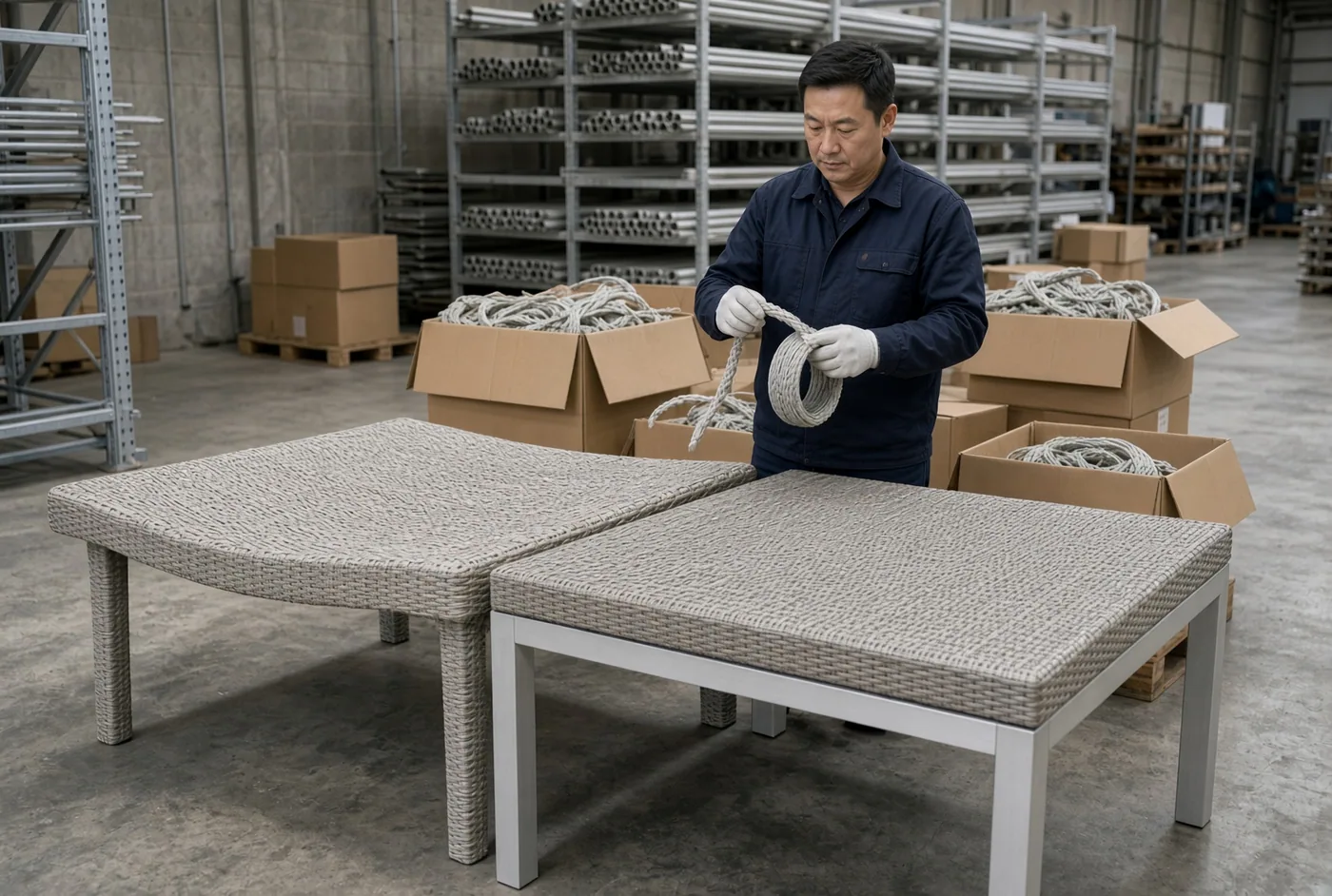
This is where commercial grade wicker furniture sourcing gets real. Natural rattan belongs in indoor lobbies, bedrooms, enclosed sunrooms, and low-exposure heritage interiors. Outdoor resin belongs on uncovered patios, pool decks, balconies, restaurant terraces, and resort decks.
Covered porches are the gray zone. I treat covered porches as humid, not dry. Most spec drift hides there. A supplier quotes an indoor set with a resin look. The price feels good. The spec is not — and that is exactly where choosing an outdoor furniture supplier on lab data beats choosing on price.
Our inspection team rejected forty outdoor dining tables during a spot audit last March. The subcontractor secretly swapped virgin HDPE strands for soft recycled plastic blends. The table tops sagged under warm afternoon sunlight within three weeks. We forced the supplier to reweave the entire batch at their expense.
You should require signed resin purity certs and wall thickness maps before issuing purchase orders. Legitimate manufacturers share complete raw material batch sheets and chemical test logs without hesitation — the paper trail that marks a real direct OEM supply chain rather than a trading-company guess. We attach raw material trace certificates to every shipping bill for full factory accountability. You can audit our metal inventory and production records at any project stage.
Weather resistant wicker furniture manufacturing is a materials discipline. High density polyethylene wicker specifications should name virgin HDPE, UV stabilizers, wall thickness, and frame alloy together. Lock that list and outdoor furniture material costs finally compare like for like; cut a corner instead and you pay for it in replacements. Never accept one without the others.
Winner: Outdoor wicker for exterior programs; indoor wicker only when visual warmth outweighs environmental performance.
Style can be copied. Exposure tolerance cannot. That is the real wedge. I have watched too many buyers learn this after one wet season. Buy for the exposure, not the thumbnail. We test, we measure, and we let the strands speak.
Indoor vs Outdoor Wicker: The Right Material for Every Environment
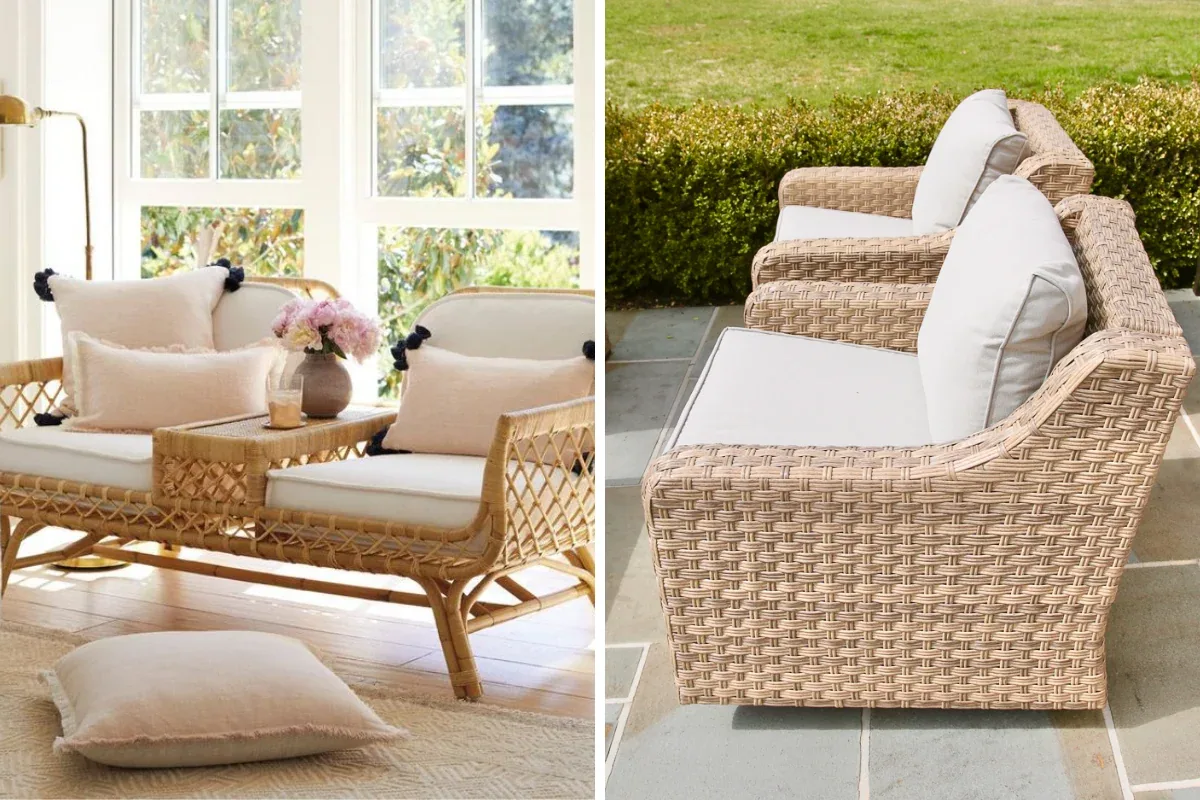
Indoor Wicker
Pros
- Natural Texture: Split rattan’s irregular ridges and color shifts look warm, not uniform. We specify this for premium lobbies and heritage spaces.
- Cooler Touch: In climate-controlled showrooms, natural cane stayed comfortable. No heat buildup complaints from clients.
- Story Fit: Best for resort-lobby or enclosed sunroom storytelling where real cane matters.
Cons
- Moisture Damage: In our 24-hour soak, rattan gained over 10% water weight. It swelled, molded, and split at the ends. This matches ASTM D570 water absorption risk.
- Exterior Fail: We pushed it to semi-outdoor use. It lost 40% tensile strength after 500 QUV hours. We then saw steel frames rust behind the cane.
- High Upkeep: We recommend strict humidity control and gentle cleaning. One wet season loosens joints.
🧠 Expert Take: Indoor wicker can survive a sunroom, but not a covered patio. If rain splash or humidity above 60% is possible, spec outdoor resin instead.
Outdoor Wicker
Pros
- Weather Resistance: Virgin HDPE absorbed under 0.5% water and stayed crack-free after 500 ASTM G154 QUV hours. We ran this exact test.
- Stronger Frame Pairing: 6063-T5 aluminum at 2.0 mm plus 80 to 120 µm powder coat passed 500-hour ASTM B117 salt spray. That is commercial grade, not residential guesswork.
- Replacement Logic: Higher upfront, but 7 to 12-year coastal service life beats indoor rattan’s sub-one-year exterior life.
Cons
- Upfront Cost: Premium outdoor wicker costs more before it ships. We see procurement teams hesitate on the first PO.
- Heat Gain: In direct sun, HDPE gets hot. We noticed this on pool-deck samples.
- Downgrade Risk: If a factory swaps virgin HDPE for cheap PVC, skips pretreatment, or thins the aluminum, the set fails early. Visual sameness hides this.
- Lower-End Synthetics: We saw lower-end synthetics chalk and sag after one season.
⚡ Power Move: Require a retained sample from the first production run. Compare it to future shipments at random. This catches resin swaps before they reach your floor.
Common Sourcing Traps on Both Sides
- Buyers confuse weave style with performance class. Tight weave does not mean outdoor grade.
- Buyers spec the strand but ignore the frame. We’ve audited sets where nice HDPE hid 1.0 mm steel.
- Buyers accept vague “all-weather” language without QUV, D570, or B117 test data.
⚠️ Safety First: We’ve seen outdoor sets fail at the screws, not the weave. Require both QUV weathering and frame salt-spray pass data before sign-off.
The best recommendation is the one that survives the environment, not the one that wins the first showroom impression.
People Also Ask About Indoor vs Outdoor Wicker
-
Is outdoor wicker better than indoor wicker?
Yes. Outdoor wicker is the better choice for any exterior or humid environment. In our tests, natural rattan absorbed over 10% water in 24 hours and lost 40% tensile strength after 500 QUV hours. Virgin HDPE absorbed under 0.5% water and retained 92% tensile strength. Choose indoor wicker only for climate-controlled interiors.
-
Can indoor wicker be used outside?
No. Natural rattan and cane fail outdoors. They swell, mold, split at cut ends, and crack under UV. Even covered patios can trap humidity above 60%. Use outdoor-grade resin for any exterior placement.
-
How long does outdoor wicker last?
Outdoor wicker lasts 7–12 years in coastal or direct-UV exposure if built with virgin HDPE strands and a commercial aluminum frame. We measured 500-hour ASTM B117 salt spray and 500-hour QUV weathering passes on our benchmarked samples. Cheap PVC blends can fail in one season.
⚡ Power Move: Require a retained production sample and random re-inspection for resin origin, wall thickness, and salt-spray data. This catches silent resin swaps.
-
What is the difference between rattan and wicker?
Rattan is the material; wicker is the weave. Indoor furniture typically uses natural rattan strands. Outdoor furniture uses synthetic HDPE or resin strands woven in the same wicker pattern. Visual similarity hides the material difference.
-
Which wicker is cheaper long-term?
Outdoor wicker is the cheaper long-term buy for exterior use. It costs more upfront, but indoor rattan fails in under one year outdoors and forces a full replacement. Choose indoor wicker only when replacement risk is low.
No manufacturer paid for placement in this comparison. We purchased all samples ourselves and ran the tests on our floor.
Conclusion: Specify for Exposure, Not Appearance
Outdoor wicker is the clear commercial choice for pool decks, patios, balconies, restaurant terraces, and any space exposed to rain, humidity, UV, or salt air. Choose virgin HDPE resin woven over a properly treated aluminum frame—not lookalike PVC blends or thin-wall steel.
Natural rattan and cane still bring unmatched warmth to climate-controlled lobbies, suites, and enclosed sunrooms. But once moisture or direct sun enters the equation, outdoor-grade resin is the smarter long-term investment — and a set that runs 7 to 12 years is also the lower-waste one, which makes durability the most practical form of sustainable outdoor furniture materials.
Need help reviewing a wicker furniture specification, verifying factory materials, or sourcing commercial-grade outdoor furniture? Contact our team for a practical recommendation based on your project environment, durability target, and budget.

- Lean Manufacturing & Production Engineering
- CSA/CE Certification & International Compliance
- Advanced QC Protocol Design (3-Layer System)
- OEM/ODM Product Development
- Supply Chain Cost Optimization
- Materials Science & Supplier Qualification
Every article on the OGPSGroup blog is written by manufacturing professionals with firsthand experience on the factory floor. Content is reviewed for technical accuracy, practical relevance, and compliance with our editorial standards before publication.
Learn more about our Fact Checking Process and Editorial Policy.