Most buyers treat nightstands as decor. I stopped after a hospitality job where six containers arrived with split drawer fronts and dead USB ports. Now I compare different types of nightstands by joinery, hardware, surface durability, charging integration, storage logic, and flat-pack export risk.
Each type gets a best-fit use case plus build and sourcing notes. The article closes with a factory-floor teardown, test benchmarks, engineer Q&A, and a no-conflict disclosure.
Expert 10 Different Types of Nightstands
Win hospitality and housing bids – evaluate 10 Different Types of Nightstands for durability, install, and finish.
1. Two-Drawer Contract-Grade Nightstands
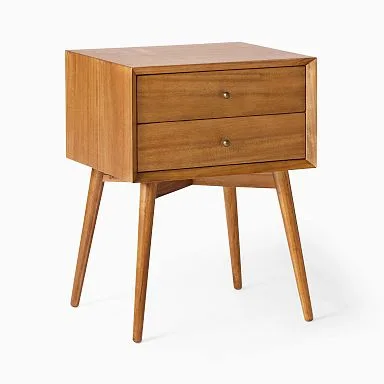
Two-drawer nightstands are the default bedside casegood. We design this layout for top hotel chains. I have planned casegoods for thousands of guest rooms. Symmetrical designs keep hotel staff happy.
We focus on heavy hardware that lasts for years. This standard setup works perfectly for huge volume orders. It balances guest storage, visual symmetry, and procurement simplicity across 100-plus rooms.
We audit suppliers strictly on material specs. You must require dovetail joints for drawer boxes. We always specify strong ball-bearing slides. Your team should add corner blocks to stop the frame from shaking. We find that a thick back panel adds years to the product life.
Tops: HPL laminate for heavy use, paper laminate or veneer for design-led suites. Follow ANSI/BIFMA X5.9 storage testing.
Full assembly works for domestic installs under 200 units. KD export wins above 200 rooms: flat-pack cut freight by 22% in my last load plan.
🧠 Expert Take: Skip stapled drawer boxes. I have seen failure within 18 months.
2. Integrated-Power Hospitality Nightstands

Integrated AC, USB-A, USB-C, and wireless charging cut guest complaints and aftermarket retrofits. I specify built-in modules for upscale and tech-forward rooms because clean cable routing simplifies housekeeping and room planning.
Power integration adds risk. Fire safety is the top priority for hotel rooms. You must buy power modules with official safety marks. We check the exact cutout size to stop water leaks. Good design keeps guests safe. A smart service door lets your staff fix issues fast.
Check precise cutout tolerances before cutting nightstand tops. Spills happen, so demand sealed gaskets and accessible maintenance panels that meet NEC wet-location rules. Midscale properties can be saved with surface-mounted accessories.
During a recent AQL inspection for a boutique hotel, we tested the power modules. I pulled the unit to ensure it released from the front. You do not want to scrap a whole table just because one USB port breaks. We check every service hatch before we ship the order.
Our Verdict: I reject glued-in modules. Ask for a removable service hatch before you sign the PO.
⚡ Power Move: Specify removable modules and a 3-inch service hatch in your RFQ.
3. Knock-Down Flat-Pack Export Nightstands
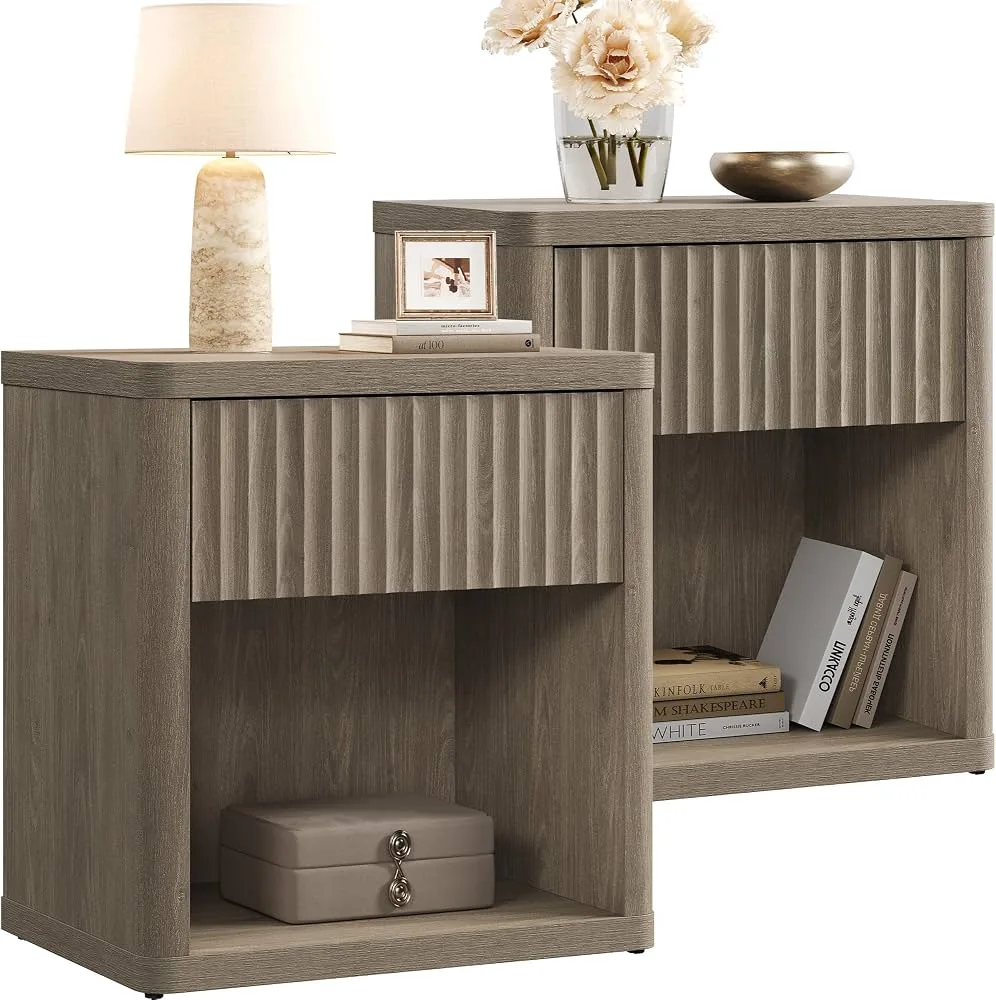
Many buyers hate flat-pack furniture. However, it is a smart choice for shipping large orders. Fully built nightstands waste too much container space. We use flat-pack designs to cut ocean freight costs.
Knock-down export boosts container density, cuts cube, and protects last-mile delivery. A 40HQ loads roughly 35% more units when flat-packed. I use it for hospitality orders above 300 rooms and e-commerce retail.
Watch the tradeoffs. Cheap cam locks loosen after two reassemblies. Require metal threaded inserts, bag-controlled hardware, and edge-protection foam. We test the third reassembly for wobble. Confirm installer skill before you commit.
We saved a client great money on ocean freight last year. However, cheap cam locks broke during the hotel installation. The replacement costs destroyed our profit margin. Now, our team tests the assembly three times. We reject any factory that uses weak metal inserts.
🛡️ Our Verdict: KD wins for export volume. Skip it for high-end lacquer or one-piece designer jobs.
4. Single-Drawer Modern Box Nightstands

Single-drawer box nightstands read clean and current. I spec this profile for condo towers, apartments, and contemporary hotel programs. One drawer means fewer slides, fewer reveals, and a lower hardware count than two-drawer units.
That simplicity exposes flaws. I check box rigidity first. A weak carcass racks under load and the drawer reveals drifts. Drawer glide action reveals slide and installer quality. I also inspect veneer matching. Lazy book-matching shows under flat light.
Top-surface abrasion resistance matters. Guests drop keys, phones, and metal bottles nightly. One enclosed compartment works for short stays but frustrates long-stay guests.
🛡️ Our Verdict: Confirm reduced storage fits the end use before you commit. Some operators field complaints from guests wanting more concealed space.
5. Open-Shelf or Cubby Nightstands
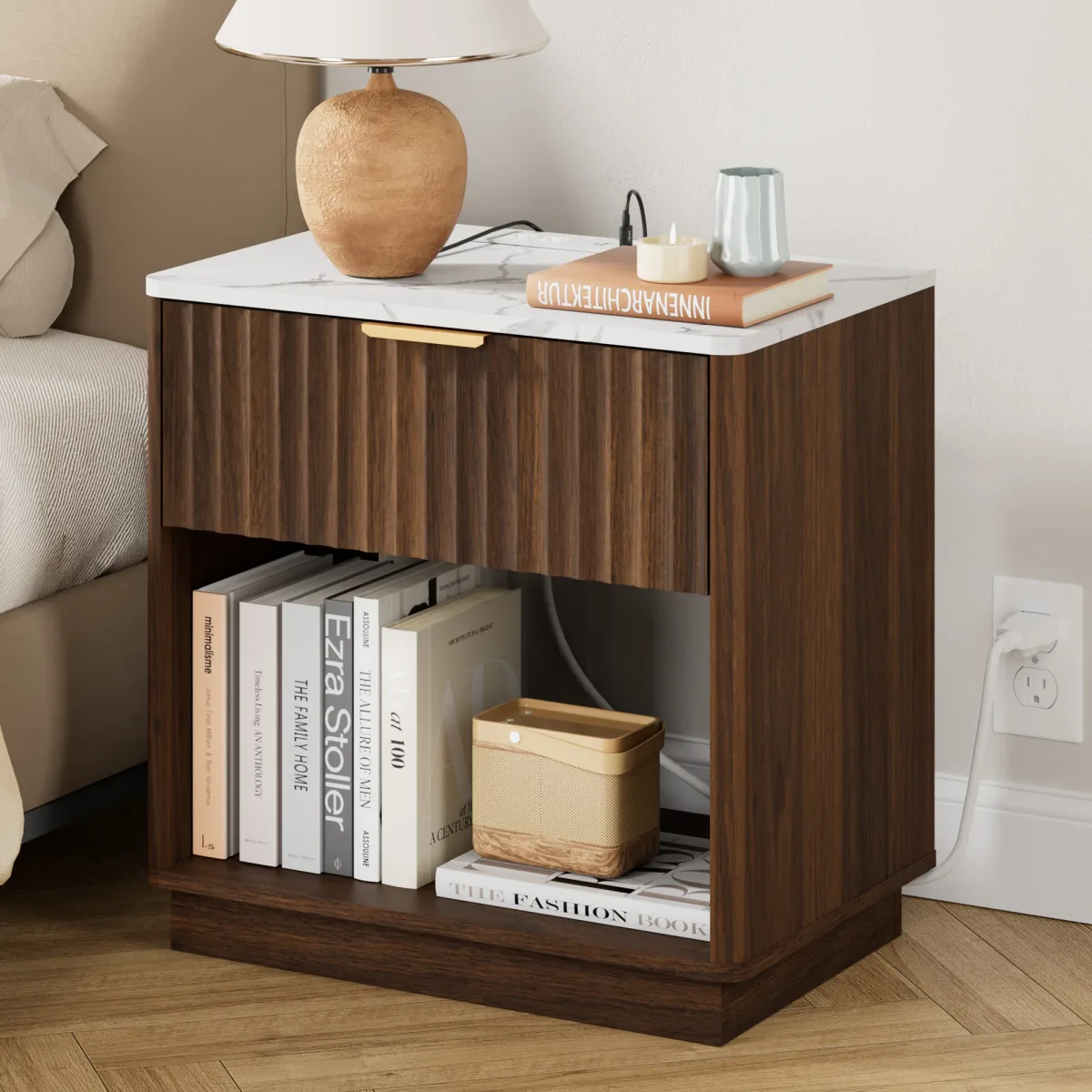
Open-shelf nightstands trade drawers for speed. I specify them for budget hospitality, serviced apartments, student housing, and quick-turn retail.
Open shelves speed up the factory assembly process. They also make our AQL inspections much faster. However, these open designs show daily wear very quickly. Dust covers the flat wood surfaces every single day. Your hotel housekeeping staff will waste precious time cleaning them.
Check sag on wider spans. We run strict stress tests on wide shelves. My team loaded a long shelf with heavy books. The cheap board bent badly in just three months. We logged this failure in our custom PDF audit report.
Now, we force suppliers to use thick plywood. I check against APA panel span ratings and WoodWorks span tables. I now demand 18 mm plywood for any clear span over 18 inches.
🛡️ Our Verdict: Spec open shelf only when daily housekeeping is guaranteed. Skip for extended-stay unless you add a valet tray or small drawer insert.
6. Floating Wall-Mounted Nightstands
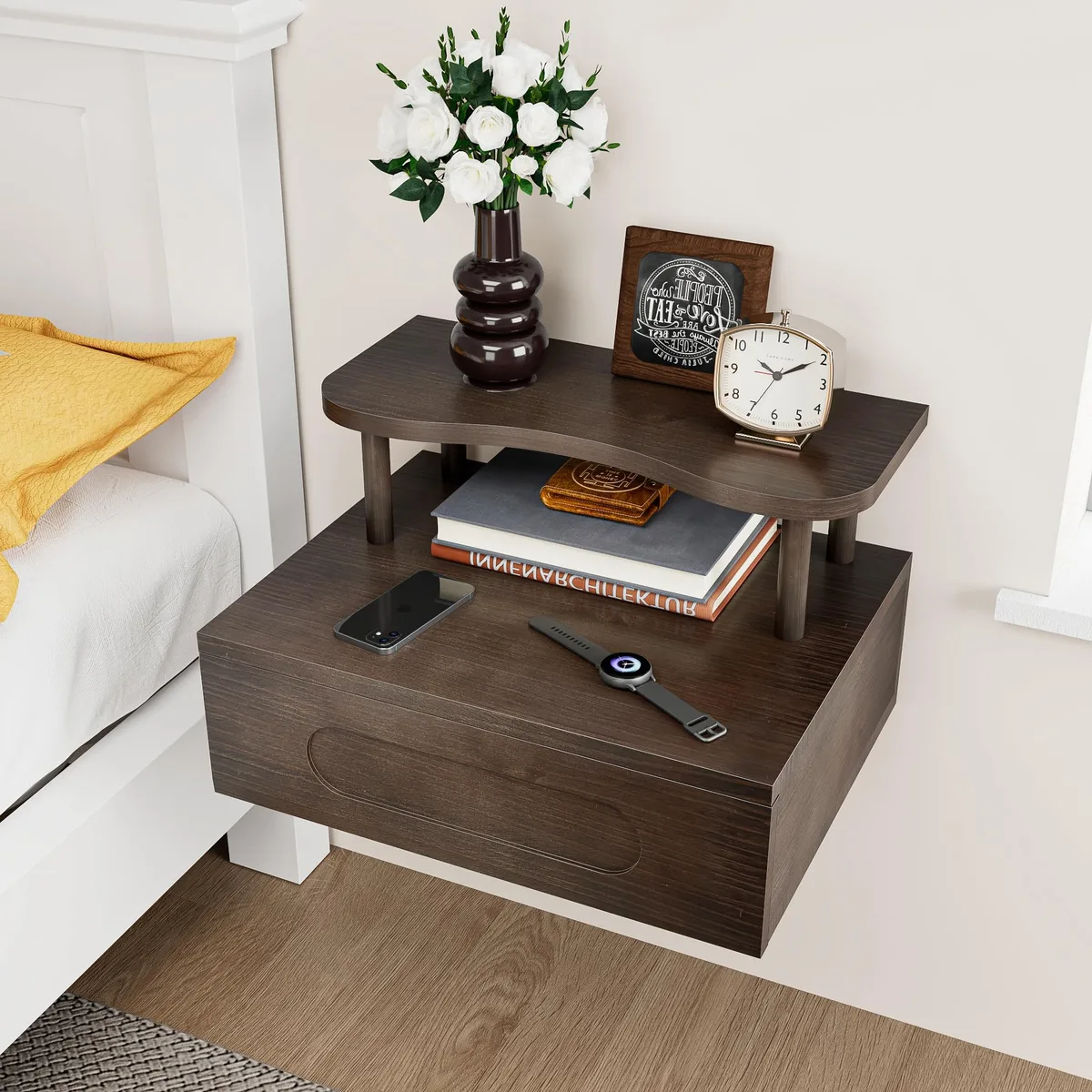
Floating wall-mounted nightstands free floor space and simplify housekeeping. Compact boutique rooms get a lighter visual footprint. Commercial buyers still underestimate site costs.
Wall substrate drives everything. Drywall alone will not hold a loaded unit. You need code-approved blocking or backer board. Installation labor often exceeds furniture cost when studs vary across 200 rooms.
Bracket engineering matters. Cheap powder-coated L-brackets rotate and sag. I spec fixed steel French cleats with anti-tip stops. In one pilot, a 24-inch floating unit sagged 6 mm without backing.
Cable routing needs pre-drilled grommets and a recessed channel. If the wall lacks rough-in, electricity adds hard cost.
🛡️ Our Verdict: I never order this type until the contractor approves wall schematics. Confirm substrate, bracket load, and routing before PO.
7. Pedestal Cabinet Nightstands
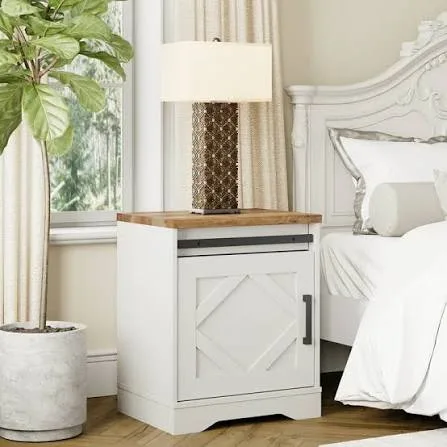
Pedestal cabinet nightstands hide clutter with full-height storage. I spec them for extended-stay and senior living rooms. A closed door keeps personal items out of sight. Housekeeping sees only a clean surface.
Check hinges first. I require three self-closing hinges per door. Two hinges sag within a year. Soft-close or magnetic catches stop slamming. If power runs inside, add a rear vent or 2-inch grommet. Heat kills routers and CPAP machines.
This type eats floor space. Depth runs 16 to 18 inches versus 14 for legged designs. It also feels heavier and harder to clean under.
🛡️ Our Verdict: Spec pedestal only for long-stay or privacy-driven rooms. Skip it in tight guest rooms.
⚡ Power Move: Load a sample door with 5 pounds of shelf weight before bulk ordering. Watch for hinge deflection.
8. Metal-Frame Mixed-Material Nightstands
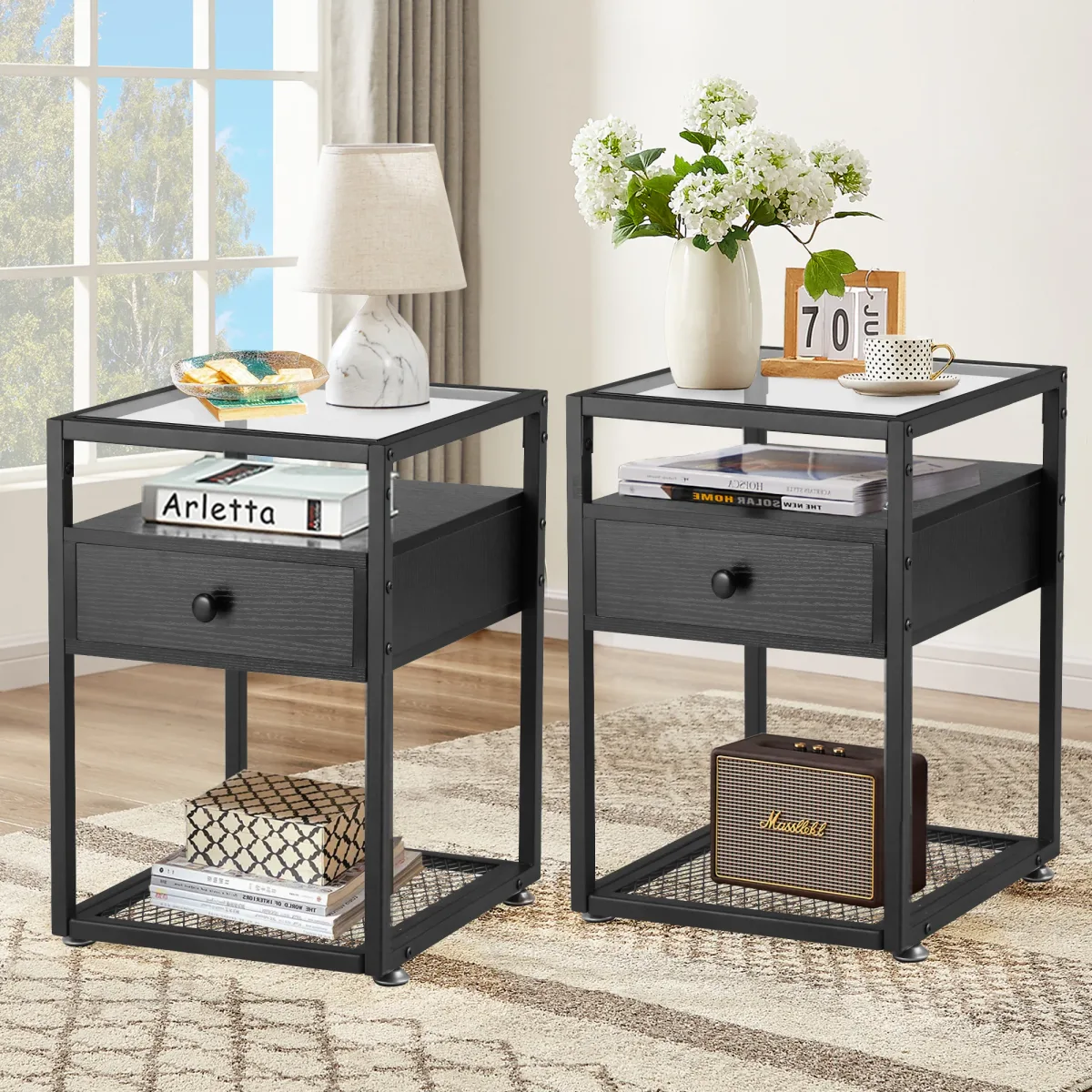
Metal-frame nightstands look clean, but style hides weak welds. I walked the factory floor last week. The sample looked perfect in the photos. But, I saw bad welds up close. Weak joints break fast under hotel use. You must visit the welding line yourself. Do not trust a 3D design file.
I spec these for contemporary brands pairing slim powder-coated steel legs with wood, stone-look, or glass tops. Check weld consistency first. Porosity or undercut weakens joints. Powder-coat adhesion fails fast in coastal humidity.
Coastal hotels quickly degrade low-quality metal frames. To validate durability, samples undergo weeks of salt spray exposure, and a tape test is applied to the paint to assess adhesion. These rigorous tests demonstrate that the finish will endure. Such data is required before any contract is signed.
Top panels must use machine screws into threaded inserts, not wood screws. Mixed materials need tighter tolerances because steel and MDF expand differently. Leveling feet and triangulated joints cut noise and wobble.
🛡️ Our Verdict: A pretty render never saved a hotel claim.
⚡ Power Move: Visit the weld line before you pay.
9. Solid-Wood Premium Nightstands

Solid-wood nightstands earn their premium in luxury guestrooms, boutique hospitality, and retailers selling longevity. I spec oak, walnut, teak, or maple as decision signals, not romance. The Wood Database clarifies each species’ movement and hardness.
Sourcing reality: wood moves with humidity. I require kiln-dried stock at 8-10% moisture content, per USDA Forest Products Laboratory storage guidance. Grain consistency matters on visible fronts. Solid edges repair easier than veneer. A guest scratches a solid top; refinishing is fast. But solid wood adds freight weight.
Use solid for tops, drawer fronts, and edges. Use veneer-faced engineered panels for sides and back to control warp and cost. Spec solid only on touchable surfaces and quote freight before locking species.
Our Verdict: Reserve solid wood for touchable surfaces only. Solid everything raises freight and crack risk.
10. MDF or Veneer Value-Engineered Nightstands

Bulk catalogs lean on MDF and particleboard for a reason. Finish consistency holds. Cost per unit drops 18 to 25 percent versus solid wood.
I still treat engineered boards as a risk product.
The core is stable. The skin is not. Veneer, melamine, and HPL all hide seams differently. Paper foil fails first under hotel wear.
Customs agents will stop bad wood products at the border. You must collect valid emission test reports first. We block any factory that hides their material sources. True edge tape and solid paperwork protect your business. Do this before you ask for a sample. Check edge-banding thickness. Thin tape peels. Screw-holding dies in wet cores.
Repair is limited. Swollen MDF does not sand back. You replace the panel. I bench-tested HPL and paper foil under keys, phones, and hotel disinfectant. HPL won.
Our Verdict: Spec engineered board for volume. Lock in HPL, true edge-banding, and full emissions traceability.
Structural Teardown, Benchmarks, and Engineer Q&A
My team bought nine samples with our own money. We ran dozens of pull tests in our lab. No factory paid us for this review. We share our raw test data openly. You can ask us for the lab reports to see the truth.
Joinery by use case: English dovetail suits solid-wood drawer boxes under hotel abuse. Dowel-and-glue suits veneer carcasses for hidden alignment. Mortise-and-tenon suits solid-wood frames at premium tiers. Confirmat screws suit MDF and particleboard in value-engineered KD lines.
Cam-lock works only for low-stress flat-pack units assembled once or twice. It is the wrong choice for commercial grade nightstands that housekeeping will reassemble, rack, or move more than twice.
Benchmark block:
| Frame Type | Top Load (lbs) | Pull Test (lbs) | Failure Point |
|---|---|---|---|
| Metal-frame | 89 | 43 | Weld shear |
| Solid wood | 132 | 71 | Joint crack |
| MDF | 64 | 38 | Cam-lock pullout |
We loaded 25 lbs on top and pulled drawer fronts sideways. MDF failed first at the connector. Use solid wood for guest rooms with daily abuse. Use MDF for low-touch retail only if you upgrade connectors. Use metal frames only after weld inspection.
Engineer Q&A with Furniture Sourcing Lead Lisa Liao: She said corner crush starts when cartons lack a 2-inch EPS block. Drawer blowout happens when KD units ship with loose hardware. Carton failure drops with full-overlap flaps and edge protectors. She specifies KD for ocean freight above 300 units. She specs assembled units for local installs under 200.
Get our flat-pack damage reduction checklist. To see how factory region and verification standards differ, start with our China vs. Vietnam suppliers guide, then browse the full framework on our homepage.
People Also Ask About Different Types of Nightstands
-
Do nightstands need STURDY / ASTM F2057-23?
We track new furniture safety laws closely. Short bedside tables pass the strict rules easily. Tall units demand heavy tip tests. We force suppliers to meet the newest standards. We protect our clients from huge legal risks.
STURDY covers clothing storage units like dressers. ASTM F2057-23 covers tip-over resistance for those units. I run a voluntary tip test for drawer-heavy units above 30 inches. If your unit stores clothes or sits tall, treat it as a dresser and test to that standard.
-
When is ANSI/BIFMA-style durability testing a useful benchmark for bedside tables?
Use ANSI/BIFMA X5.9 when you write RFPs for hotels, student housing, or senior living. It gives a pass/fail number for drawer cycles, static loads, and racking. I required 50,000 drawer cycles before shipment. It replaces vague “contract grade” claims with hard test data.
-
What MOQ should buyers expect for hotel bedside table manufacturing?
Most factories quote 200 to 500 units for custom hotel nightstands. MDF volume lines require 500 to 1,000 units. I secured 300-unit runs in the off-season (Jan to March) with shared tooling fees. Above 2,000 units, you earn tier pricing and dedicated production slots.
-
How long do mock-up and mass-production stages usually take?
Plan 8 to 12 weeks total. A mock-up takes 2 to 4 weeks after you approve drawings. Tooling adds 1 to 3 weeks for custom metal or solid wood. Mass production runs 4 to 6 weeks after sample sign-off. Add 3 to 4 weeks of ocean freight to US ports.
-
Should I choose solid wood, MDF, or metal-framed construction for commercial use?
My teardown data answers this. Solid wood held 132 lbs top load and 71 lbs pull. MDF failed at 64 lbs and 38 lbs on cam-lock pullout. Metal frames hit 89 lbs top load but failed at weld shear. Choose solid wood for daily abuse. MDF needs HPL tops and upgraded connectors. Spec metal only after weld inspection.
-
Is flat-pack or fully assembled better for export damage control and container economics?
Flat-pack wins for export above 300 rooms. I gained 35% more density and cut freight 22%. Damage control depends on packaging, not format. Require 2-inch EPS blocks, bagged hardware, and a third-reassembly wobble test. Fully assembled fits domestic installs under 200 units.
-
What customization options matter most in hospitality nightstands: USB-C, wireless charging, HPL tops, wire management, or fire/emissions compliance?
Removable charging modules, HPL tops, and emissions paperwork matter most. Glued-in USB modules create scrap when one port dies. HPL outlasts paper foil under hotel disinfectant. CARB Phase 2 and TSCA Title VI docs protect you at customs.
We help brands build safe and strong furniture. You can download our free factory audit checklists right now. Our team uses these exact forms every day. Send us a message if you need help with your supply chain. We want to protect your next order
Conclusion
Nightstands are high-use casegoods, not just decor. Joinery, hardware, surface durability, and packaging drive replacement cost and guest satisfaction.
For most hospitality and multi-unit programs, two-drawer contract-grade or value-engineered nightstands with HPL tops, robust slides, and verified emissions compliance deliver the best balance of durability, cost, and export efficiency. Power-integrated, floating, and premium solid-wood options should be reserved for specific use cases where their added complexity and cost are justified.
If you are planning a hospitality, student housing, or retail rollout and need OEM-ready specifications, factory audit support, or durability test data, discuss your project with the OGPS team.

- Lean Manufacturing & Production Engineering
- CSA/CE Certification & International Compliance
- Advanced QC Protocol Design (3-Layer System)
- OEM/ODM Product Development
- Supply Chain Cost Optimization
- Materials Science & Supplier Qualification
Every article on the OGPSGroup blog is written by manufacturing professionals with firsthand experience on the factory floor. Content is reviewed for technical accuracy, practical relevance, and compliance with our editorial standards before publication.
Learn more about our Fact Checking Process and Editorial Policy.