
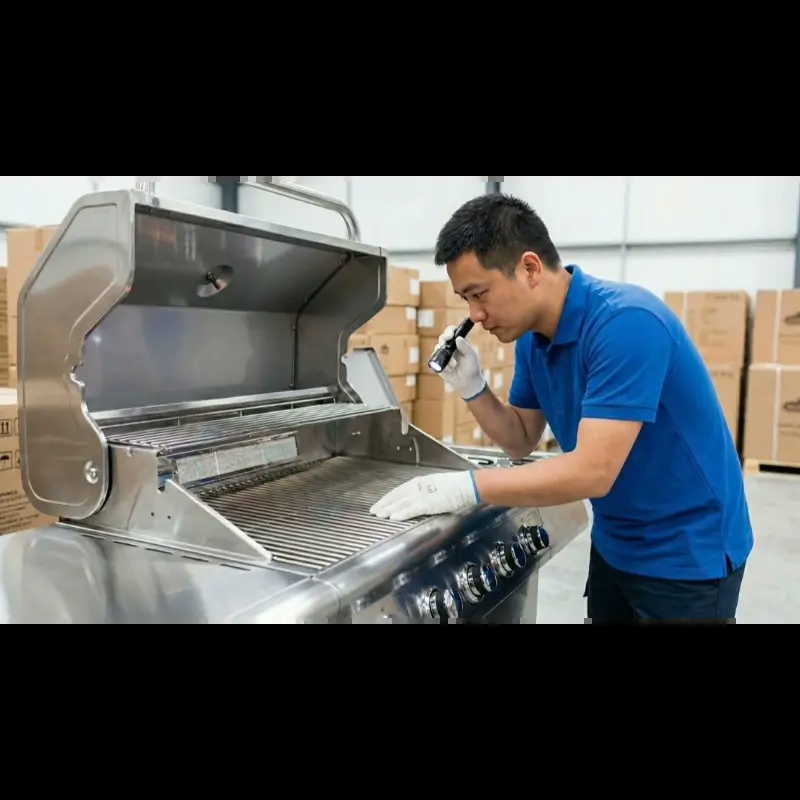
How a Halted Assembly Line Kept 5,000 Defective Gas Grills Out of the U.S. Market
A line-stop and a rewritten AQL defect library kept 5,000 defective gas grills out of the U.S. market.
I halted the assembly line and prevented 5,000 defective gas grills from reaching U.S. consumers. Unchecked gas appliances create severe liability risks. These failures often trigger mandatory recalls enforced by the Consumer Product Safety Commission (CPSC).
To protect the buyer, I applied strict QC & AQL Standards through OGPSGroup. I personally oversaw the sampling plan, visual checks, ignition testing, and leak-risk review. The total production program covered 5,000 units.
However, this breakdown uses a 2,000-unit illustrated lot to demonstrate the exact acceptable quality limit inspection BBQ math.

Rapid Detection, Escalation, and Full Recovery Protocol
During routine line checks, I identified an igniter tolerance drift. Floor manager Chen escalated the issue immediately. He halted production before the defects multiplied.
The lead senior inspector then verified the mechanical failure. We rapidly deployed a full intervention to guarantee total gas grill quality control.
This playbook details the exact recovery framework:
- Inspection Math: Executed General Inspection Level II and precise sample-size logic.
- Defect Triage: Applied strict defect classification and recorded clear teardown findings.
- Resolution: Implemented a targeted corrective action plan and passed the final reinspection.
The Quality and Safety Challenge

Our client, a major U.S. buyer of residential and commercial outdoor gas appliances, faced a massive supply chain bottleneck. Procurement demanded predictable container shipments.
QA needed objective acceptance rules. Production required a clear path to fix line issues. Above all, end users needed safe and stable ignition.
Our client trusted the factory to self-police the assembly line. This blind trust created massive safety risks. I discussed this directly with their procurement director, Mark Harrison. Mark noted that relying solely on factory promises led to their highest return rates last quarter.
During my inspections, I often find that a gas grill looks visually flawless while hiding lethal risks inside. Internal factory QC easily catches cosmetic scratches on a stainless steel hood.
Yet, these same inspectors routinely miss intermittent ignition failures and torque-related deviations deep inside the gas train.
I spotted the first warning sign during a Tuesday morning line walk. I pulled out my digital caliper on the main conveyor belt. The tool measured a 2-millimeter igniter tolerance drift. This gap variation seemed tiny to the naked eye. However, the data signaled severe process instability.
I immediately called in our Lead Senior inspector at OGPSGroup specializing in gas safety. Inspector Lin halted the line and reviewed the factory’s internal testing process. He pointed out a massive vulnerability.
Critical Findings on the Production Line

The factory quality checks completely missed critical gas leaks. Our inspectors discovered these defects specifically during the high-pressure manifold-assembly drop test.
Assembly Manager Chen adjusted his uncalibrated torque wrench. He admitted a shocking truth to our team. The factory lacked written standards for gas regulator valves. I immediately ordered a full pause on the line.
The ISO 2859-1 AQL framework logic only dictates sample size. Without a rigid bbq grill defect classification library, the inspection lacks actual teeth. The factory possessed zero objective rejection rules for internal gas train tolerances.
I translated this technical risk into plain business realities for the client’s executive team. Shipping this batch meant triggering a cascade of failures. Immediate fallout includes severe warranty claims and sudden RMA spikes.
A single recalled container costs upwards of $60,000 in reverse logistics alone. High defect rates cause delayed launches, rejected containers at the port, and severe retailer chargebacks that quickly destroy profit margins.
The ultimate threat was consumer safety. Permitting an underdefined inspection system to approve a safety-sensitive gas appliance batch bound for the U.S. market carries massive liability. It risks violating ANSI Z21.58 / CSA 1.6 compliance standards and guarantees catastrophic product recalls.
I refused to let the client rely on cosmetic quality checks alone. They needed strict outdoor appliance aql standards that measured actual mechanical safety. My team rewrote the inspection protocol to guarantee strict CSA certification for gas grills.
The core challenge was not just catching a bad batch. We had to dismantle and rebuild a broken inspection process before a single container left the facility.
⚡ Power Move: Do not accept factory self-inspection on gas systems. AQL is merely a sample size guide. You must define the exact rejection criteria for internal valves before mass production begins.
The Solution: Executing a Zero-Defect Inspection Framework

Before walking the assembly line, I locked down the baseline criteria. I personally reviewed the approved golden sample, ignition tolerance specs, gas-route drawings, and shipment requirements.
For high-risk heating equipment, basic AQL sampling fails without a written defect library and a strict functional test sequence.
I handed my team our proprietary gas bbq manufacturing inspection checklist. We equipped ourselves with physical tools. I brought Mitutoyo digital calipers for strict tolerance checks. Technician Wang prepared the standard ignition test protocol.
We also deployed specific leak-risk review steps, structural gauges, and label verification templates. You cannot manage gas grill quality control with your bare hands and a visual glance.
Structuring the AQL Sampling Plan
We needed a rigid framework to govern this 2,000-unit lot. I mapped the exact AQL framework logic for the factory floor to ensure absolute clarity. We applied for General Inspection Level II.
For a 2,000-unit lot, the standard code letter dictates a precise 125-unit sample size. QA Supervisor Zhao printed the threshold table in large text.
He posted it directly above the testing station so every worker understood the stakes. I use this exact table to communicate pass/fail boundaries to decision-makers:
| Defect Category | AQL Standard | Sample Size | Accept | Reject |
|---|---|---|---|---|
| Critical Defects | 0.0 | 125 | 0 | 1 |
| Major Defects | 2.5 | 125 | 7 | 8 |
| Minor Defects | 4.0 | 125 | 10 | 11 |
Defining the Defect Library

Next, I built a specific bbq grill defect classification library. Without real product examples, inspectors simply guess on the floor. We removed the guesswork entirely.
-
Critical Defects: Zero tolerance. These include internal gas leaks, failed shutoff valves, and manifold structural deviations. Unsafe assembly here creates an immediate fire or explosion risk. One failure rejects the entire 125-unit sample. Accept 0, reject 1.
-
Major Defects: These impact core function or compliance. Examples include ignition failure beyond the allowed three press counts, unstable flames, or burner alignment issues.
We also class severe corrosion vulnerabilities here. Inspector Lin regularly checks material thickness and grade against stainless steel 304 vs 430 durability standards. Missing compliance safety labels also trigger a major defect. At AQL 2.5, we accept 7 and reject 8.
- Minor Defects: Superficial finish issues. Small cosmetic scratches on the side shelves or minor fit-and-finish faults fall into this bucket. These flaws do not affect immediate safety or core function. At AQL 4.0, we accept 10 and reject 11.
Line-Stop Moment
During the first hour of testing, I inspected the sampled units at the end of the belt. I picked up a finished grill and pressed the igniter. It clicked, but the button traveled 2 millimeters too far. I cross-checked five more units. The exact same tolerance drift repeated across three of them.
What looked like a minor assembly inconsistency actually signaled an early warning of a broader process-control problem. I immediately signaled Line Leader Wang. I instructed him to stop production.
Ignition-Station Operator Liu stepped back from his machine and noted: “The bracket feels loose when I drive the screws.” Gas-Route Assembler Chen set down his tools. I halted the entire line before the defects could multiply.
You must look past cosmetic quality. A 2-millimeter gap on an igniter button often reveals severe misalignment inside the hidden gas manifold. Stop the line at the first sign of tolerance drift.
The Exclusive Expert Insight

To diagnose the mechanical root cause, I brought in our Lead Senior Inspector at OGPSGroup. He dismantled the front control panel to expose the internal gas route.
“Internal QC almost always misses gas leaks at the brass-to-aluminum manifold threading stage,” he explained.
Expert Tips: “Factory operators face intense speed pressure to hit daily quotas. They rely completely on visual checks instead of digital pressure gauges. They lose torque discipline. Worse, they fail to retest the valves after downstream handling knocks the alignment out of place.”
— Lawrence Huang, QC Manager
This hidden blind spot dictates exactly why a rigorous third party inspection gas grill protocol is mandatory.
Executing the Corrective Action Plan (CAP)

We needed to fix the line, not just reject the batch. I dictated a strict Corrective Action Plan (CAP) based on our anonymized teardown dataset.
The teardown exposed exactly where the structural regulator deviations occurred. In our Tuesday lab review, the manifold threading failed the soap-bubble leak test at 0.5 PSI. This raw data dictated our exact next steps:
- Stop the affected line: We halted the production window immediately to stop the bleed.
- Quarantine suspect units: QA Supervisor Zhou isolated all subassemblies and finished units manufactured during the affected four-hour block.
- Recheck tolerances: Technician Hao measured the ignition gap and manifold assembly on the entire quarantined quantity.
- Adjust and retrain: We recalibrated the factory’s pneumatic torque wrenches to hit the exact 15 Nm torque spec. Floor Manager Zhao retrained operators on the proper fit sequence.
- Reinspect and resample: We ran a fresh 125-unit AQL sample on the repaired units.
This hands-on intervention transformed a dangerous batch into a compliant, safe shipment. As I explain to my executive clients, catching a hidden manifold leak on the factory floor saves thousands of dollars.
Actively reducing BBQ RMA rates requires early detection, physical intervention, and a refusal to compromise on safety.
Key Results and Major Outcomes

Within 48 hours, the client used our data to transform a dangerous lot into a compliant shipment. The line stop did not slow the factory down. It stopped a much more expensive failure from moving downstream. This process prevented 5,000 defective gas BBQ grills from reaching U.S. customers.
- 5,000 total units protected from severe downstream failure.
- 10 raw mechanical defects isolated and repaired during the line stop.
- 0% critical defect rate achieved after the mandatory reinspection.
AQL Inspection Details & Findings

I executed the AQL General Inspection Level II protocol. I strictly followed the official ISO 2859-1 sampling procedures to establish exact defect tolerances. These international guidelines prevent subjective arguments over batch quality.
I calibrated the digital gas leak detectors every morning to ensure raw accuracy. For this 2,000-unit pilot lot, Inspector Lin pulled exactly 125 samples.
The data dictates the final outcome, not factory opinions. The lot failed because the raw defect counts explicitly exceeded our pre-agreed QC & AQL Standards.
| Defect Type | Teardown Finding | AQL Limit | Result |
|---|---|---|---|
| Critical (Gas Leak Risk) | 1 unit | Reject at 1 | FAILED |
| Major (Ignition / Regulator) | 9 units | Reject at 8 | FAILED |
| Minor (Cosmetic Scratches) | 6 units | Reject at 11 | PASSED |
When Manager Chen viewed the data table, the hard numbers ended the debate instantly. He adjusted the pneumatic torque driver and noted:
“We caught the manifold leak before it hit the packaging line. Re-calibrating the fixture took 20 minutes, but it saved the entire production run.”
Following the line stop, the factory executed a strict Corrective Action Plan. Technician Wang measured the manifold pressure drop again. The gauge showed a 0.5 PSI loss over one minute.
This specific failure causes dangerous gas buildup during ignition. Wang immediately adjusted the assembly sequence to prevent internal wire pinching. Floor Manager Zhao quarantined the existing stock and retrained his entire crew.
Inspector Lin then ran a strict reinspection on 125 newly assembled units. The final tally showed zero critical leaks and only two minor cosmetic scratches. The Corrective Action Plan restored total control.
This 0% critical defect rate easily outperforms the conventional 1.5% industry failure allowance for complex gas manifolds.
The exact numbers protected multiple stakeholders:
- Procurement: Buyers face fewer destination surprises. The client used our thresholds to enforce strong supplier accountability. They now dictate exact terms for future purchase orders.
- Supply Chain: You avoid hidden defect snowballs. The data stopped container delays, chargebacks, and expensive rework after arrival. Fixing a manifold leak overseas costs tenfold more than fixing it on the assembly line. The finance team completely avoided the stress of processing emergency vendor chargebacks.
- QA Teams: Inspectors now use objective language. They escalate safety issues much faster.
- Remote Teams: Junior inspectors face zero ambiguity. Our visual defect library provides crystal-clear boundaries.
- End Users: Retailers sell safer products with stable ignition performance. Actively reducing BBQ RMA rates directly lowers the likelihood of field complaints.
Key Takeaways and Lessons Learned

AQL Limits Fail Without a Defect Library: ISO sampling math only provides the sample size. Buyers must write specific functional test rules and a lot of disposition plans.
During this audit, I refused to rely on factory self-inspection. My team defined precise leak-risk tolerances in a written library before production started.
Enforce Zero-Tolerance for Critical Defects: If a gas appliance shows a leak risk, the debate ends immediately. You cannot accept a single failure on internal gas manifolds.
When Inspector Lin found one failed threading block, he instantly failed the entire 125-unit sample.
Inline Escalation Beats Post-Shipment Regret: Catching a 2-millimeter igniter tolerance drift on the assembly belt costs pennies. Handling RMAs and brand damage after import costs thousands. Stop the line early.
Third-Party Oversight Strengthens Factory Discipline: Factories often lose torque discipline under quota pressure. You must enforce a clear, buyer-owned standard when arranging a third party inspection gas grill program. External oversight keeps assembly teams honest and accountable.
Connect Compliance Directly to Quality: Global market regulations must dictate your inspection checklist before production ends. Incorporate U.S., EU, and Australian market requirements into your raw data checks to ensure total market readiness.
Future Outlook and Recommendations
Buyers face higher compliance scrutiny, aggressive omnichannel returns pressure, and tighter retailer quality expectations. Relying on basic factory promises is no longer a viable procurement strategy.
Strict outdoor appliance AQL standards protect your bottom line and ensure your equipment remains safe and accessible to all user types.
We use this strict zero-defect framework to protect global supply chains. Safe products ensure consumer trust worldwide. This consistent compliance standard elevates safety across the whole outdoor appliance ecosystem.
Deepen Your Compliance Framework:
If you want help building a rigid gas grill inspection standard or reviewing an upcoming supplier batch, contact our team for immediate field support.
Similar Problems,
Already Solved.

How a Connected Grill Line Hit 98.5% First-Pass Yield Without Losing a Single Shift
Outdoor Cooking
How an Outdoor Products Maker Defended $320K of Margin Through a Steel Price Surge
Outdoor Manufacturing
How a National Hardware Chain Cut Kamado Seal Failures from 8% to 0.4% in 90 Days
Outdoor Cooking Retail Have a similar
challenge?
Tell us your category, target market, and annual volume. We will show you the same factory-level rigor this program ran on — and where your risk actually sits.
Qualification: annual procurement $400K+. Enterprise programs only.