Disclosure. OGPSGroup is a China-based sourcing and manufacturing partner for outdoor-living brands. We do not manufacture, own, or represent any company listed on this page, and no company has paid for inclusion or ranking. Every entry below is compiled from public materials — the manufacturer’s own website, its Companies House record, and published catalogues — and each entry states its source and access date. Where a claim could not be verified, it is left out. Manufacturers may submit corrections with supporting documents.
A coastal patio destroys thin steel in a single winter. A fixed masonry opening is measured before anyone quotes a grill. A charcoal menu needs a builder who understands heat, airflow and extraction. For a procurement buyer the useful question is not “which grill is best” but “which UK maker fits this brief, at what lead time, for what money.”
This is a shortlist of 7 UK charcoal grill manufacturers that build charcoal-first products in the UK, followed by 2 gas and hybrid systems that are frequently grouped with them but are not charcoal-first. For the wider category — gas, pellet, kamado and portable — see our BBQ grill manufacturers hub.
List of 7 UK Charcoal Grill Manufacturers
| Manufacturer | Location | Build & material | Key models |
|---|---|---|---|
| Ox Grills | Stratford-upon-Avon | 316 stainless; hand-built live-fire | Argentine and Santa Maria grills |
| Somerset Grill Co | Somerset | 304 stainless V-grills; mild-steel Asado | Asado Gunmetal, Grande, Asado GO! |
| Wildpyre | Nottinghamshire | Fabricated stainless steel | Asado and Parrilla grills, fire tables |
| Kasai | UK | British stainless frame, clay/vermiculite lining | Konro and Shichirin (Nano to XL) |
| Blok | Derby (Little Eaton) | Vermiculite lining; high-carbon steel surface | NAKA, KITA, HAKO, Baby Q |
| Trailblazer BBQ | Northern Ireland | Stainless steel; towable chassis | 350 / 600 / 1200 Streetmaster trailers |
| Dolphin Fabrications | Sheffield | 304 and 430 stainless | Bespoke grills + DW/172 canopies |
Two further names appear under charcoal searches but build gas-first systems. They are listed separately below so the two categories are not confused.
1. Ox Grills

What it makes. Argentine and Santa Maria-style live-fire grills for restaurants and residential kitchens, hand-built in Stratford-upon-Avon by Ox Grills Limited (Companies House 09443946, incorporated 2015). The units use a dynamic raise-and-lower grill bed and marine-grade 316 stainless steel — the molybdenum-bearing grade that resists salt-air corrosion on exposed coastal sites, as explained in our stainless steel comparison guide. (Source: oxgrills.com; Companies House 09443946; accessed 2026-10-16.)
Where it fits. Chef-led open-fire concepts and marine or coastal hospitality, where equipment sits outside all year and a failed frame is a re-purchase rather than a repair.
What to lock down before quoting. Ask for TIG weld close-ups and a material-grade certificate. This is a small workshop, so capacity and lead time are finite — confirm both before you commit a project schedule.
2. Somerset Grill Co

The build model. Hand-made Asado-style grills with a height-adjustable grate and a rear ember maker, built in a South Somerset workshop by The Somerset Grill Company Ltd (Companies House 11373134) and shipped fully assembled. (Source: somersetgrill.com; Companies House 11373134; accessed 2026-10-16.)
The trade-off. These burn wood and charcoal, and live fire behaves differently from a gas burner: more sudden smoke, heavier ash, and an airflow the kitchen has to learn to control. Plan a daily ash routine and brief the team before you buy — and read our charcoal vs gas grill breakdown for the fuel trade-offs.
Before you buy. Fully assembled delivery pays off on a tight installation window, because it removes a day of on-site assembly labour. Compare formats in our types of BBQ grills guide.
Connect with Somerset Grill Co
3. Wildpyre

Why it is on this list. Wildpyre Limited (Companies House 13714618, incorporated 2021) fabricates steel grills and fire tables in Nottinghamshire, precision-cutting and assembling its own stainless steel parts. The range runs from compact domestic grills to large commercial fire tables, in Asado and Parrilla formats. (Source: Companies House 13714618; UK trade press; accessed 2026-10-16.)
The custom path. Because the parts are cut and fabricated in-house rather than imported, size and configuration can be adapted to a fixed masonry opening — useful when an architect has already set the dimensions and every other quote is off-the-shelf.
Get the paperwork right. On a bespoke build, agree who owns the drawings before any steel is cut. Never leave intellectual property to chance: demand a drawing approval and a tolerance sign-off.
4. Kasai

The format. Kasai builds Japanese-inspired Konro and Shichirin charcoal grills in a stainless steel frame with clay or vermiculite linings, designed in the UK and made with British stainless steel. The lining reflects heat back onto the coals, so the grill sears at high temperature on very little fuel. (Source: kasaigrills.com; accessed 2026-10-16.)
What the design solves. A Konro box reaches its working range quickly, and the insulated body keeps the outer steel cool enough to work around. That makes it a strong fit for yakitori and focused sear menus.
The limit. The cooking surface is narrow by design. Binchotan-style coal beds run hot — published figures put the searing zone in the region of 750–900 °C — but the format cannot match a wide grate for high-volume steak prep. Compare how extreme heat treats different metals in our cast iron vs stainless steel grates guide. If your menu needs broad-surface bulk cooking, this is not it.
5. Blok
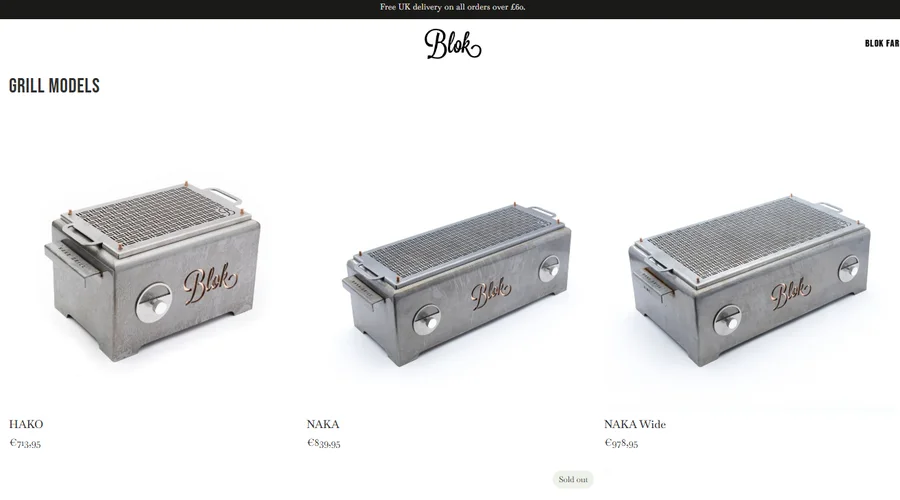
The range. Blok hand-builds charcoal grills at its Little Eaton, Derby workshop — the Japanese-inspired NAKA table grill, the larger KITA workhorse (about 1 m, serving 10 to 12), and the compact HAKO and Baby Q. Bodies use vermiculite linings with high-carbon steel cooking surfaces. (Source: blok-knives.co.uk and UK trade press; accessed 2026-10-16.)
Best for. Smaller rooms and menu-led concepts that want genuine konro performance without a full commercial footprint. The tabletop range runs from about €714 (HAKO) to €979 (NAKA Wide), with a portable Baby Q below it and the larger KITA scaling into light commercial service.
Why the guarantee matters. Every unit carries a five-year manufacturer’s guarantee — unusual for a hand-built steel grill, and the number to weigh when you compare total cost of ownership against an imported box of the same size.
6. Trailblazer BBQ

The use case. Trailblazer builds towable commercial charcoal BBQ trailers and smokers in Northern Ireland for mobile and event catering. The units are built for large batch volumes — the manufacturer quotes throughput of up to 1,200 burgers an hour on its larger trailers — and ship fully assembled. (Source: trailblazerbbq.com; accessed 2026-10-16.)
Road legality. A towed catering trailer is a vehicle, not kitchen equipment. Trailblazer states that its trailers hold Whole Vehicle Type Approval and are classified Category O1, i.e. towable on a standard UK driving licence. Confirm the specifics of your configuration against the UK towing weight and width limits before ordering.
Treat it like a fleet purchase. Plan winter storage and suspension maintenance. A chassis that survives highway vibration is the whole point — ask how the frame is welded, because continuous road vibration is what fails a standard weld.
7. Dolphin Fabrications

What it actually is. Dolphin Catering Fabrications is a Sheffield-based commercial catering fabrication and ventilation specialist. It designs and builds bespoke stainless steel kitchen equipment and extraction systems, and fabricates charcoal grills as part of a wider fit-out rather than as a stand-alone grill brand. It works in 304 and 430 stainless steel. (Source: dolphinfabrications.co.uk; accessed 2026-10-16.)
Why buyers pair with it. A large charcoal grill is useless if the room fails its ventilation inspection. Dolphin engineers the canopy and airflow as part of the same fabrication, so a buyer avoids coordinating a separate grill vendor and a separate extraction vendor.
The material note. 430 covers dry, standard indoor setups; specify 316 for coastal or wet environments, and ask for the test report behind any corrosion claim rather than a verbal assurance. The next section explains what that report should contain.
Connect with Dolphin Fabrications
Gas and hybrid systems buyers also shortlist
These two are frequently grouped with charcoal brands, but both build gas-first systems. Charcoal is an accessory or an insert, not the core product.
| Manufacturer | Location | What it builds | Charcoal role |
|---|---|---|---|
| Cinders Barbecues | Lancashire | Commercial LPG gas barbecues | None — gas only |
| Draco Grills | UK (design) | Modular outdoor kitchens; gas kamado and 6-burner gas BBQs | Drop-in charcoal tray on selected 4-burner models |
Cinders Barbecues has manufactured barbecues at its Bentham, Lancashire factory for over 35 years and does not produce a charcoal range — its commercial line is LPG. It belongs on a shortlist where operational speed and lower morning labour beat smoky flavour; it does not belong on a charcoal list. If gas is the direction, see our UK gas BBQ grill manufacturer page.
Draco Grills is a modular gas system. The charcoal option is a drop-in tray that fits selected 4-burner models. Treat it as a secondary accessory: verify exact model compatibility and secure replacement-part support for the tray, because a drop-in insert sees more heat than the chassis around it was designed for.
Made in the UK, or sourced from China?
Both routes are legitimate, and the deciding factor is usually volume rather than quality. A UK workshop earns its place when you need one bespoke piece, a fast replacement, or a British-made claim on the label. A China-based OEM earns its place when the product is fully specified, the volume is high, and the unit cost curve matters more than the per-unit lead time.
| Decision factor | UK maker | China-based OEM |
|---|---|---|
| Minimum order | Often a single unit | Set per SKU, usually in volume |
| Tooling | Custom fabrication priced per job | Fabrication tooling amortised across the run |
| Lead time | Workshop capacity; weeks per unit | Sample, then bulk after the PO, plus sea freight |
| Unit cost at volume | Stays close to the labour cost | Falls sharply as volume rises |
| Custom design | Drawing-level, one-off | Drawing-level, repeatable |
| Certification | Product must meet UK/EU rules (UKCA / CE, GPSR) | Same rules — verify with the test report |
| Best when | Low volume, high specification, fast turnaround | High volume, fixed specification, cost-led |
Quote against landed cost, not ex-works price. A UK quote is usually delivered and assembled; a China-based quote is normally ex-works, so add tooling amortisation, quality control, freight, duty and the working capital tied up in a container before you compare. On that basis the two routes often land closer than the headline numbers suggest, and the gap narrows further as the specification rises. Our China charcoal grill manufacturer guide covers the sourcing side, and the BBQ import guide covers duty, freight and payment terms.
How to Vet UK Charcoal Grill Manufacturers?
Step 1: Run an AQL final inspection
Agree a sampling plan before the container loads. For grill bodies, the ISO 2859-1 AQL 2.5/4.0 scheme separates major structural failures (weld consistency, grate flatness, chassis alignment) from minor cosmetic defects (finish marks), and also covers fastener completeness and packaging integrity. Write the acceptance class into the PO — our BBQ grill AQL standards guide sets out the defect classes we apply.
Step 2: Read a salt-spray report properly
Salt destroys cheap metal, so a corrosion claim should arrive with evidence, not adjectives. A credible salt-spray report states, at minimum:
- the standard used (ISO 9227 or ASTM B117)
- the test duration in hours and the salt concentration
- the exact steel grade of the sample and where the sample came from
- the testing laboratory and the date of the test
- the acceptance criterion, plus photos of the result
OGPSGroup did not commission any salt-spray test for this page. Where a manufacturer has not published a report, treat its corrosion claim as unverified.
Step 3: Follow the 5-point checklist
Use this checklist with any grill supplier, or start with our how to choose a grill manufacturer guide:
- Confirm the fuel. Charcoal-first, or a gas unit with a charcoal insert?
- Confirm the safety standard. Ask which edition of BS EN 1860-1 the product is tested to.
- Verify the steel grade. Get the grade in writing (304 / 316 / 430) and match it to the environment.
- Protect IP. On custom builds, fix drawing ownership and approval before cutting steel.
- Check ventilation. Decide early whether the room needs a custom extraction canopy.
Need help running this on a supplier? Visit our contact page.
People Also Ask About UK Charcoal Grill Manufacturers
1. Which of these are truly charcoal-first?
Ox Grills, Somerset Grill Co, Wildpyre, Kasai, Blok, Trailblazer and Dolphin build charcoal-fired products. Cinders and Draco build gas-first systems where charcoal is secondary or absent. For an intense charcoal menu, specify one of the seven.
2. Is BS EN 1860-1 the main standard I should ask about?
It is the key one for solid-fuel barbecues. BS EN 1860-1:2024, published by BSI, sets the safety, construction, marking and test requirements for barbecues that burn solid fuel. Note carefully what it is and is not: it is a harmonised standard that supports the EU/UK General Product Safety Regulation (GPSR) — a presumption-of-conformity route, not a licence. Separately, any surface or accessory that touches food falls under food-contact materials law: the EU framework regulation (EC) No 1935/2004, and in the UK the Materials and Articles in Contact with Food Regulations 2012. Germany’s LFGB is a national requirement that applies on top for that market. Ask for the specific certificate, not the standard’s name — our BBQ certification guide lists the documents to request.
3. When should I specify 304, 316 or avoid 430?
Use 316 for coastal and wet sites — its molybdenum content is what resists chloride pitting. Use 304 for dry inland and indoor applications. 430 is the entry grade: acceptable for sheltered indoor use, the wrong choice for an exposed outdoor frame, where it will corrode faster.
4. Do I need canopy or extraction planning for a commercial charcoal install?
Yes. An enclosed commercial grill needs designed extraction, and in the UK that is normally built around DW/172. Treat the canopy as part of the grill specification, not an afterthought: decide it before the grill is fabricated so one supplier owns the fit.
5. Is a gas/hybrid platform acceptable if I only cook over charcoal occasionally?
Yes. A gas unit with an optional charcoal tray covers light charcoal use without the daily fire-lighting labour. Just confirm the tray fits the exact model you are buying, and check that the chassis is rated for the heat the tray adds.
6. What is the difference between an Asado, a Parrilla and a Konro grill?
A Parrilla is the hinged iron grate that holds the food over the coals. An Asado is the wider live-fire build around it — a raised firebox, an ember rake and a height-adjustable grate. A Konro (and its smaller relative, the Shichirin) is the Japanese version: a compact insulated box that concentrates heat into a narrow searing surface. If your menu is whole cuts and long live-fire service, look at the Asado and Parrilla builders. If it is skewers, yakitori or focused searing, a Konro is the right format.
7. What warranty should I expect on a UK-built charcoal grill?
It varies with the build, so get it in writing before you order. In this shortlist the stated terms range from 12 months on Trailblazer’s commercial trailers, through 1 to 2 years on Kasai’s Konro grills, to five years on Blok’s hand-built units. A long structural guarantee on a hand-made steel product is a good signal, but check what it covers — the chassis and liners, or just the fixings.
8. How do I verify a maker actually builds in the UK?
Three checks. First, look the company up on Companies House and read the registered address and SIC code — a manufacturing code with a live filing history is a good sign. Second, look for a Made in Britain listing or an equivalent membership. Third, ask for the production address rather than the registered office, and confirm the unit is fabricated there. A brand that builds overseas but sells from a UK office will usually make that clear when you ask directly.
What this page does not cover
- It covers commercial and hospitality charcoal grills. The consumer kettle and kamado market — Weber, Big Green Egg, Kamado Joe and similar — is a different category and is not ranked here.
- It lists makers with a UK base. It is a working shortlist, not a global ranking.
- No grill was independently tested for this page. Every fact comes from the source named in its entry, accessed 2026-10-16.
- Two of the names are not dedicated grill brands: Dolphin builds grills inside a wider kitchen-fabrication scope, and Cinders and Draco are gas-first systems where charcoal is secondary or absent.

- Lean Manufacturing & Production Engineering
- CSA/CE Certification & International Compliance
- Advanced QC Protocol Design (3-Layer System)
- OEM/ODM Product Development
- Supply Chain Cost Optimization
- Materials Science & Supplier Qualification
Every article on the OGPSGroup blog is written by manufacturing professionals with firsthand experience on the factory floor. Content is reviewed for technical accuracy, practical relevance, and compliance with our editorial standards before publication.
Learn more about our Fact Checking Process and Editorial Policy.