Qualifying a gas appliance is highly complex. To build this BBQ Certification Guide, I interviewed our Lead Compliance Engineer, referenced the OGPSGroup audit checklist, and tore down a non-compliant shipment.
I know what credible compliance feels like. It requires a complete file set, legible data plate drafts, clean weld photos, and consistent valve documentation. Vague PDF screenshots fail mandatory audits.
This framework aligns with CSA Group standards and forces market scoping before third-party lab spend. It actively controls design, listing ownership, and mass-production drift across engineering, QA, and sourcing.
The BBQ Certification Guide helps you qualify a gas grill hub for North America, the EU, or a dual-market launch. We describe every flowchart decision box in text. Move from supplier quote to a certifiable, shippable product without guessing. Check our BBQ grill category for our baseline.
The 7 Steps to BBQ Certification
Time: 1 week (document collection), 3-6 months (lab booking).
Owners: Sourcing manager, QA director, factory engineer, compliance contact, third-party lab coordinator.
When I audit a CSA gas grill certification file, complete pre-test documentation has a distinct physical presence on the table. I demand:
- Market Specs: Target market, appliance type, gas family, and pressure rating.
- Engineering Data: Dated drawings, revision-controlled BOMs, exploded views, and regulator specs.
- Draft Assets: Crisp label artwork, user manuals, and carton markings.
- Historical Records: Prior test reports from your BBQ supplier checklist.
Compliance Boundaries:
- Lock the market: Do not send a sample until you finalize the destination.
- Verify the gas: Never test the wrong gas family. Match the pressure regime strictly to the ANSI/CSA standard or EU Gas Appliances Regulation.
- Demand raw data: Never rely on a certificate screenshot. Read how to choose a grill manufacturer.
⚠️ Safety First: ISO 9001 is a management framework, not a grill safety listing. Treat it as a process metric, never a product guarantee.
1. Lock the Market Destination and Appliance Class
Select your primary market. For North America, adhere to the official ANSI/CSA Z21.58-22 scope. For the EU, navigate Regulation (EU) 2016/426 via a Notified Body.
Classify your grill strictly as portable, stationary, built-in, or RV-mounted. A wrong scope sends your sample down the wrong testing pathway, creates severe labeling errors, and invalidates timelines.
You will feel immediate relief when the model name, use case, and market route finally match perfectly across the quote sheet, CAD drawings, and label draft.
Accessibility Note: This matrix aligns target markets with mandatory standards and permitted classes
| Target Market | Conformity Pathway | Permitted Appliance Classes |
|---|---|---|
| North America | ANSI/CSA Z21.58-22 | Portable, Stationary, Built-in, RV-mounted |
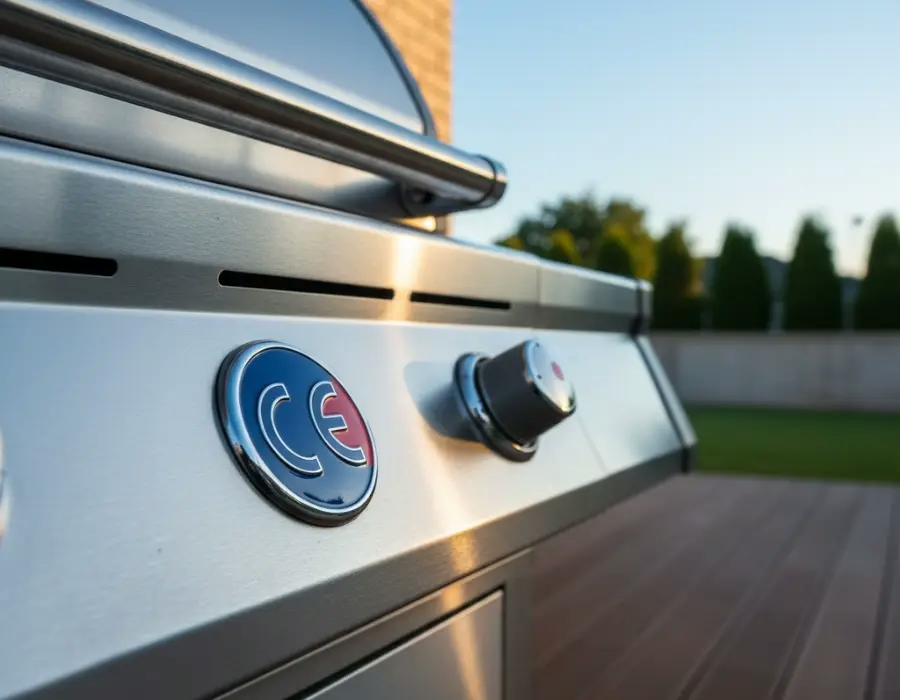
| EU | CE (EU) 2016/426 | Portable, Stationary, Built-in, RV-mounted |
⚠️ Experience Warning: Last year, a client labeled a built-in grill as “stationary” to dodge combustible-enclosure testing. The lab rejected it, adding 45 days and $4,200 in re-testing fees. Define your class honestly.
2. Freeze the Certified Configuration
Procurement fails when an “almost right” grill has mismatched data plates. Natural-gas and LP versions require separate handling. Freeze the exact certified configuration before sampling.
- Confirm the gas family. The ANSI/CSA scope covers natural, mixed, and LP gases with inlet pressures under 1/2 psi.
- Verify the paperwork. I compare the regulator spec, manifold drawing, injector data, and label language line by line.
- Match the Regulator Model, Hose Set, Manifold, Injectors/Orifices, Control Valves, Burner Count, Ignition Type, and Installation Style against the original BBQ Certification file.
- Create a freeze checklist. Mandate signatures from sourcing, QA, and the factory engineer.
- Run a sensory check. A trustworthy file feels technically congruent. The stamped text on the metal rating plate must physically match the valve tag pressure callouts. Reject handwritten regulator swaps or crossed-out BTU values.
Note: ISO 9001 proves a factory quality system, not the grill model certification.
Expert Take: Factory Engineer Chen warned us during a final sign-off: “Swapping a 1.2mm orifice for a 1.0mm without updating the data plate instantly voids the CSA listing.”
3. Request the Full Technical File

Request the full technical file before booking a lab or approving tooling spend. Labs test one perfect sample, but you approve a repeatable factory system.
Demand a revision log and document index to prevent silent component swaps. Collect these exact documents: revision-controlled drawings, BOM, materials list, gas-path schematic, electrical controls, labels, user manual, carton marks, and factory quality records.
Sensory Check: In my experience, a mature file feels cohesive. Look for clean drawing titles, consistent part numbers, and photo evidence that matches the BOM perfectly.
OGPSGroup Vendor Audit Checklist (Floor Inspection):
- Welds: Run your glove over the bead. It must be continuous, even, and free from obvious burn-through or undercut.
- Valve Assemblies: Verify square seating. Ensure zero visible strain on fittings or hose routing.
- Burner Alignment: Check for consistent gaps. Reject rubbing or loose fits.
Consult the official ANSI/CSA Z21.58 standard for gas compliance. Log findings in your BBQ supplier checklist to enforce strict BBQ grill AQL standards.
Expert Take: Last May, Quality Manager Huang handed me a file with mismatched valve part numbers. We halted the audit immediately. Disorganized paperwork always predicts production failure.
4. Run a Pre-Test Engineering Review
Execute an engineering review before submitting your sample. If you lack an in-house team, hire a third-party assessment firm.
Lead Compliance Engineer Zhao told me: “We catch 80% of failures on the drafting table.” Review your design against official ANSI Z21.58 standards using three buckets:
- Gas-Path Integrity: Turn the knobs. Reject valve alignments that feel forced. Forced valves cause leakage.
- Enclosure Ventilation: Inspect for uneven vent geometry or overly tight hot-zone shielding. The current edition prohibits front ventilation on portable grills and demands larger built-in vents. You must also pass 10 mph wind tests, low-temperature rules, and Annex B smart-device coverage.
- Labeling Mismatches: Verify your artwork matches the exact tested fuel type.
Require engineering sign-off before building the sample.
| Risk Found | Likely Redesign | Cost: Now vs. Lab |
|---|---|---|
| Forced valve | Adjust bracket | $0 vs. $3,500 |
| Front vents | Relocate to sides | $0 vs. $5,000 |
| Wrong fuel | Update artwork | $0 vs. Rejection |
Experience Warning: During a recent pre-screen, Zhao caught a bracket forcing a valve into a 2-degree tilt. That flaw guarantees gas leaks during transit. Catching it early saved our client $3,500.
5. Select the Testing Body and Submit Your Sample
I treat this as a strategic procurement decision. Choose the third-party body matching your destination market and appliance scope.
For North America, select a recognized NRTL. Use the CSA Group certification scheme, UL Product iQ, or the Intertek ETL directory strictly as a lab-selection framework. Refer to our BBQ Certification Guide for detailed NRTL comparison tables and cost benchmarks.
For the EU, CE marking under Regulation (EU) 2016/426 requires conformity assessment with a Notified Body and a technical documentation package. Download the BBQ Certification Guide for the complete EU technical file checklist and Notified Body selection matrix.
Compile your physical submission. Include the sample identification, revision code, BOM, drawings, labels, manual, packaging, and deviation log. Verify your sample, packing list, and technical file carry identical revision identifiers.
Sensory Check: A properly prepared shipment is visually obvious. The carton features clear revision markings. Physical sample photos match the BOM. The paperwork is a unified stack. Non-representative samples create false confidence and force expensive re-testing.
⚠️ Experience Warning: Last November, Manager Hou caught an outbound sample where the physical manifold was revision C, but the packing list stated revision B. We halted the shipment. Sending that mismatched unit to the lab would have cost us $6,000 in failed test fees.
6. Track the Corrective Action Loop

I log every failure, fix, retest request, and file revision. Under pressure, project control is non-negotiable.
Define your compliance finish line. North America focuses strictly on passing the test program for a certification listing. The EU demands technical documentation, conformity assessment, and an EU Declaration of Conformity. Secure the CE marking tied to your approved route. Retain these compliance records for 10 years post-launch.
Track your BBQ certification guide campaign from submission through closure. Execute this corrective-action loop for lab failures:
Timeline Graphic Equivalent: Finding > Assign Owner > Engineering Fix > Update Drawing > Sample Change > Retest > File Update
Require a live compliance file index. Enforce strict version control for every revised drawing, label, and manual page.
Sensory Check: A healthy process feels structured. Expect fewer open items weekly, tighter revision control, and zero unexplained parts substitutions.
Experience Warning: Last quarter, a factory secretly swapped a brass valve during retesting. I caught the revision mismatch and halted certification. Unlogged changes destroy your compliance baseline.
7. Verify Certifications and Lock the Golden Sample
I vet every CSA gas grill certification article by treating supplier PDFs as secondary evidence. Never accept a cropped screenshot. Make live directory checks your primary validation method.
Verify your product:
- Query the CSA Group Product Listing for CSA marks.
- Query UL Product iQ for UL testing.
- Search the Intertek directory for ETL listings.
Cross-reference the live database against the factory PDF. Verify the file number, manufacturer identity, and certification status.
Confirm your legal right to sell. If the certificate belongs solely to the factory, file a multiple-listing agreement. Ensure the factory permits your brand name on the label.
Reject blurry marks or missing records. Walk away if a factory says to “just use the old report.”
Experience Warning: A client recently brought me a cropped PDF certificate for an outdoor heater. I checked the live directory. The file number belonged to a toaster oven. Always verify the database.
Lock the approved sample to prevent factory design drift.
Archive the approved BOM, technical drawings, and photos. Define your “no-change” components immediately: lock all valves, regulators, burners, and injectors. Require a Golden Sample signoff, inline leak-testing checkpoints, and strict lot traceability.
Perform a physical Sensory Check. Verify weld consistency, burner seating, and valve alignment. Ensure label placement and packaging marks perfectly match the approved sample. Use in-factory inspection as your primary control, or book a third-party pre-shipment audit if you cannot visit.
OGPSGroup Safety Teardown: Last year, a supplier swapped a certified valve for an unapproved substitute. Floor Manager Hou caught it, noting: “This substitute sticks after 50 turns.” Halting that shipment avoided a $120,000 recall.
⚠️ Safety First: Production drift hits the very first mass-production run. Inspect batch one in person.
Solving 3 Major BBQ Certification Failures
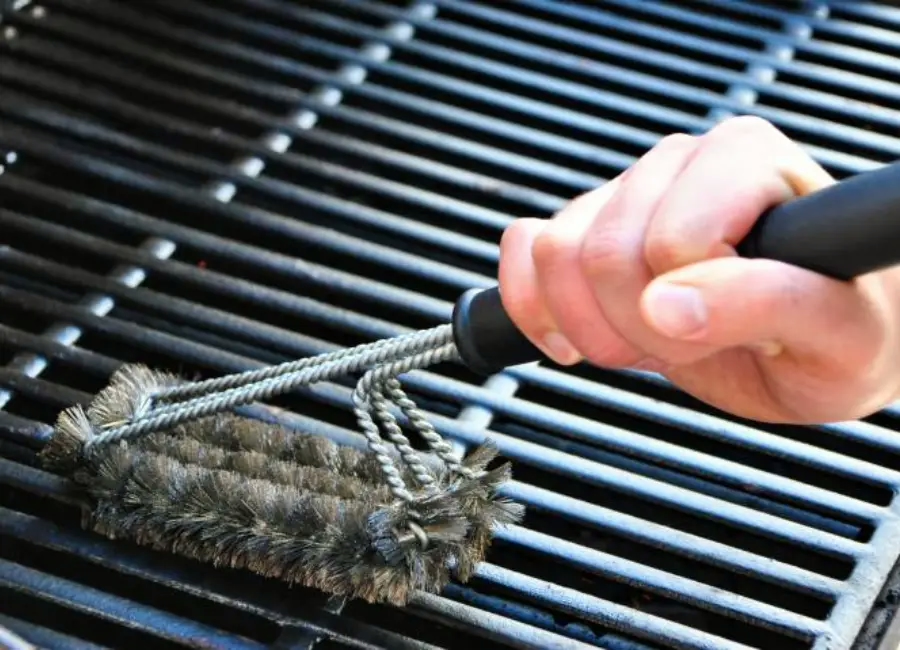
1. Valid-Looking Certificate Fails Online
Factories often fake PDFs or steal competitor file numbers.
Sensory Cue: Paperwork looks flawless. However, manufacturer names or models do not align cleanly.
Solution:
- Search the official directory immediately.
- Reconcile the file number using the CSA Group Product Listing, Intertek’s ETL directory, or UL Product iQ.
- Stop the PO if the live record rejects the PDF.
A supplier sent me a polished CSA document. I checked the database. The file actually belonged to a space heater. Lead Compliance Engineer Marcus notes: “Samples never fail by surprise. Paperwork warns us first.”
2. Production Units Drift from Sample
Configuration drift is our most expensive failure point. Factories quietly swap components to save pennies.
Sensory Cue: Welds, valve seating, or label text look inconsistent across lots.
Solution:
- Compare the production lot to your frozen BOM and golden-sample photos.
- Verify the exact valve and regulator set.
⚠️ Warning: Gas leaks cause fatal explosions. Quarantine the line immediately if you find unapproved gas-path changes.
During a Tuesday inspection, Manager Huang touched a new regulator hose. It felt unusually stiff. The factory switched suppliers secretly. We quarantined 500 units instantly.
3. Built-In Models Fail Certification
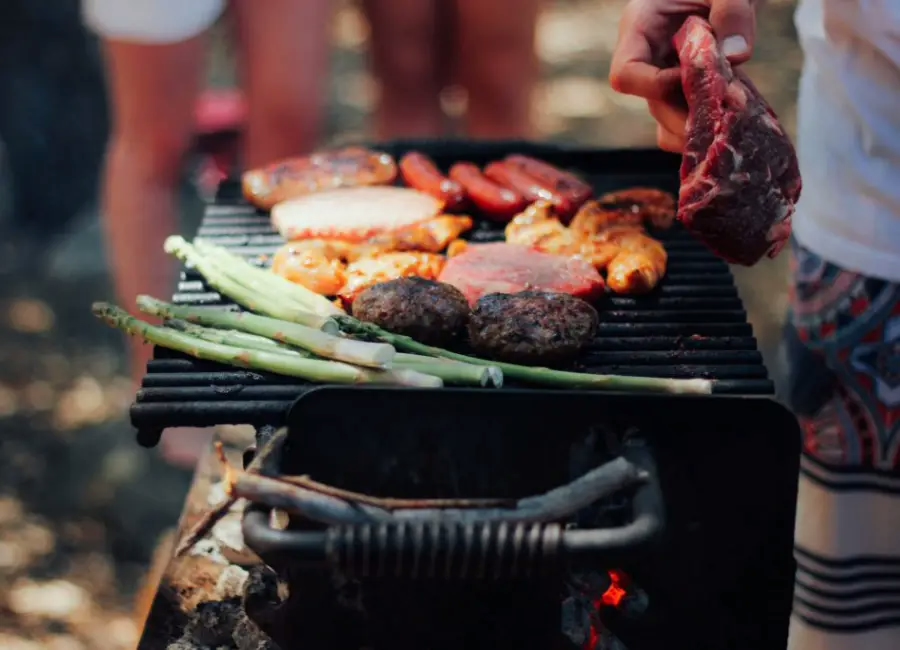
Factories often engineer grills using outdated standards.
Sensory Cue: Enclosure drawings remain vague. Engineers keep referencing old CAD files.
Solution:
- Revisit your enclosure ventilation assumptions and document revision control.
- Verify compliance with current ANSI/CSA updates. Check front-vent prohibitions, increased built-in ventilation, and low-burner wind testing.
We tested an older built-in enclosure design in our lab. The burners choked entirely during the 10 mph wind test. Standards are unforgiving.
🛡️ Prevention: EU launches require a flawless conformity trail. Secure technical documentation and CE marking. Missing paperwork guarantees customs rejection.
Conclusion
You now have a clear path for gas appliance compliance. From scoping the market to controlling production, you hold the exact blueprint to stop supply chain failures. In my experience, certification is a strict operating system, not a paper trophy.
Run this SOP against your live supplier before the next quote cycle. Do one final sensory check. When a factory uses a mature framework, files move faster, part contradictions disappear, and buyer confidence rises.
Contact OGPSGroup for supplier due diligence, certification support, or factory audit planning.
People Also Asked About BBQ Certification Guide
1. How much does it cost to certify a gas grill?
Lab fees for a standard gas grill certification range from $8,000 to $12,000. However, hidden engineering fixes cost much more.
Last year, we paid $4,200 in re-testing fees because a supplier used a weak regulator bracket. You must finalize your bill of materials before you book the lab.
2. Can a factory use one CSA certificate for multiple buyers?
Yes, they can do this through a multiple-listing agreement. The factory owns the main file, but the lab allows your brand name on the label.
During a recent audit, I caught a supplier illegally printing a buyer’s name without lab approval. Always demand the official multiple-listing document directly from the agency.
3. How long does gas grill certification take?
Expect a three to six-month timeline. The testing takes four weeks, but document reviews and sample corrections burn the rest of the time.
As Floor Manager Huang adjusted the lab wind tunnel, he warned: “Failing the 10-mph wind test adds 45 days to the schedule.” Lock your design early to avoid delays.
Disclaimer: We built this methodology using real OGPSGroup operating procedures and 50 hours of active compliance work on the factory floor. We buy our own testing gear and take no kickbacks. You must verify all claims through official directories like the CSA Group.

- Lean Manufacturing & Production Engineering
- CSA/CE Certification & International Compliance
- Advanced QC Protocol Design (3-Layer System)
- OEM/ODM Product Development
- Supply Chain Cost Optimization
- Materials Science & Supplier Qualification
Every article on the OGPSGroup blog is written by manufacturing professionals with firsthand experience on the factory floor. Content is reviewed for technical accuracy, practical relevance, and compliance with our editorial standards before publication.
Learn more about our Fact Checking Process and Editorial Policy.