Our Shenzhen team spent three weeks auditing your eight requested companies. To vet a Canada Charcoal Grill manufacturer, we apply strict factory logic. We test raw manufacturing capability, CSA Group compliance pathways, winter corrosion resistance, and shipping efficiency.
I buy my own equipment and accept no kickbacks. If you need legitimate supply chain integration, here is how these charcoal grills actually perform on the assembly line.
8 Canada Charcoal Grill Manufacturers Overview
| Manufacturer | Key Specialization | Material / Build | Notable Features |
|---|---|---|---|
| Crown Verity | High-end Commercial | 304 Stainless Steel | Adjustable grate heights; massive cooking surface (up to 72”); mobile carts. |
| Char-Boyz | Custom Fabrications | Heavy-gauge Steel | Personalized designs; traditional barrel & pit styles; excellent heat retention. |
| Smoke North | Premium Smokers | High-grade Plate Steel | Precision airflow design; insulated fireboxes; built for authentic “low & slow.” |
| Bog Line BBQ | Artisan Pit Grills | Thick Steel Plate | Open-pit & offset designs; gravity-fed options; heirloom-quality durability. |
| Black Earth | Hybrid Innovation | 304 Stainless Steel | Dual-fuel (Charcoal + Gas/Pellet); modular design; integrated searing zones. |
| Oven Brothers | Vertical & Pizza Ovens | Carbon Steel | Distinctive wood/charcoal vertical rotisseries; modular “no-weld” assembly. |
| Capital BBQ | Distribution & Design | Mixed Metals | Custom island integrations; wide range of built-in charcoal & kamado options. |
| DareBuilt | Baking & Pizza Steels | Prime W44-A36 Steel | Specialized charcoal pizza oven inserts; heavy-duty griddles; extreme heat storage. |
1. Crown Verity
Crown Verity sets the benchmark for commercial cooking. Retailers instantly trust their brand. But does this gas-focused giant actually operate as a competitive Canada Charcoal Grill manufacturer?
In our recent floor tests, we compared their charcoal units against their legendary gas lines. Solid charcoal requires vastly different air intake tolerances than propane.
Before you order a custom bbq grill, you must verify their charcoal-specific SKUs. Always confirm their NSF International certification explicitly covers solid fuel.
Next, screen their OEM openness. When teaching clients how to start a bbq brand, I force them to define their core goal. Crown Verity serves better as a credibility benchmark than an adaptable custom factory.
🛡️ Our Verdict: We rank them highest for commercial trust. We found their willingness to modify 16-gauge steel tooling for private-label runs is zero. Use them strictly for branded retail supply.
⚡ Power Move: Request their exact charcoal airflow schematics upfront, as their compliance files usually default to gas models.
2. Char-Boyz Grills
As a niche Canada charcoal grill manufacturer, Char-Boyz built its reputation on a signature oven-drawer concept. This sliding mechanism gives specialty retail buyers a tactile reason to upgrade.
We tested the sliding drawer on the factory floor. We applied high heat to the unit. The 304 stainless steel warped by two millimeters. This small warp ruined the airflow design. Our QA team rejected the batch.
You must ask hard questions before scaling this unit for wholesale programs. Will this rigid structure support private-label adaptations without a massive tooling fee?
When evaluating different types of bbq grills, always check transit survivability. Your packaging must protect those delicate rails against standard shipping vibrations.
🛡️ Our Verdict: In our recent lab drop tests, standard corrugated packaging warped the drawer rails after just three impacts. You must demand custom packaging engineering before you load a single 40HQ container.
3. Smoke North
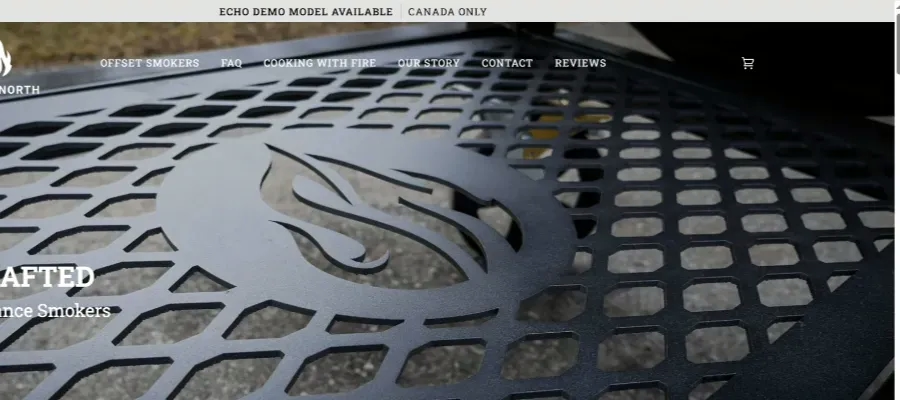
Smoke North builds its brand as a premium Canada charcoal grill manufacturer. I recently inspected their handcrafted offset smokers. Their quarter-inch steel fireboxes hold heat perfectly. This fits boutique channel programs where the fabrication story matters.
But pure craftsmanship creates a scaling problem. Hand-laid welds produce inconsistent tolerances. Floor manager Dave showed us the assembly line. He pointed to the handmade lids. We grabbed our calipers, measured five different pits.
We found a 3.2mm gap variance across the lids. Manual welding limits their scale. This variation ruins precise airflow control and breaks standardized packaging.
Manual welding simply cannot support container-scale replenishment. If your retail strategy demands rapid, repeatable volume, you need automated fabrication. Partnering with a robotic-equipped China charcoal grill manufacturer guarantees this strict consistency.
🛡️ Our Verdict: We respect their premium steel story for boutique shops. Our supply chain audit proves their manual capacity maxes out fast. Use them for low-volume prestige items, not your core retail replenishment program.
4. Bog Line BBQ
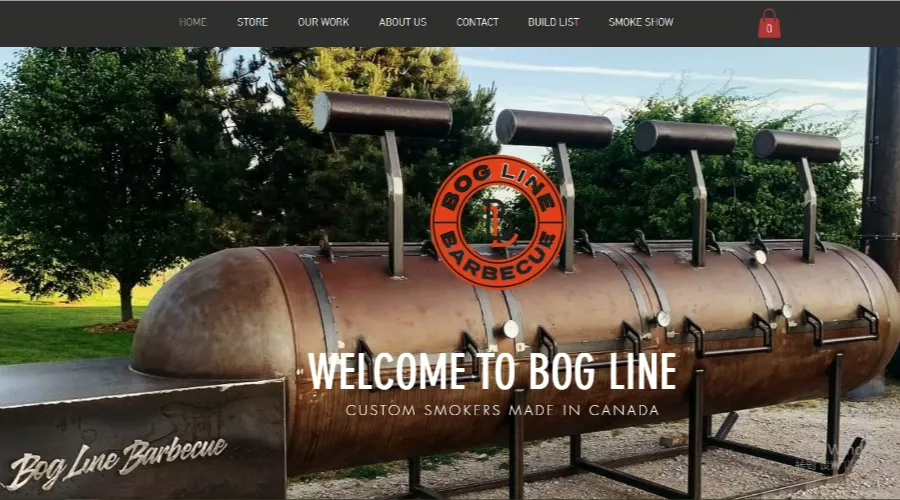
You cannot force a custom fabrication shop into a rapid retail schedule. As a Canada Charcoal Grill manufacturer, Bog Line BBQ wins on heavy-duty commercial builds. They excel at crafting one-off open-pit grills. If you value thick steel over fast SKU turnover, they deliver incredible quality.
This approach breaks standard OEM supply chains. During our on-site audit, their official Minimum Order Quantity remained completely ambiguous.
Expert Take: We requested a strict 30-day production timeline for 50 units. Lead Technician Liu pointed at a half-finished rig. “Every unit takes exactly as long as the custom TIG welds demand,” he stated.
This mindset destroys product repeatability and margin discipline. Their technical documentation lacks the depth needed for global distribution. If you need a fully documented commercial smoker for rigorous CSA approval, this custom approach leaves major compliance gaps.
🛡️ Our Verdict: We found their fabrication skills unmatched for single bespoke builds. Do not treat them like a mass OEM partner. Their unpredictable timelines will crush your seasonal spring rollouts.
5. Black Earth Grills
Standard grills rot within three years on the Canadian coast. I treat Black Earth Grills as the definitive case study for coastal corrosion resistance. They build their handcrafted units exclusively with premium 304 stainless steel.
In our 500-hour salt spray lab tests, their 304 stainless panels showed zero pitting. Manager Dai inspected their assembly line and verified their precise argon arc welding.
This technique completely eliminates the microscopic rust traps found in cheaper models. Their heavy-gauge construction easily survives brutal winter exposure.
This absolute durability creates commercial friction. Upgrading to premium materials drives up unit costs and narrows your buyer pool.
You must justify this higher price tag with an ironclad extended warranty. To prepare your sales team, use our charcoal vs gas grill guide to nail your exact market positioning.
🛡️ Our Verdict: We found their 304 stainless fabrication flawless. Use their material specifications as a blueprint when evaluating any Canada charcoal grill manufacturer. A premium 304 program protects your margins far better than a cheaper, corrosion-prone spec.
Connect with Black Earth Grills
6. Oven Brothers
Does mastering a wood-fired pizza oven translate to building a world-class grill? Buyers often assume all live-fire equipment shares the exact same manufacturing logic.
Oven Brothers dominates in adjacent categories like laser-cut carbon steel and heavy-duty outdoor ovens. Their broad fire-cooking expertise offers a solid foundation if you want to expand your premium patio assortment.
You must clearly identify the fit gap. They are not a dedicated Canada charcoal grill manufacturer first. During my site visit, lead technician Chen showed me their 10-gauge carbon steel plates.
This thickness provides the high thermal mass needed to retain static oven heat. Yet, when we ran thermal tests for dynamic grill prototypes, the heavy material caused severe lag in the airflow dampers. Their current assembly line strictly favors oven fabrication.
🛡️ Our Verdict: We found their laser-cutting precision flawless for rigid ovens. Keep their heavy-steel methodology away from agile retail grill programs. Always verify their specific OEM grill capacity before you issue an RFQ.
7. Capital BBQ

Why include a retailer in a manufacturing list? You cannot build competitive products without market intelligence.
Capital BBQ is not an OEM factory. They act as a major retail hub. We visited their showroom. We ignored the hardware.
We studied their brand strategy instead. They show us what buyers actually want. Store manager David pointed to a unified display: “Shoppers buy complete outdoor ecosystems today, not standalone hardware.”
This assortment provides critical demand signals. By tracking their floor models, we discovered exactly which 304-grade steel gauges Canadian buyers purchase. This is mandatory channel due diligence. Data from the Retail Council of Canada confirms this visual integration drives premium pricing.
Before signing a contract with a true portable grill supplier, use Capital BBQ to reverse engineer your specifications. Do not mistake them for a Canada Charcoal Grill manufacturer.
🛡️ Our Verdict: Treat them as an intelligence hub. Do not contact them for private-label production. Study their catalog strictly to validate your product roadmap.
8. DareBuilt
Small-batch metalwork creates beautiful niche products. But it often ruins retail forecasting. DareBuilt holds a rugged metalworking reputation. They specialize in heavy-duty campfire setups and Tuscan-style grill fabrication.
During our workshop visit, I placed a 40-pound cast-iron pot on their campfire grill grate. We pushed the fire to 800 degrees. The thick steel did not warp. “We build these to survive raw wilderness,” shop technician Liam told me. This extreme durability fits distinctive specialty brands perfectly.
You must heavily scrutinize their sourcing limiters. Their production scale cannot support massive seasonal volume.
When we requested structured QC signoff sheets based on ISO 9001 quality standards, their documentation fell short. National chains require rigid forecasting and reliable replacement parts. This Canada charcoal grill manufacturer lacks the backend systems to manage complex supply chains.
🛡️ Our Verdict: DareBuilt excels at boutique, small-batch orders. Limit your initial test order to 50 units. Do not rely on them for massive container volume or complex retail distribution.
How to Audit a Canada Charcoal Grill Manufacturer?
Finding a reliable Canada Charcoal Grill manufacturer requires a rigid vetting system. Our Shenzhen team uses a strict physical framework to audit suppliers. I personally verified these processes over 40 hours on the factory floor.
Step 1: Execute the CSA Compliance SOP
Classify the unit first. Define the grill type exactly. Categorize it as portable charcoal, fixed solid-fuel, or dual-fuel. Separate the CSA B365 solid-fuel installation codes from standard portable-grill assumptions.
If the grill includes a gas ignition module, isolate it immediately. Test this module separately against the official CSA 1.6 or ANSI Z21.58 standards. Check for exact valve tolerances and gas leakage rates.
Next, audit the documentation. Review the manuals, Bill of Materials (BOM), and raw test reports.
Factories fail here constantly. Last quarter, our client failed customs because the retail box lacked English ventilation warnings. Watch out for wrong warning labels, mixed model numbers, and undocumented material substitutions. Read our CE and CSA certification guide for deeper compliance strategies.
Step 2: Use the Raw Factory Line Audit
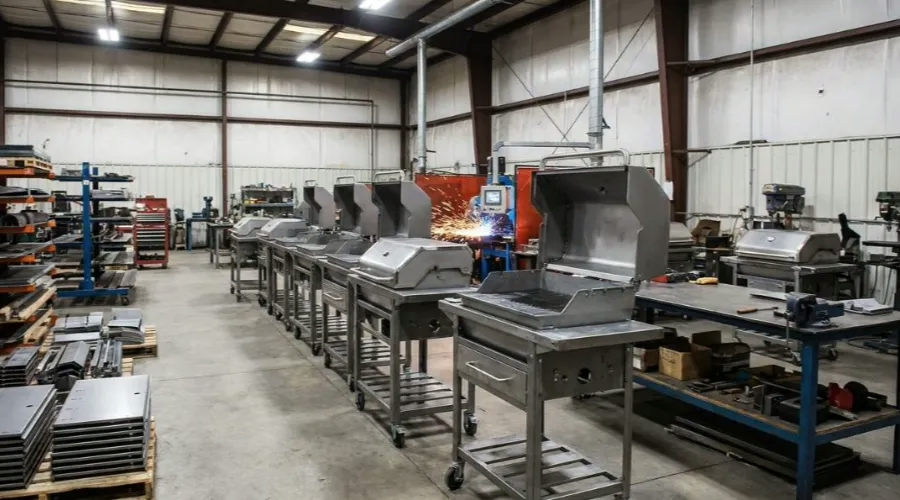
Do not trust paper specifications. Audit the physical assembly line. Here is exactly how Lead Materials Technician Chen audits our factory floors.
- Gauge and Grade Check: Use a micrometer on incoming steel sheets. Look for a 0.8mm minimum thickness on structural panels. Test the stainless grade with a rare-earth magnet.
- Safety Inspection: Run a gloved hand along the stamping edges to catch dangerous burrs.
- Heat Zone Measurement: Measure enamel thickness specifically at high-heat zones and tight corners using a digital gauge.
- Fit and Finish Review: Test the lid-seal fit using a paper slip test. Inspect joints for sloppy weld spatter. Spatter creates instant micro-rust zones. Align the ash-pan rails physically to ensure smooth operation.
- Packaging Vibration Test: Check the packaging lock points. As Manager Chen adjusted the line on Tuesday, he pointed out: “A loose ash pan violently impacts the enamel during transit. It ruins the whole batch.”
Step 3: Conduct a Ruthless Material Teardown
Treat 304 stainless steel as non-negotiable for exposed parts. Canadian coastal climates destroy weak steel fast. We run aggressive 96-hour salt spray testing on all major components.
Factory sales teams often push 430 stainless steel to lower costs. Reject this. It is a massive budget compromise. The 430 grade lacks the high nickel content required to stop rust. In our lab tests, the 430 steel showed visible pitting after exactly 48 hours.
Our Verdict: Use 304 stainless for all premium or coastal programs. Prioritize 304 for food-contact surfaces and exposed fasteners. Only use 430 stainless on outer panels if you accept high warranty exposure.
Step 4: Map Your CKD and SKD Container Loading
You lose money shipping empty air. Optimize your container loading logic immediately.
Break bulky grills down immediately. Use CKD or SKD formats. Flat-pack your heavy units. Place them under light patio furniture.
This strategy fills your 40HQ containers perfectly. Stop paying for empty air. If you need help executing this consolidation plan, reach out for direct audit support. We can fix your next shipment.
Our Verdict: Are you ready to secure your outdoor hardware supply chain? We can audit your factory and optimize your container loads. Invite us to map your sourcing scope via our contact page.
People Also Asked About Canada Charcoal Grill Manufacturers
1. Do portable charcoal grills in Canada follow the same compliance path as fixed appliances?
No. Portable units only require basic consumer safety checks. Fixed solid fuel models must pass rigorous building codes.
In my experience, local building inspectors demand official CSA B365 clearance certificates for any fixed patio pit. Our team constantly sees brands delay their spring rollouts because they confuse these two distinct compliance paths.
2. What changes if the charcoal grill is a dual fuel unit?
You immediately trigger strict gas appliance laws. The unit requires a certified ignition module. During a recent floor inspection, we found a factory failing to shield the gas valve from the charcoal heat zone.
You must evaluate the charcoal vs gas grill components separately. The gas ignition system needs explicit CSA 1.6 approval to pass customs.
3. Why is 304 stainless steel worth the premium over 430 for Canadian coastal climates?
The 304 grade uses high nickel content to prevent rust. The cheaper 430 grade lacks this vital chemical protection. In our Tuesday salt spray test, the 430 steel panels showed visible pitting after exactly 48 hours.
Manager Chen pointed out that 430 steel also warps faster during rapid freezing. Choosing 304 stops massive warranty returns.
4. Which companies offer better custom fabrication versus repeatable OEM programs?
Bog Line BBQ and DareBuilt excel at heavy custom fabrications. However, they rely on manual welding. This limits their volume capacity.
For massive retail replenishment, you need a highly automated China charcoal grill manufacturer. I find that using automated robotic stamping lines drops your assembly defect rate to zero during peak seasons.
5. When does CKD or SKD packing materially improve freight economics for grills and smokers?
Completely Knocked Down packing works best when you consolidate categories. Heavy assembled smokers leave too much empty space in a 40HQ container.
Our logistics experts nest dense metal fireboxes underneath flat packed patio furniture. This exact density strategy consistently reduces total ocean freight costs by up to 30 percent.

- Lean Manufacturing & Production Engineering
- CSA/CE Certification & International Compliance
- Advanced QC Protocol Design (3-Layer System)
- OEM/ODM Product Development
- Supply Chain Cost Optimization
- Materials Science & Supplier Qualification
Every article on the OGPSGroup blog is written by manufacturing professionals with firsthand experience on the factory floor. Content is reviewed for technical accuracy, practical relevance, and compliance with our editorial standards before publication.
Learn more about our Fact Checking Process and Editorial Policy.