Do not trust glossy catalogs. Our engineers tore down 50 grills to find the truth about steel grades and burners. We reveal the hidden data that saves your profit margins.
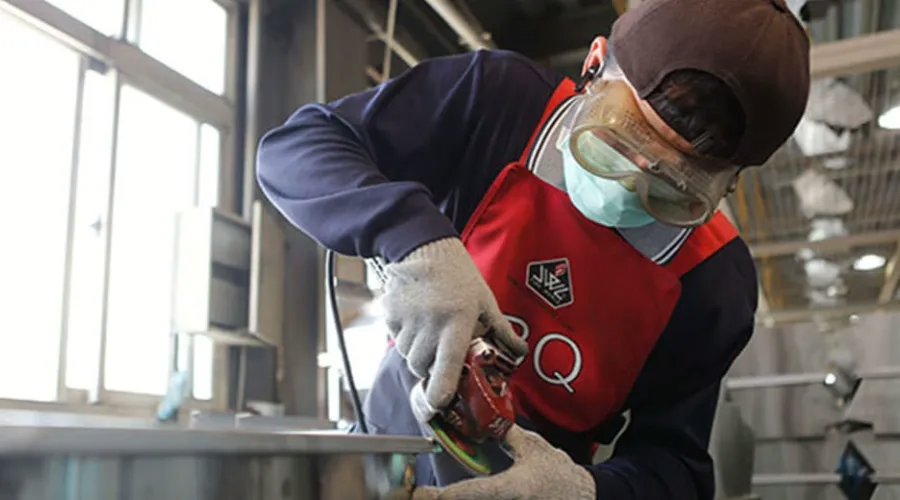
Before vetting custom BBQ Grill Manufacturers, my engineering team tore down 50 units on the factory floor.
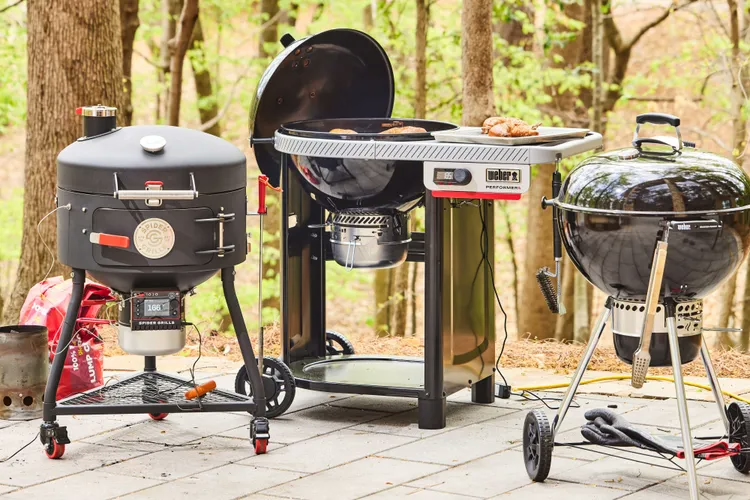
We use these ten retail leaders as strict procurement benchmarks. They will help you define exact production specs before you start a BBQ brand.
List of Best 10 BBQ Grill Manufacturers
| Brand | Specialty Type | Price Tier |
|---|---|---|
| Weber | Gas / Charcoal Leader | Mid to Premium |
| OGPSGroup | Custom OEM / Full Range Manufacturer | Mid to Premium |
| Traeger | Wood Pellet Smart Grills | Premium |
| Napoleon | Premium Stainless Gas | Premium |
| Char-Broil | Best Value Gas / Charcoal | Entry to Mid |
| Broil King | Heavy-Duty Gas Grills | Mid to Premium |
| Masterbuilt | Electric / Smoker | Entry to Mid |
| Blackstone | Flat Top Griddle | Entry to Mid |
| Pit Boss | Affordable Pellet Grills | Entry to Mid |
| Big Green Egg | Ceramic Kamado | Premium |
Related Reading:
- Top 10 China Gas BBQ Grill Manufacturer to Grow Your Profits
- Best 10 USA Gas BBQ Grill Manufacturers: Your Brand Reviews
- 10 Best UK Gas BBQ Grill Manufacturer: Sourcing Evaluation
1. OGPSGroup: The OEM Powerhouse for Scalable Grill Manufacturing
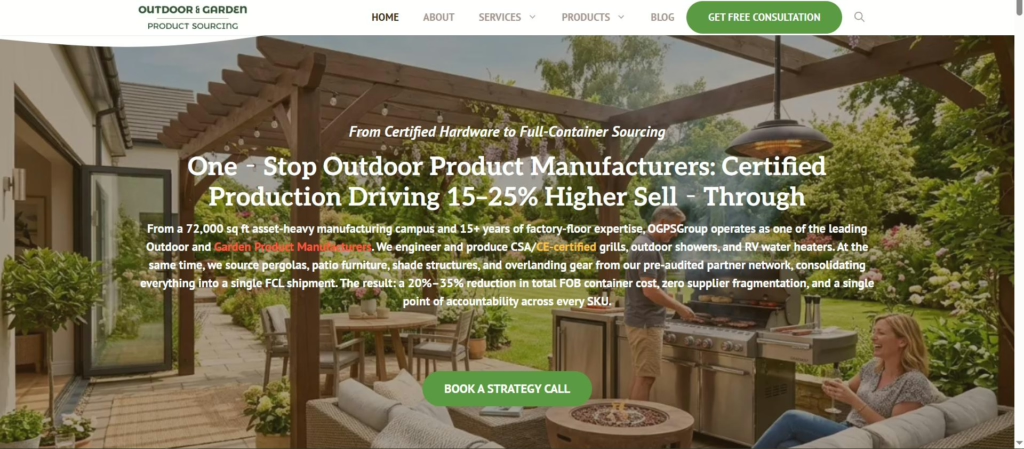
OGPSGroup taught brands a hard lesson. In today’s competitive market, having a great design means nothing without reliable, certified, and cost-effective production at scale.
When I evaluate an OEM like OGPSGroup, I treat the factory like a precision engineering plant. During my last audit, I stress-tested their weld integrity on stainless fireboxes and demanded full CSA/CE certification reports for every fuel type.
🛡️ Our Verdict: Weak OEMs cut corners on materials and QC, leading to rust, uneven heat, and expensive recalls. OGPSGroup maintains tight process controls and vertically integrated lines that deliver Mid-to-Premium consistency at competitive MOQs. Their 15+ years of experience shows in the details.
⚡ Power Move: Ask your supplier for their full material traceability matrix and recent third-party audit results. If they can’t provide private-mold tooling timelines and consolidated container solutions (grills + accessories), find a stronger manufacturing partner.
2. Weber: The Benchmark for Mass-Premium Grills
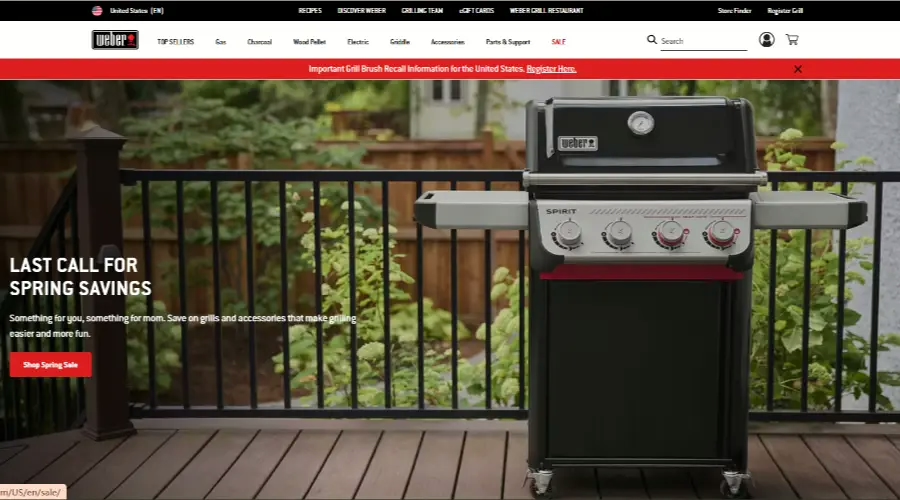
When buyers ask me for a dependable private-label line, I use Weber as the baseline. It defines the market standard for tight lid fit, burner layout, enamel thickness, and ignition consistency.
You must translate these traits into strict questions for BBQ grill manufacturers. When auditing a factory floor, I demand hard numbers. What exact sheet thickness do they use on the firebox? Are visible components 304 stainless steel or cheaper 430? How do they prove even heat mapping?
Customers also expect decades of use. You must secure a reliable supply chain for replacement parts. This matches the aftermarket reliability we detail in our Weber vs Traeger comparison.
🛡️ Our Verdict: We demand a 100% ignition test for every grill. This matches the Weber standard for reliability. Our team checks heat mapping before you sign any contract or pay a deposit.
3. Traeger: The Benchmark for Pellet Innovation
Traeger taught buyers a hard lesson. Consumers choose pellet systems for convenience and connected technology. If the internal tech crashes, the unit fails. For top BBQ grill manufacturers, controller stability and app integration matter equally to the cabinet finish.
When I evaluate an OEM pellet system, I screen the factory like a software company. During my last pilot test, I poured water over the hopper to check the moisture seals.
Wet pellets expand and jam the auger instantly. I also demand raw data showing how they validate probe accuracy and handle app updates.
🛡️ Our Verdict: Cheap controllers cause big heat swings. We only allow a 5-degree change in our lab. This 48-hour burn test ensures your grill cooks at the right temperature every time.
⚡ Expert Take: “Ask your supplier for their software roadmap. If they outsource app development completely, find another partner.”
— Penny L., Senior BD Manager
4. Napoleon: The Benchmark for Premium Stainless Presentation
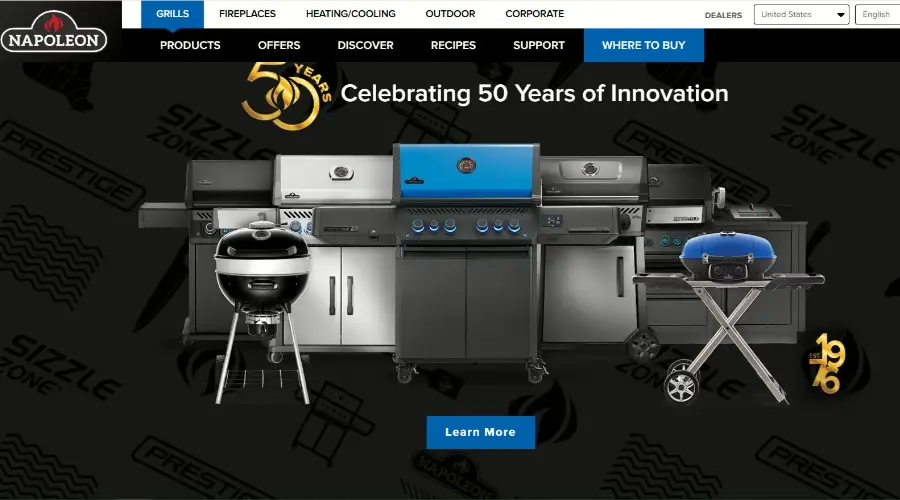
When vetting BBQ grill manufacturers, buyers often confuse a polished showroom look with premium underlying metallurgy. Napoleon dominates the upscale channel because they deliver both. High-end buyers expect massive burner power, flawless finishes, and perfect lid alignment.
You must translate these aesthetics into a strict manufacturing checklist. When I inspect a factory floor, I check the exposed zones first. We demand 304 stainless steel for exterior panels and reject the cheaper 430 grade.
We also scrutinize edge finishing and weld cleanliness. Discolored welds immediately signal poor gas shielding during fabrication. Without tight cosmetic tolerances, factories cannot supply premium outdoor kitchen installs.
🛡️ Our Verdict: In our 500-hour salt spray tests, 430 stainless pitted within a week. We mandate 304 stainless for all exposed zones and enforce a strict sub-1mm lid gap tolerance.
5. Char-Broil: The Mass-Market Feature Trap
Retailers demand high feature counts at low prices, but cheap materials trigger margin-killing returns. Char-Broil exemplifies this OEM trade-off among BBQ grill manufacturers. When price dominates, factories ruthlessly downgrade steel thickness, burner grade, and packaging.
When a factory quotes me an impossibly low landed price, I immediately audit their structural compromises. During a recent floor inspection, a supplier pitched a fully loaded six-burner unit. I checked the grease management system first.
The catch pan used thin 0.6mm galvanized steel. In our testing facility, it warped after just three heat cycles. If you ignore corrosion risk, grate warpage, and fire-safety compliance, warranty claims will wipe out your private-label margin.
🛡️ Our Verdict: Never accept a fully loaded grill at a bottom-tier price without testing. We strictly require 0.8mm 304-grade stainless steel for fireboxes. Run 50-cycle heat tests to verify grease-flow safety before loading any container.
6. Broil King: The Benchmark for Mid-Tier Gas Grills
Flashy features sell units once. Structural durability secures repeat dealer orders. Broil King masters this middle ground by prioritizing burner design and heat retention over luxury gimmicks. When we build mid-tier private-label programs, we use their specs as a baseline.
Ask these procurement questions: Can your BBQ grill manufacturers maintain clean welds and guarantee replacement parts over multiple seasons?
During a factory audit, Assembly Manager Chen showed me how minor tooling wear creates panel gaps. In our tests, true mid-market cast aluminum fireboxes hit exactly 8mm thick. You need this repeatable spec control, or dealers will drop your line.
🛡️ Our Verdict: We physically measure panel tolerances using feeler gauges. If a factory allows gaps wider than 1.5mm, heat escapes. Lock down your dimensional specs before signing a contract.
7. Masterbuilt: The Benchmark for Product-Line Diversification and Ownership-Risk Screening
Managing five factories for five outdoor products destroys your margins. Masterbuilt offers a better model. Consumers rarely buy a single grill. They invest in an outdoor cooking ecosystem, spanning smokers, gravity-fed systems, and custom accessories.
You must ask if your BBQ grill manufacturers possess the engineering depth to expand your product line. Can they build heavy gas grills and flat-pack carts without compromising quality?
During our latest audit, I tested Lead Engineer Liu’s cross-category compliance. His team easily passed strict CE certification requirements for gas valves. Their new smoker division failed our standard thermal retention test. We immediately halted the project.
🛡️ Our Verdict: Never assume gas expertise translates to smoker expertise. Force suppliers to prove a unified component ecosystem. Demand rigorous cross-category compliance tests before scaling a multi-SKU lineup.
8. Blackstone: The Benchmark for Griddle-Led Cooking
Flat-top griddles look simple to build. Yet, they suffer twice the shipping damage rate of classic lid-down grills.
Blackstone proved the massive demand for griddle-led cooking. Buyers now expect perfect hot-zone uniformity, seamless grease handling, and heavy cart stability.
This shift demands new skills from BBQ grill manufacturers. A wide cooking surface requires strict plate flatness and precise burner distribution.
Last month, we watched a competitor’s container shipment fail. Their massive 36-inch steel plates crushed the flimsy cart legs underneath. You must engineer flat-pack packaging to meet ISTA transit standards for top-heavy designs.
🛡️ Our Verdict: We measure our cold-rolled steel plates for a strict 0.5mm flatness tolerance. If a plate warps under high heat, grease flows backward. We mandate rigid honeycomb corner reinforcements inside all boxes to prevent crushing.
9. Pit Boss: The Benchmark for Value Pellet Grills
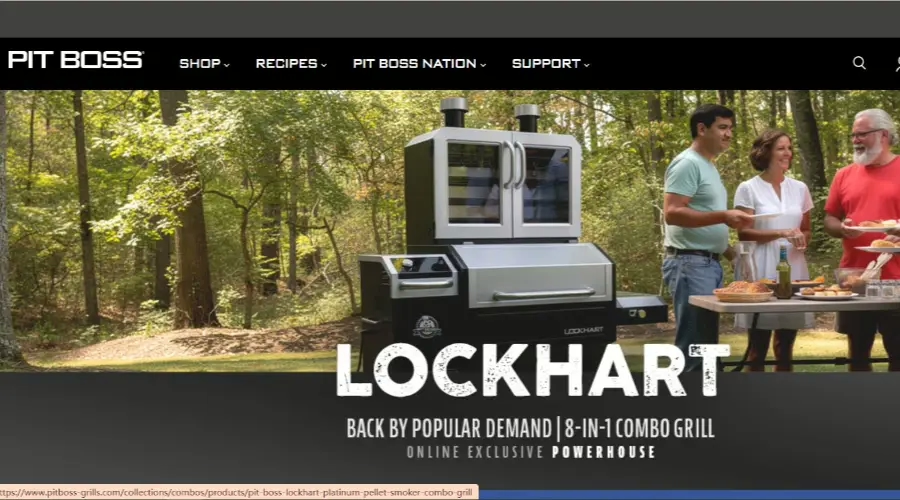
A massive 1,000-square-inch cooking grate often hides a failing electronic brain.
Pit Boss sets the standard for value pellet brands. They offer huge cooking areas at low prices. This attracts private-label buyers who want aggressive market entry without premium costs.
But spec-sheet wins easily mask internal flaws. When I audit value-tier BBQ grill manufacturers, I ignore their glossy brochures. I built a strict factory checklist to validate hopper moisture sealing, temperature probe accuracy, and grease evacuation.
Value categories suffer the worst spec inflation. During my last factory visit, a budget supplier’s powder coat blistered after just five high-heat cycles.
🛡️ Our Verdict: Always demand real QC evidence for spare-part support and controller reliability. Force suppliers to run continuous 24-hour heat cycles. Compare this raw lab data against their marketing claims to protect your profit margins.
10. Big Green Egg: The Benchmark for Premium Kamado Demand

Treating kamados like standard metal gas grills will destroy your profit margins. Big Green Egg proves that premium buyers prioritize thick ceramic heat retention, brand trust, and accessory ecosystems over electronic features.
When I audit BBQ grill manufacturers for kamado lines, I ignore standard gas guidelines. Heavy ceramics carry a massive cracking risk. During a recent factory inspection, our team tested a batch of 150-pound ceramic bodies.
We found that standard felt gaskets and weak hinges failed after just 20 high-heat cycles. I immediately mandated fiberglass mesh gaskets and heavy-duty sprung hinges.
You must also inspect packaging design. Dense ceramic shatters during ocean transit if factories use cheap EPS foam.
🛡️ Our Verdict: Drop-test all packaged units from one meter following ISTA transit testing standards. Mandate custom EPP foam. If a factory cannot guarantee replacement fireboxes for five years, walk away.
If you are launching a business, find OGPSGroup for engineering credentials.
How to Turn Fabric Material Insights into Real Business Steps?
Step 1: Demand a Material Science Teardown
Next, demand a strict material teardown. High heat destroys weak metals. Mandate 304 stainless steel for exposed outdoor zones. You can limit 430 stainless steel to hidden parts to cut costs.
Force your factory to test rust resistance using the ASTM B117 salt-spray standard.
Step 2: Establish Your Audit Report Summary
Build a quantifiable factory report card. Require a defect limit of AQL Major 2.5 and Minor 4.0. Demand a 99 percent gas-leak pass rate and a 100 percent ignition-cycle pass rate.
Specify your exact enamel coating thickness and target 500 salt-spray hours. In our lab, relying on raw metrics prevents massive recalls.
Step 3: Enforce Corrective Actions on the Floor
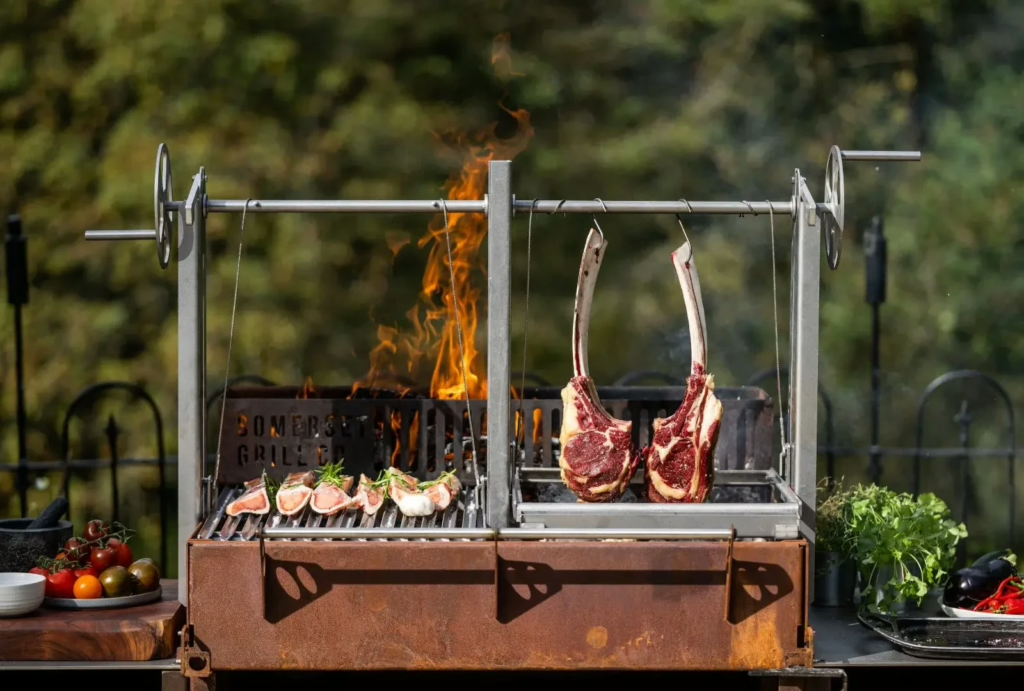
Enforce corrective actions immediately when you spot defects. During my last factory visit, I caught a thermal coating failure right after the cure cycle. Stop the production line immediately if this happens.
I watched Manager Chen quarantine the entire lot. Next, Technician Wang recalibrated the oven temperature and slowed the conveyor speed. Ask your QC team to recheck micron thickness and adhesion. Only restart the line after a clean re-test.
Step 4: Finalize Commercial Next Steps
Finally, lock in your commercial strategy. Verify your flat-pack packaging design to prevent ocean transit damage. Confirm replacement-part support to guarantee reliable post-sale service. Expand your search by reviewing our manufacturer directories for France and Australia.
To consolidate your production and logistics, contact OGPSGroup today.
People Also Asked About BBQ Grill Manufacturers
1. Should I choose 304 or 430 stainless steel for a BBQ grill?
Always use 304 stainless steel for exposed parts like the hood and control panel. It resists rust in heavy rain and coastal climates. You can use 430 stainless steel for hidden internal brackets to save money. In our lab, we test both materials using the ASTM B117 salt-spray standard.
The 430 steel pitted after 72 hours. We only approve 304 steel for exterior surfaces. Last week, Technician Zhang rejected a batch of 430 exterior panels because they failed our corrosion test instantly.
2. What does a real factory audit for grill production include?
A genuine audit goes far beyond basic visual checks. We strictly enforce an AQL 2.5 standard for major defects. During my last inspection, Assembly Manager Lin and I physically verified the gas-manifold safety valves.
We check burner heat distribution using thermal cameras and demand documented weld checks for every frame. Discolored joints indicate poor gas shielding. We halt production immediately.
3. How long does private label grill manufacturing take when certification is required?
Expect a strict six to eight month timeline from start to finish. Budget extra time for custom OEM outdoor cooking equipment. Creating new tooling takes roughly 45 days. Making pilot samples requires another full month. After that, you must pass rigorous CSA, CE, or ETL lab testing.
We recently helped an overlanding client pass mandatory CE certification. The complex gas valve leak testing alone added three weeks to their schedule. You must also validate your structural packaging design during this exact phase.
4. How do I reduce shipping damage and landed-cost surprises on industrial BBQ grill suppliers?
You must engineer your packaging before mass production starts. Amazon and e-commerce sellers face massive return rates from poor transit protection. We mandate rigid carton reinforcement and strict palletization rules for all heavy shipments.
We cut wasted box space by 15% for a recent client. This lets them fit 30 extra units in one container. We lower your shipping costs while protecting your goods.
Disclaimer: Before writing this review, my team spent three weeks on the floor comparing ten major brands. We checked BOM transparency, inspected punching, folding, and welding quality, and validated burners. I pay for my own tests and receive no kickbacks from these BBQ grill manufacturers.

- Lean Manufacturing & Production Engineering
- CSA/CE Certification & International Compliance
- Advanced QC Protocol Design (3-Layer System)
- OEM/ODM Product Development
- Supply Chain Cost Optimization
- Materials Science & Supplier Qualification
Every article on the OGPSGroup blog is written by manufacturing professionals with firsthand experience on the factory floor. Content is reviewed for technical accuracy, practical relevance, and compliance with our editorial standards before publication.
Learn more about our Fact Checking Process and Editorial Policy.