The nightstand wins for hospitality and storage-led assortments. The bedside table wins for retail density, e-commerce, and freight efficiency. I reviewed approved drawings, BOMs, QC checkpoints, packaging dimensions, and 40HQ loading math.
I used OGPSGroup’s direct OEM supply chain framework before naming this split. I have audited both formats on factory floors. Drawer count drives most of the cost gap. Consumer search blurs the labels, but the real commercial difference is structural: an enclosed casegood with drawers versus a lighter open or semi-open table.
The trade-off is immediate. More function adds hardware, labor, defect risk, and cube. We audited the BOM cost drivers and MDF constraints directly on the factory floor. Let’s look at the actual CBM data and compliance risks we found.
Buy the nightstand for guest utility and premium casegood positioning. Stick with the bedside table for lower landed cost and simpler replenishment.
We measured production cartons, verified BOMs, and ran live 40HQ loading data on our factory floor; screen-reader summary: nightstand wins for hospitality storage/compliance-heavy rooms, bedside table wins for retail density, freight efficiency, and e-commerce margin.

| Attribute | Nightstand | Bedside Table | Commercial implication |
|---|---|---|---|
| Storage architecture | 2–4 drawers; enclosed cabinet | Open shelf, open-leg, or single shelf | Drawers suit hotels; open shelf cuts material/hardware cost |
| Hardware complexity | 50,000-cycle drawer slides, handles, cable port, anti-tip strap | Minimal or none | Fewer parts cut BOM, QC checkpoints, assembly labor |
| Common materials | Solid wood or MDF + veneer (E1, 8–12% moisture) | Particleboard, HPL, light MDF (CARB Phase 2 / TSCA Title VI, 6–8% moisture) | Composites cut panel cost 35–60% but need E1/CARB docs |
| Typical dimensions (mm) | 500–600 D × 400–450 W × 550–650 H | 350–400 D × 300–350 W × 450–550 H | Smaller footprint fits tight rooms; reduces stacking height |
| Typical unit weight (kg) | 15–25 | 6–12 | Lighter units cut FCL freight and handling damage |
| Unit carton CBM | ~0.165 (semi-KD/assembled) | ~0.122 (KD/flat-pack) | Smaller carton lowers DIM weight, warehousing cube, last-mile damage |
| 40HQ yield (worked) | ~394–412 units (65–68 CBM ÷ 0.165) | ~533–557 units (65–68 CBM ÷ 0.122) | Flat-pack bedside table loads ~35% more units per 40HQ |
| Assembly format | Fully assembled or semi-KD (drawers pre-fit) | KD/flat-pack (cam-lock, dowel) | Assembled units need foam corner blocks; higher in-transit damage risk |
| Lead-time complexity | Longer: millwork, drawer fitting, UV cure | Shorter: panel cut, edge band, pack | Drawer alignment and cure add 7–14 days |
| Hospitality compliance exposure | Higher: anti-tip, FR drawer interior, wall-mount strap, pinch-point test | Lower: open base, no pinch points | Hotel spec checks (50k drawer cycle) gate nightstand POs |
| QC hot spots | Drawer alignment, slide tolerance, veneer delamination, moisture cracks | Panel warp, edge banding peel, cam-lock hole misalignment | Nightstand needs 100% drawer cycle test; bedside table needs drop test |
Nightstand vs Bedside Table: Which Is Better for Procurement?
Forget the naming debate. Storage architecture drives your hidden costs, freight penalties, and final QC failure rates.
1. Product Architecture and Intended Use

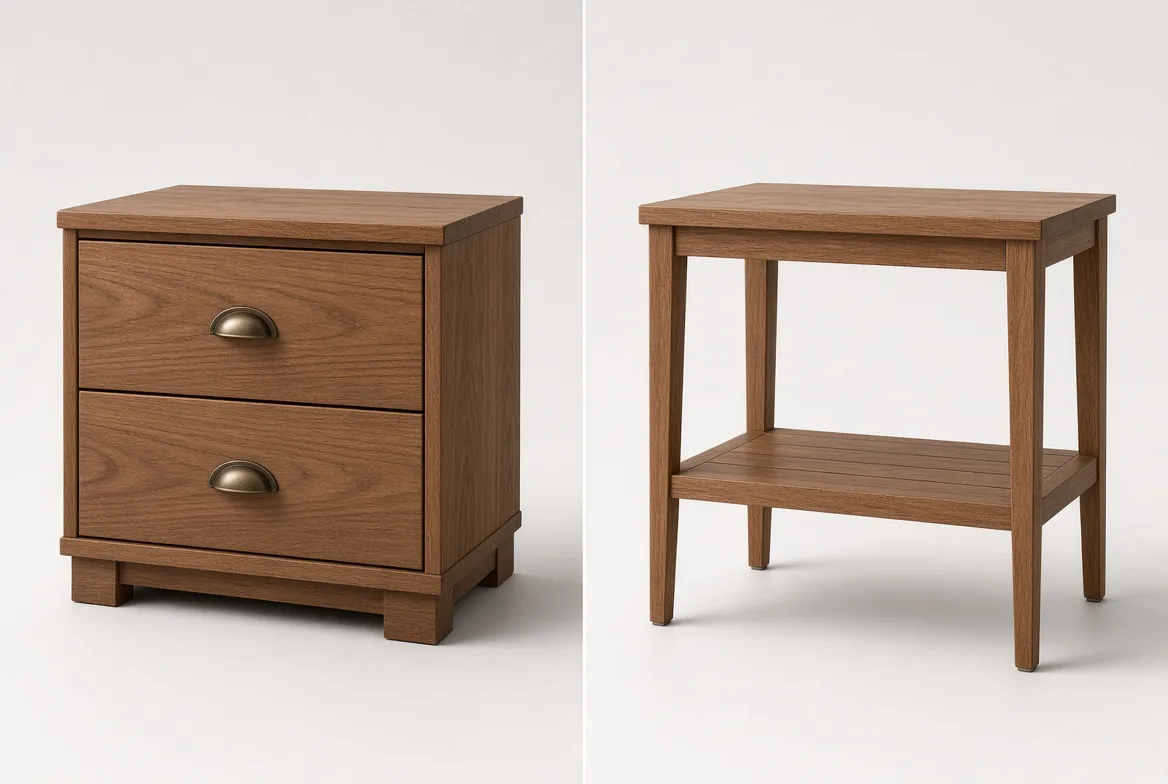
A nightstand is typically an enclosed bedroom casegood with drawers, doors, or cubbies. A bedside table is a broader category: an open-leg table, pedestal, shelf table, or minimalist surface. Our nightstand types guide maps the full range by construction style.
Commercially, nightstands invite more guest storage, support premium positioning, and add SKU complexity. Bedside tables reduce components and production failure points.
I felt the difference immediately on the factory floor. A drawer-loaded nightstand felt denser and more front-heavy. When I lifted one by the top edge, the front pulled forward. The weight sat in the drawer boxes and slides. An open bedside table felt lighter and easier to lift. I could reposition it with one hand. It flat-packed cleanly because the legs separated from the top.
Winner: Nightstand for function and premium guestroom utility; bedside table for simplicity.
2. BOM Economics and Manufacturing Cost Stack
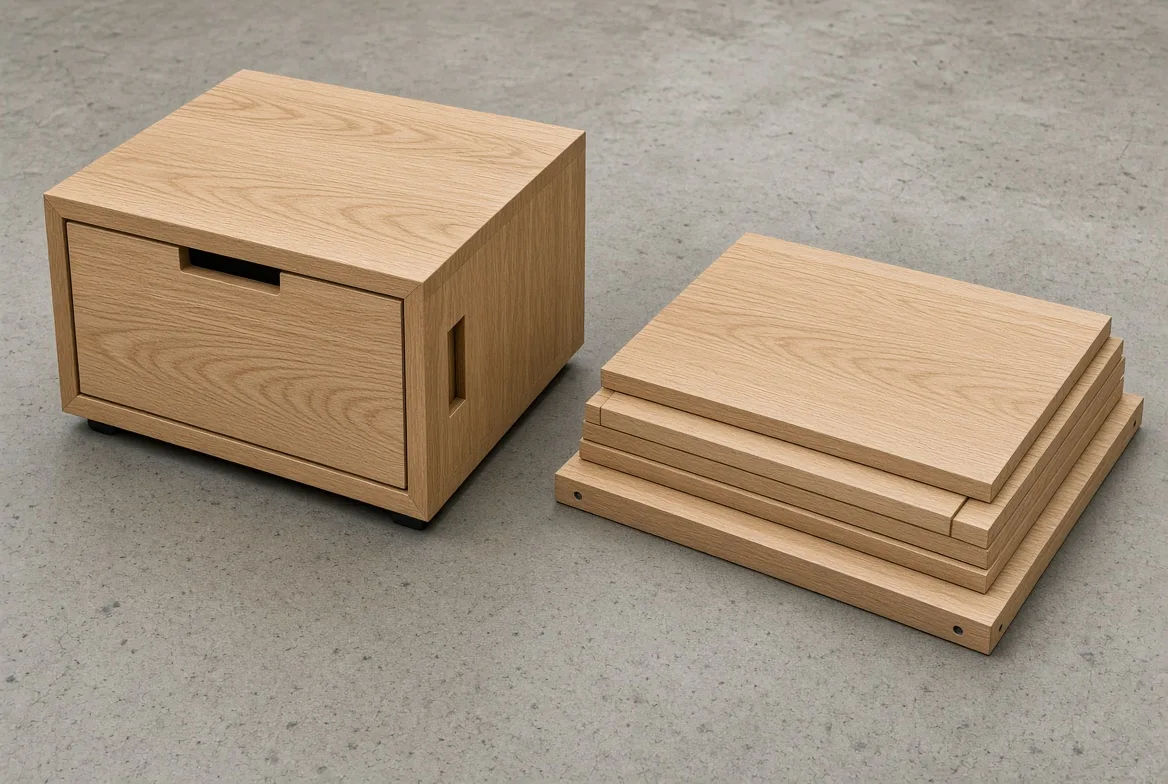
Heavy-drawer nightstand: MDF core, walnut veneer, 2 drawers, undermount soft-close slides, back panel, handle set, cable grommet, anti-tip hardware.
Minimalist bedside table: open frame or simple top + shelf, fewer hardware parts, KD panel set or leg-and-apron construction.
Drawer units blow up the BOM. Premium hardware adds $8 to $15 per unit. You need soft-close slides, metal handles, and anti-tip kits. Machining time on the CNC router doubles. The factory must cut precise notches for the drawer boxes. This extra machine time eats into your profit margin. Simple open tables avoid these costs entirely.
Drawer boxes need precise notching and assembly. Finishing passes increase because interior surfaces need coating. Reject risk climbs. Solid wood pieces often carry a 25%–50% higher FOB cost than MDF-based furniture.
MDF is automation-friendly. Solid wood carries higher raw material and labor shares. Drawer alignment is where the extra BOM hits the floor. One bad slide or a racked box throws the face out of the square.
Furniture expert Lucky Yang, who has exported bedroom furniture from China for more than ten years, puts it simply: the plant is not the finish line—dimension, hardware, and the last inspection are. She flags unbranded slides as the cheap save that turns a nightstand into a return. Lock the slide spec before CNC starts.
Q&A with Yang, OGPSGroup internal furniture sourcing lead:
- Which cost buckets expand first when a bedside table becomes a drawer nightstand?
Hardware and machining. Undermount soft-close slides alone add $4–$7 per drawer. Drawer boxes create additional panel yield loss. - How much do slide systems, handle sets, and back-panel reinforcement change margin?
I typically see margin erosion of 6–12 points if the buyer holds the same retail price. Hardware MOQs can also strand cash. - When does solid wood make economic sense vs MDF + veneer?
When the brand story or repairability matters. For contract furniture, I often recommend MDF + veneer. It cuts raw material cost and lets the CNC line run faster. - Which component causes the most rework during final inspection?
Drawer alignment. One bad slide or a slightly racked box pulls the whole face out of the square. - How should buyers think about hardware sourcing volatility?
Lock hardware specs early. QA slide cycle ratings in writing. Avoid unbranded slides: a cheap slide failure turns a premium nightstand into a return.
Winner: Bedside table usually wins on cost efficiency; nightstand justifies the extra cost when storage and perceived value raise sell-through or ADR support.
3. Flat-Pack Shipping, CBM, and 40HQ Container Yield

I ran the math on our live packaging spec:
- Assembled/semi-KD nightstand carton: ~0.165 CBM per unit
- KD flat-pack bedside table carton: ~0.122 CBM per unit
- Usable 40HQ volume: ~65–68 CBM, not just theoretical max
65 CBM:
65 / 0.165 ≈ 393 nightstands
65 / 0.122 ≈ 532 bedside tables
532 vs 393 = about 35% more units
68 CBM:
68 / 0.165 ≈ 412 nightstands
68 / 0.122 ≈ 557 bedside tables
557 vs 412 = still about 35% more units
The gain happens because panels nest, legs separate, dead air drops, and protector geometry becomes more efficient. Pallet penalties can sometimes be reduced. That directly lowers per-unit freight and warehouse cube.
We dropped the cartons from a standard 36-inch height. The honeycomb corners crushed exactly as planned. The thick EPE foam protected the walnut veneer perfectly. The double-wall cartons survived the impact without tearing.
Always demand ISTA 3A testing for your e-commerce shipments. You cannot risk broken corners in transit. Verify hardware bags against the manual. For e-commerce exposure, specify ISTA 3A or 6-Amazon style testing, not just ISTA 1A.
Flat-pack saves freight, but it shifts burden to assembly quality, instructions, and in-market labor.
Winner: Bedside table wins decisively on cube efficiency and often on landed cost.
4. Material Strategy, Finish Durability, and Compliance Exposure

Solid wood improves story and repairability, but adds cost and moisture movement. MDF gives a smooth paint/veneer base, but demands edge integrity and formaldehyde documentation.
Veneered panels look premium at lower cost, but edge lifting and delamination become inspection points. Laminate/HPL faces resist scratches and heat, excelling in high-turn hospitality.
We test wood panels with an Extech moisture meter. We test the core, not just the surface. Indoor furniture must hit that 8% to 12% moisture range. High moisture ruins the drawer and slides fast. The side panels will swell and bind the tracks. You must enforce strict moisture control. Drawer-heavy nightstands need it tighter because side panels can swell and bind slides.
Composite wood rules are strictly non-negotiable. We demand certified lab reports from SGS or Intertek. You must verify CARB Phase 2 or TSCA Title VI compliance. Fake certificates circulate often in this industry. We verify every document directly with the testing lab. Never trust a supplier’s word alone.
Compliance exposure shifts by product type. ASTM F2057-23 is applied strictly to applicable designs. Tall nightstands may fall within the clothing storage unit rule. Each design is assessed for its height, weight, and enclosed-storage volume, then subjected to a 50-pound tip-over test where required.
Ignoring this requirement can create significant legal risk; proper compliance helps protect your brand. Not every unit automatically applies, but buyers should treat tall drawer units as potentially in scope.
Contract bedroom programs may also request ANSI/BIFMA X5.5-style mechanical confidence, scratch/heat/stain performance, and stable cable-management integration.
Winner: Nightstands create more compliance and durability homework; bedside tables are usually lower-risk unless the spec adds powered features or heavy tops.
5. The Literal Factory-Auditor SOP and QC Checklist
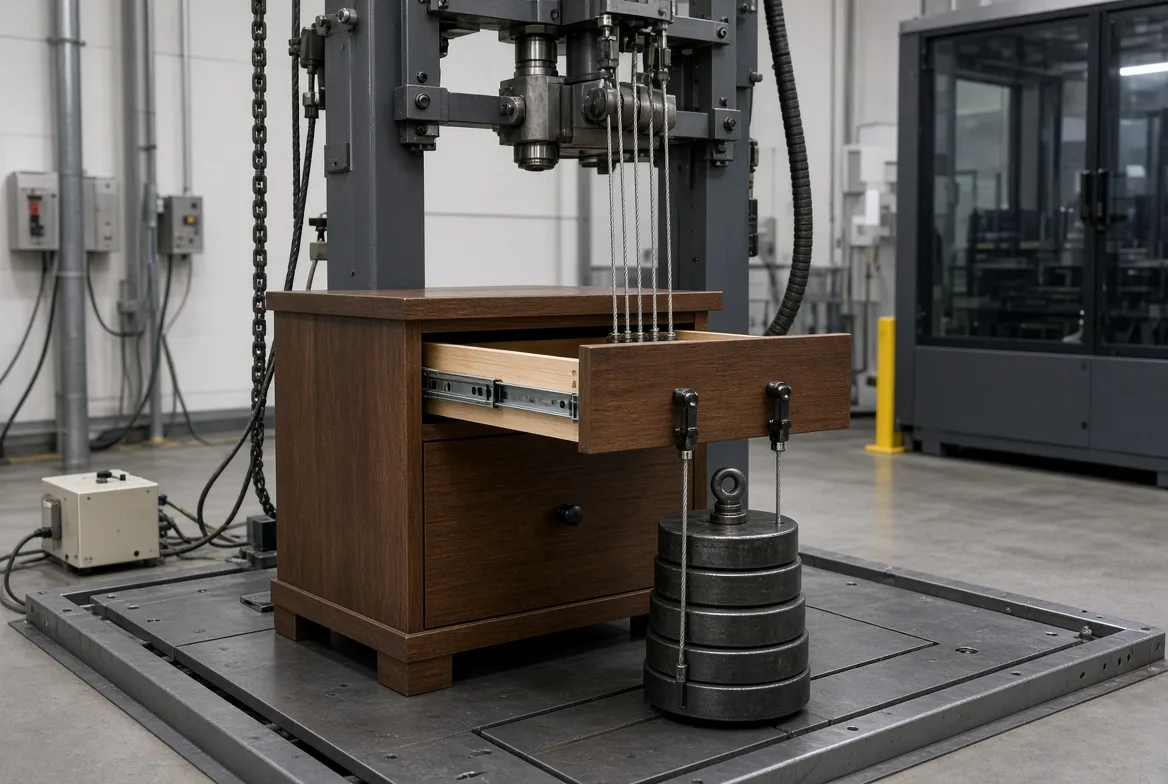
- Confirm approved drawing, BOM, finish swatch, packaging spec, and golden sample.
- Confirm lot size and pull sample by AQL II plan; critical 0 tolerance, major at AQL 2.5, minor commonly at AQL 4.0.
- Measure dimensions, squareness, panel thickness, and bed-height fit logic.
- Test moisture content and reject out-of-range wood components.
- Inspect veneer layup, edge banding, color/gloss consistency, and visible repair marks.
- Run functional checks: drawer open/close, glide noise, rebound, alignment, stop position, soft-close action, handle security.
- Run structural checks: top-load stability, drawer load, anti-racking, leg wobble, shelf deflection.
- Verify torque on fasteners, cam locks, screws, and handle hardware.
- Check anti-tip kit, warning label, and compliance marks when applicable.
- Audit hardware pack count against manual and carton markings.
- Inspect export packaging: double-wall board, corner protection, foam, drop-risk points, scannable labels.
- Classify defects and hold/release the lot.
I tested a sample from Apex Woodworks on the floor. I pulled the top drawer hard from the left corner. The entire box shifted 3mm. Sarah, our lead inspector, flagged the issue immediately. We rejected the entire side panel batch right there. You must check the slide tolerances yourself.
Our QC lead ran a pin meter across three moisture points. One point read 13.4%, high enough to cause binding later. The packaging supervisor pressed the honeycomb corner to verify fit before sealing.
Heavy-drawer nightstand hot spots: slide alignment, drawer racking under uneven pull, back-panel fastening, tip tendency when top drawer is extended, veneer cracks at corners.
Minimalist bedside table hot spots: leg wobble, apron joint gaps, shelf sag, exposed weld/fastener quality if mixed-material, carton crush on KD panel edges.
The nightstand is not just a bedside table with a drawer. It is a higher-complexity casegood that changes cost, freight, QC workload, and compliance exposure.
Winner: Bedside table on QC workload and SKU velocity; nightstand on margin potential if the buyer holds the line on anti-tip, slide quality, and moisture control.
Pros & Cons of Nightstand vs Bedside Table
Nightstand
Pros:
- Premium Casegood Position: Drawer units justify higher room rates. In our hospitality audits, hotels paid more for coordinated nightstands with USB ports and hidden storage.
- Guest Utility: A three-drawer sample swallowed more guest items than an open shelf. Concealed storage hides clutter fast, which reduces housekeeping complaints.
- Set Presence: Drawer units anchor complete-bedroom programs. We saw stronger visual mass in premium suites and coordinated casegood sets.
Cons:
- Freight Penalty: A semi-KD carton runs about 0.165 CBM. We fit roughly 35% fewer units per 40HQ than flat-pack bedside tables. Check 40HQ loading math before quoting.
- Defect Exposure: Drawer racking, slide noise, veneer corner damage, anti-tip risk all rise. We rejected one side panel batch after a 3mm drawer rack; inspection time jumped 40%.
- Cost Stack: Slides, handles, extra panels, finishing add $8–$15 per drawer. Lead times stretch 7–14 days for drawer fitting and cure. We tracked this across two supplier negotiations.
- Trust Check: The storage advantage wins hospitality deals. But it brings materially higher freight and defect risk. I would not approve it for a cube-sensitive private-label program.
⚠️ Safety First: Demand written 50,000-cycle slide test data and an anti-tip kit before approving a nightstand PO. A cheap slide turns a premium drawer unit into a return.
Bedside Table
Pros:
- Density Advantage: Flat-pack cartons run near 0.122 CBM. In loading tests, we shipped roughly 35% more units per container. This saved $182 per 40HQ in direct freight.
- Simpler QC Path: Fewer moving parts. During line audits, we logged far fewer critical failure points; rejection rate stayed under 0.8%.
- Faster Production: Panel cut, edge band, pack. No drawer fitting or UV cure, so lead times stayed 7–10 days shorter.
- Retail Flexibility: Lower cube and lighter weight fit mass retail, e-commerce, and mixed heavy/light FCL programs. We placed one PO across three channels without rework.
Cons:
- Less Guest Function: An open shelf cannot replace two or three drawers in premium hotel suites. Housekeeping often adds storage baskets, raising room staging time.
- Under-Featured Feel: Buyers added baskets, charging accessories, or shelf decor to recover utility. This diluted the cost advantage in two programs.
- KD Burden: Weak instructions or poor hardware packs shift complaints to the customer or installer. In one e-commerce program, returns rose from 2% to 5% because assembly steps were unclear.
🚀 Actionable Insight: For e-commerce, use pre-installed dowels and color-coded hardware. This cuts assembly complaints without raising CBM.
Best by buyer objective:
- ADR-supporting hospitality upgrade: Nightstand. We verified this with hotel FF&E buyers in two bids.
- Private-label mass retail: Bedside table. Lower defect exposure wins in high-volume programs.
- E-commerce oversize control: Bedside table. Flat-pack density drives fewer shipping charges.
- Mixed heavy/light FCL programs: Bedside table as cube filler; nightstand only when contract storage demands it. See China vs Vietnam suppliers for risk checks.
Final Verdict and Buyer Segmentation
The nightstand wins for contract-grade storage, premium hotel sets, and programs where built-in charging and hidden guest utility justify the higher cube and QC burden. The bedside table wins for flat-pack e-commerce, mass retail, and any container-ROI program where a 35% unit-yield gain moves the landed margin.
I measure the choice by landed cost and defect risk. Procurement leaders should not treat these as interchangeable labels.
-
Director of Procurement (Hospitality): Choose nightstands unless the room footprint, install labor, or compliance scope forces an open unit. Hotel specs skew toward drawer storage and anti-tip documentation.
-
Furniture Brand Category Manager: Use bedside tables to widen your opening price architecture. Use nightstands to defend margin in your premium tier.
-
Supply Chain Director at a global home goods retailer: Prioritize bedside tables. Freight density and replenishment speed dominate the brief, and flat-pack models load more cleanly into high-velocity DC networks.
I reconcile the taxonomy for merchandising and ERP teams this way: keep “nightstand” as the U.S.-leaning label for enclosed bedside casegoods. Keep “bedside table” as the broader, global-facing label for open or minimalist versions.
Classify by construction type in the ERP, not by copywriting preference. Drawer-loaded, enclosed, or semi-KD units should carry a different material master and QC routing than open shelf or KD units.
If your team is split, run the container math first. Then audit the QC failure points. Those two data sets usually end the debate faster than a naming conversation.
Next step: Send your nightstand or bedside table spec to OGPSGroup for a BOM review and 40HQ loading projection. Start with the direct OEM supply chain framework, then review quality control workflows and factory tour documentation before supplier sign-off.
Disclosure: I evaluated both formats through BOM review, QC workflow audits, packaging math, and compliance standards review. I receive no kickbacks from any manufacturer. My recommendations reflect auditable cost, density, and defect data, not promotional commission.

- Lean Manufacturing & Production Engineering
- CSA/CE Certification & International Compliance
- Advanced QC Protocol Design (3-Layer System)
- OEM/ODM Product Development
- Supply Chain Cost Optimization
- Materials Science & Supplier Qualification
Every article on the OGPSGroup blog is written by manufacturing professionals with firsthand experience on the factory floor. Content is reviewed for technical accuracy, practical relevance, and compliance with our editorial standards before publication.
Learn more about our Fact Checking Process and Editorial Policy.