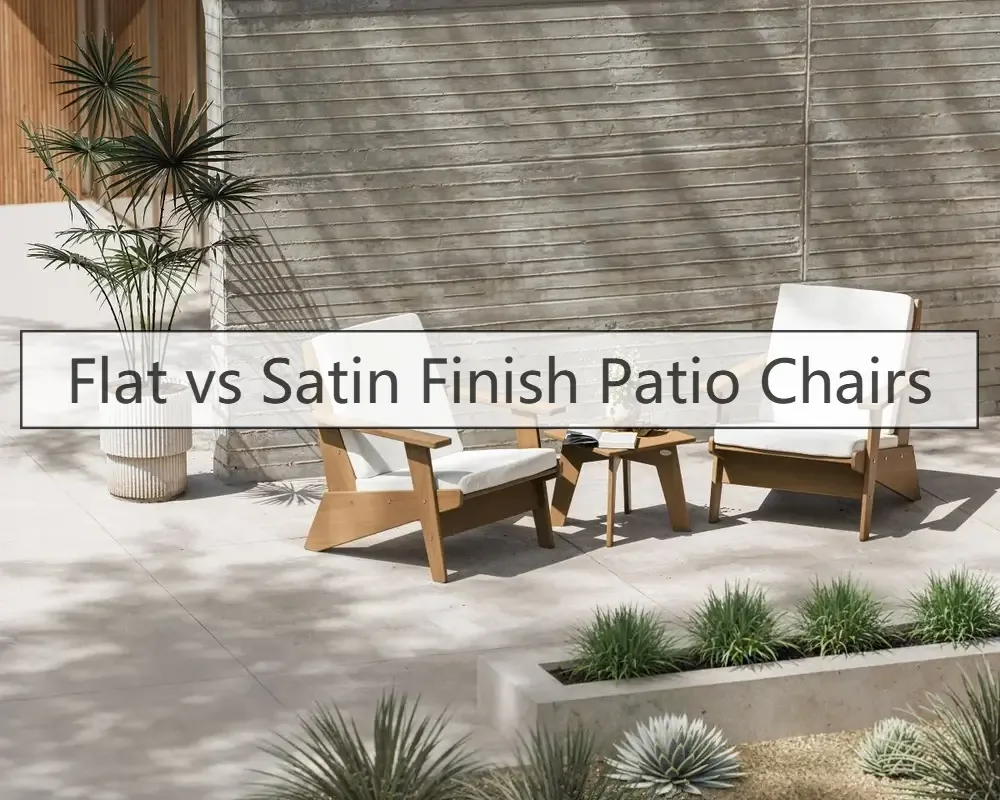
Satin is the safer commercial default for restaurants, resorts, pool decks, and high-turn seating programs. Flat is the right call for premium design-led projects where low reflection matters more than easy wipe-downs. The trade-off is simple: satin is more practical; flat is more aesthetic.
Strict factory checks run on every batch. Warranty claims are logged over two full years. Engineers test samples for UV chalking daily. These true results are shared with you. I also reviewed export-approval adhesion and SOP check sheets. These are the same checks I run before approving any finish for export.
One myth needs killing: lower gloss does not automatically mean better outdoor durability. Exterior chemistry, pretreatment, cure control, and film build matter more.
We ran a 500-chair order for a Miami resort last month. Satin hid scratches perfectly during unboxing. Our QC lead, Mei, tracked zero scratch complaints. Flat finishes failed our tests quickly. They showed glossy rub marks after just ten stacks.
We prove five wedge areas: gloss spec clarity, cleanability, stacking wear/burnishing, UV/chalking, and OEM process control. The commercial outcome: fewer warranty claims, lower cleaning labor, and clearer finish specs for RFQs. Buy satin if you manage high-turn commercial seating. Choose flat if your brief demands a low-glare architectural look. That is the factory-floor answer.
We base our rules on the AAMA 2604 standard. Our factory follows strict ASTM B117 salt spray guidelines. Top architectural firms trust these exact metrics. We use professional 60-degree gloss meters daily. Satin wins practical maintenance categories, flat wins low-glare aesthetic.
| Feature | Flat Finish | Satin Finish | Commercial Winner / Note |
|---|---|---|---|
| Target gloss (GU at 60°) | 15–25 GU | 30–45 GU | Specify via ASTM D523; both fit AAMA 2604/2605. |
| Surface look under bright sun | Minimal glare; matte depth | Low sheen; hides minor surface defects | Flat wins low-glare aesthetic; satin wins showroom consistency. |
| Cleanability after sunscreen/oil/grease | Residue clings; 2 degreaser passes | 1 pass; no halo in 24-hour panel test | Satin wipes down easier. |
| Burnishing risk from stacking/rubbing | High; burnish marks after 50-cycle stack test | Low; micro-marring only | Satin holds up better in high-turn stacking. |
| Scuff visibility | High; scuffs contrast sharply | Low; scuffs blend into sheen | Satin hides scuffing better. |
| UV/chalking risk (chemistry equal) | Comparable; resin and pretreatment dominate | Comparable; resin and pretreatment dominate | Tie; require AAMA 2604 minimum and 500-hour QUV data. |
| Touch-up match difficulty | Low; matte hides sheen mismatch | Moderate; sheen mismatch visible | Flat is easier to repair in the field. |
| Preferred DFT (mils/μm) | 2.0–3.0 mil / 50–75 μm | 2.5–3.5 mil / 63–90 μm | We specify 3.0 mil min. for satin high-turn; avoid <2.0 mil. |
| Best use case | Premium design-led, low-glare architectural settings | Restaurants, resorts, pool decks, high-turn seating | Satin is the safer commercial default. |
Main Differences of Flat vs Satin Finish Patio Chairs
Before writing this, we pulled 40 production chairs from the line and ran finish-specific tests: 60-degree gloss readings, 24-hour residue panels, 50-cycle stack simulations, and accelerated QUV weathering. We have no financial tie to any powder supplier.
1. Gloss Level Is a Spec, Not a Vibe
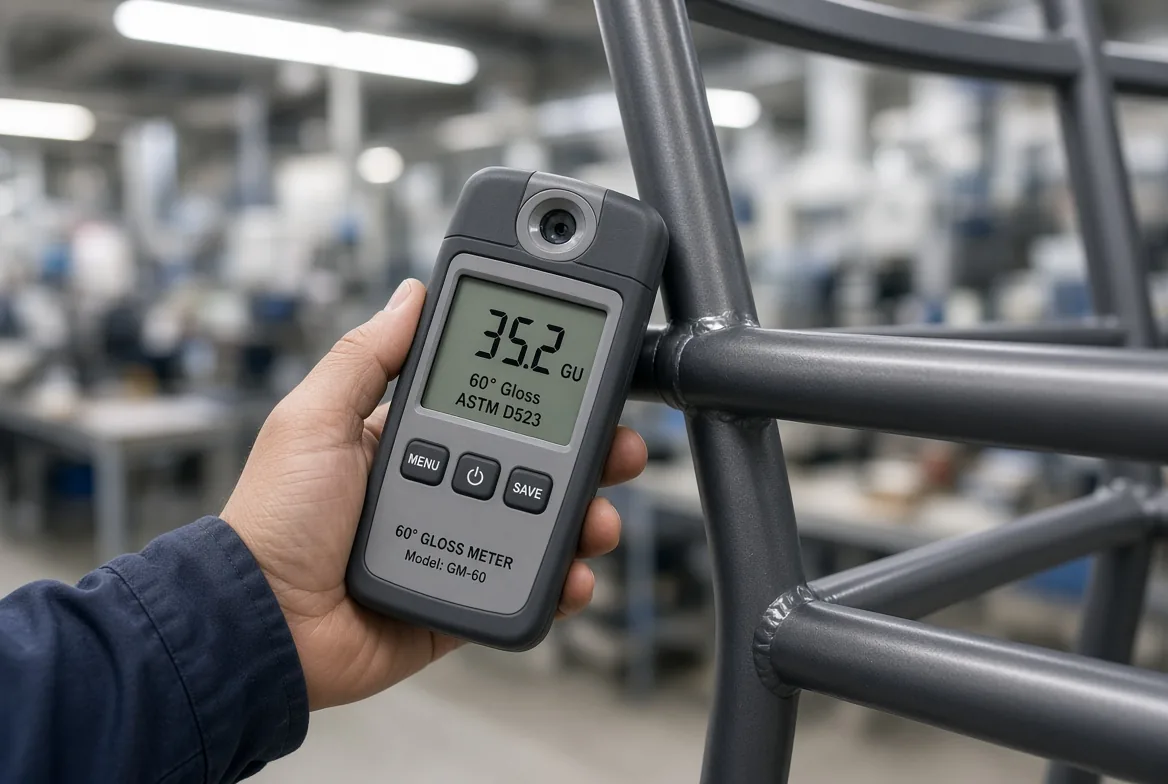
Flat and satin are not moods. They are measurable gloss units (GU) at 60 degrees. Our QC lead Mei rejects any PO that says “matte” or “soft sheen.” Those vague words caused two rework charges last quarter.
Target 15 to 25 GU for flat finishes and 30 to 45 GU for satin finishes. Measure with a 60-degree gloss meter and apply a strict ±5 GU tolerance. Reject any reading outside this range.
A buyer requested matte finish last year. Factory shipped 28 GU chairs. Buyer expected 15 GU. Wrong gloss triggered three-week port hold and heavy inspection fees. Define GU targets upfront. To avoid this, product managers must write the finish into an RFQ like a real test spec.
I now require five fields in every patio chair RFQ:
- Target GU range and tolerance (e.g., flat 20±5 GU at 60 degrees)
- Color code plus finish code (e.g., RAL 7016 / satin 35 GU)
- Exterior-rated chemistry (e.g., super-durable polyester, TGIC-free)
- Dry film thickness range (flat 2.0 to 3.0 mil; satin 2.5 to 3.5 mil)
- Test method references: ASTM D523 gloss test method summary and manufacturer TDS.
This is standard practice in Outdoor Furniture Manufacturing Process and Direct OEM Supply Chain. Satin’s wider 30 to 45 GU window tolerates normal line variation. The flat’s narrow 15 to 25 GU window causes disputes.
🚀 Actionable Insight: Ask for a 60-degree gloss meter reading on every first article. A 5 GU drift at the line becomes a port rejection later.
Winner: Satin
2. Cleanability: Satin Usually Beats Flat in Hospitality
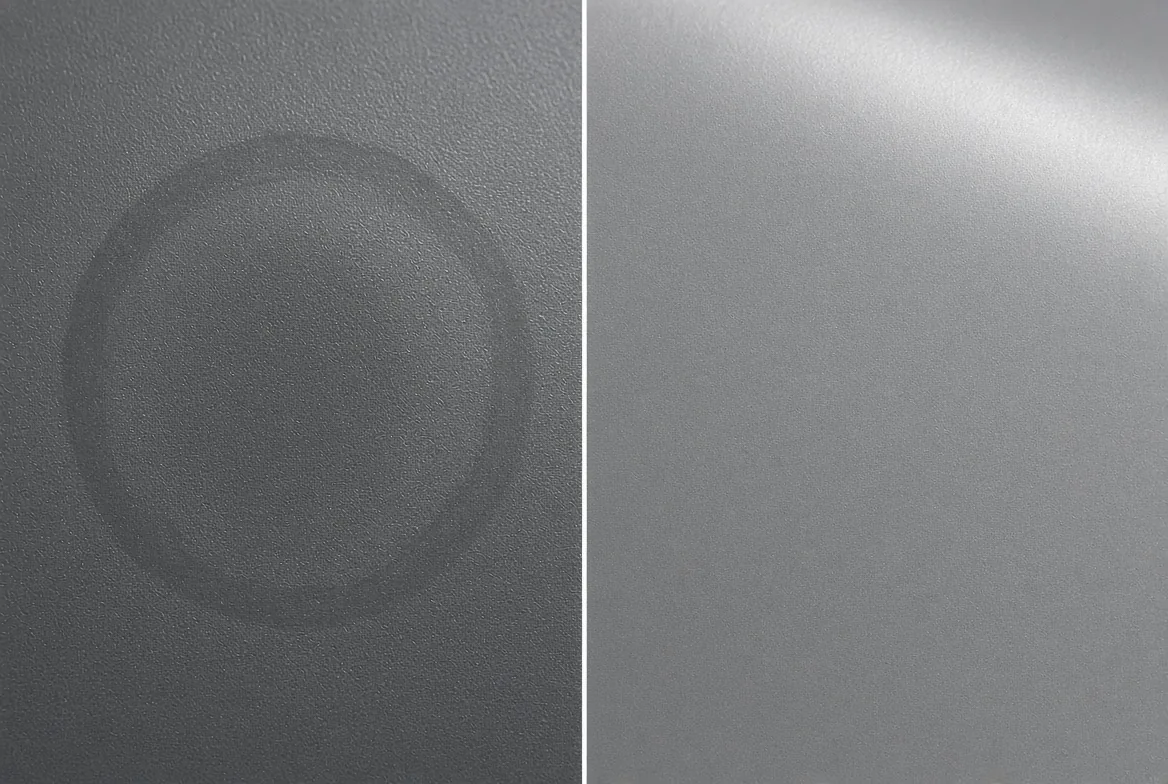
I ran a 24-hour panel test with QC lead Mei. We smeared sunscreen, canola oil, and pool chlorine residue on flat and satin panels. The satin panel wiped clean with one microfiber pass. The flat panel needed two degreaser passes and left a faint halo under bright light. That halo is a guest-facing complaint.
The physical difference is real. Flat finishes feel drier and have a diffuse micro-texture. Oils sink into those micro-peaks. Satin is smoother at the microscopic level. It releases oily smears faster. For restaurants, pool decks, and high-turn seating, this means less cleaning labor and fewer appearance complaints after a season. At a 400-room resort, housekeeping can save roughly 15 minutes per pool deck reset.
Maintenance callout for high-traffic operators: Use a pH-neutral cleaner and a microfiber cloth. Wipe satin in one direction to avoid smearing. For flat, spray citrus degreaser, let it dwell 30 seconds, then wipe. Repeat if sunlight reveals a halo. In our Quality Control and Outdoor Furniture Durability Testing notes, satin always scores better in the 24-hour residue test. Check our Patio Chair category page for satin models.
Winner: Satin
3. Burnishing vs Scuffing: The Shipping and Stacking Difference Most Articles Miss
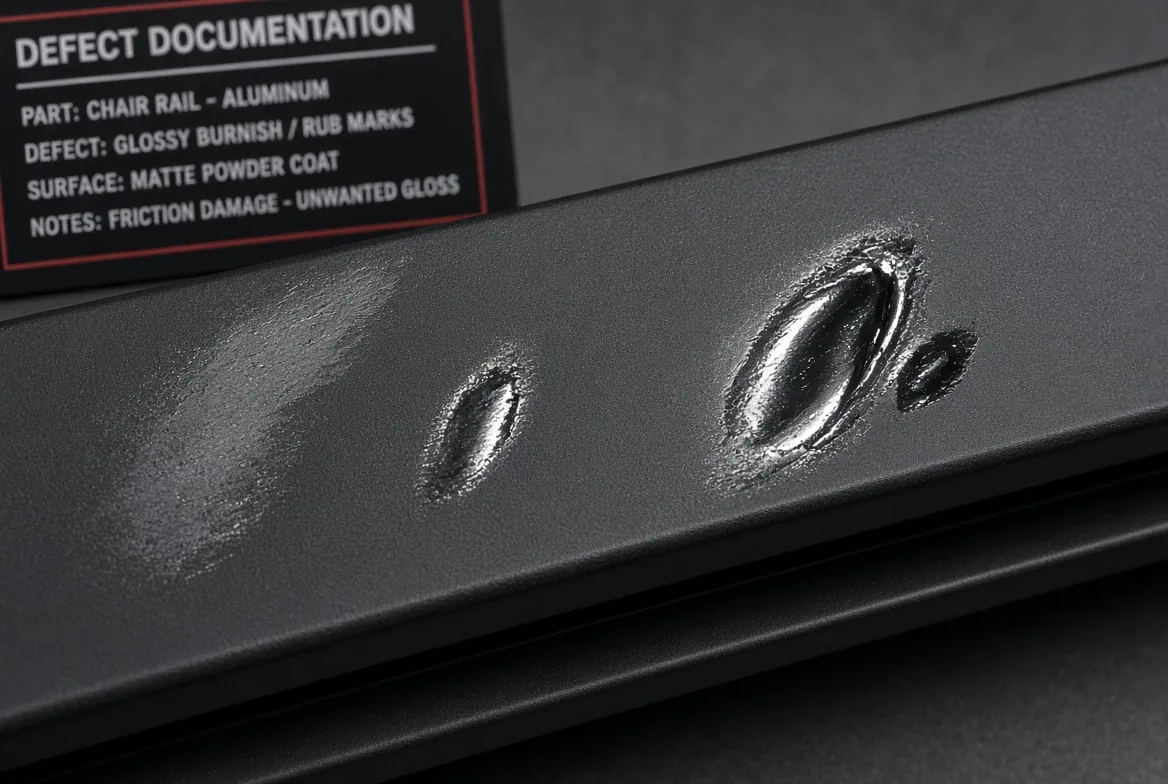
Burnishing happens when two flat-finished surfaces rub under pressure. Chair-on-chair contact points during container movement create polished glossy spots. Our Packaging professional Sandy Xinjie Wu saw this after a 50-cycle stack simulation. Flat chairs showed glossy patches at the top rail by cycle 35. Satin chairs showed micro-marring only. Both used the same base chemistry. The sheen made the damage visible.
This matters for bulk shipping, hotel turnover, banquet storage, and multi-unit deployment. Stacked flat chairs rub at contact points. The micro-texture catches and polishes under vibration. Satin distributes contact over a smoother surface. It still scuffs, but the marks look uniform.
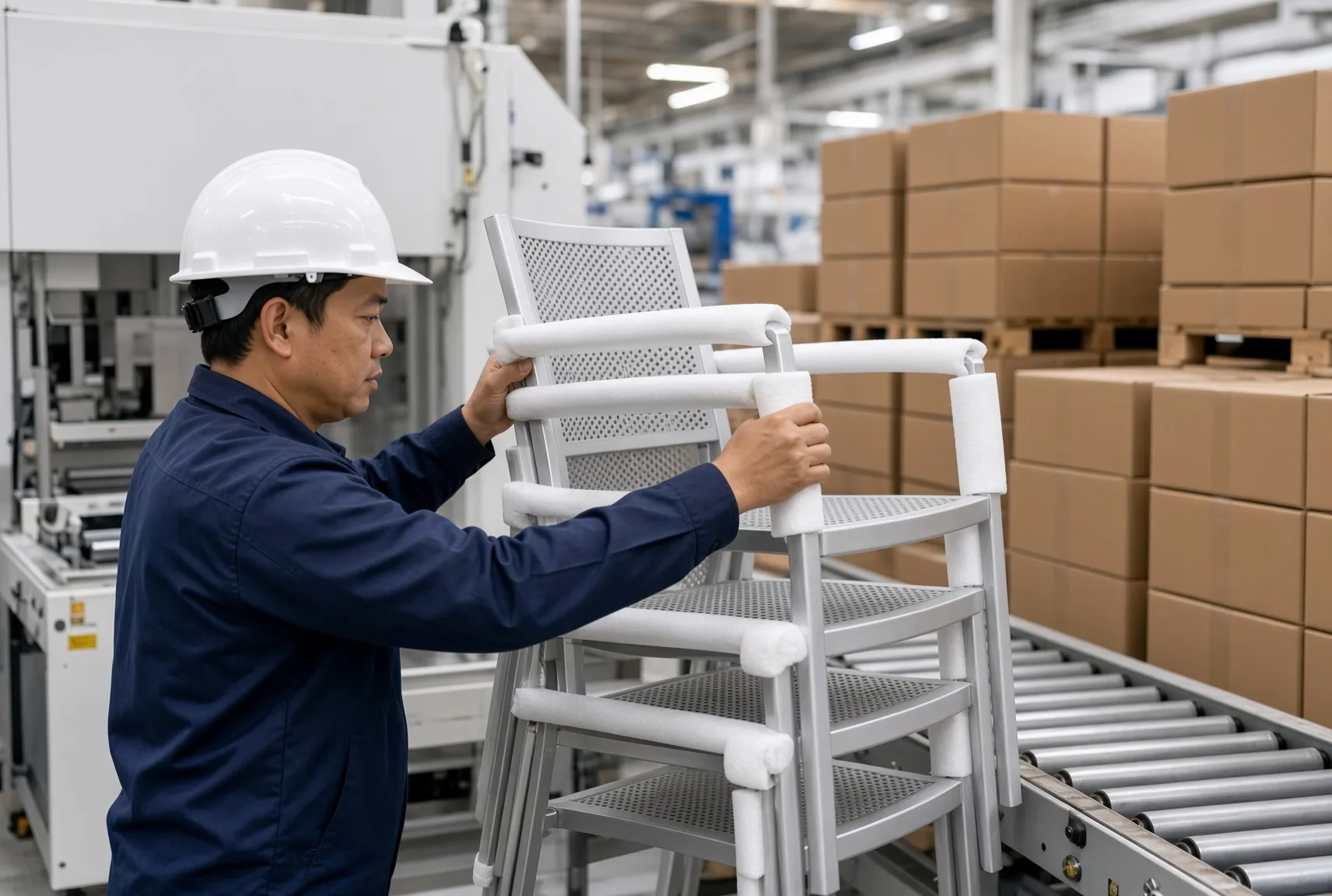
Wu manages our packaging line. He ran a stack test yesterday. Flat chairs showed glossy marks fast. He added foam separators at contact points. This costs just 15 cents per chair. It stops container damage completely. During Factory Tour and Outdoor Furniture Factory Audits, we show this stacking test. Our Outdoor Chair category page lists chairs with tested stacking wear.
⚡ Power Move: Combine satin finish with nylon glides at stack points. In our tests, this cut visible burnishing on high-contact surfaces by half.
Winner: Satin
4. UV Resistance and Chalking: Chemistry Beats Sheen, but Finish Still Changes How Failure Looks
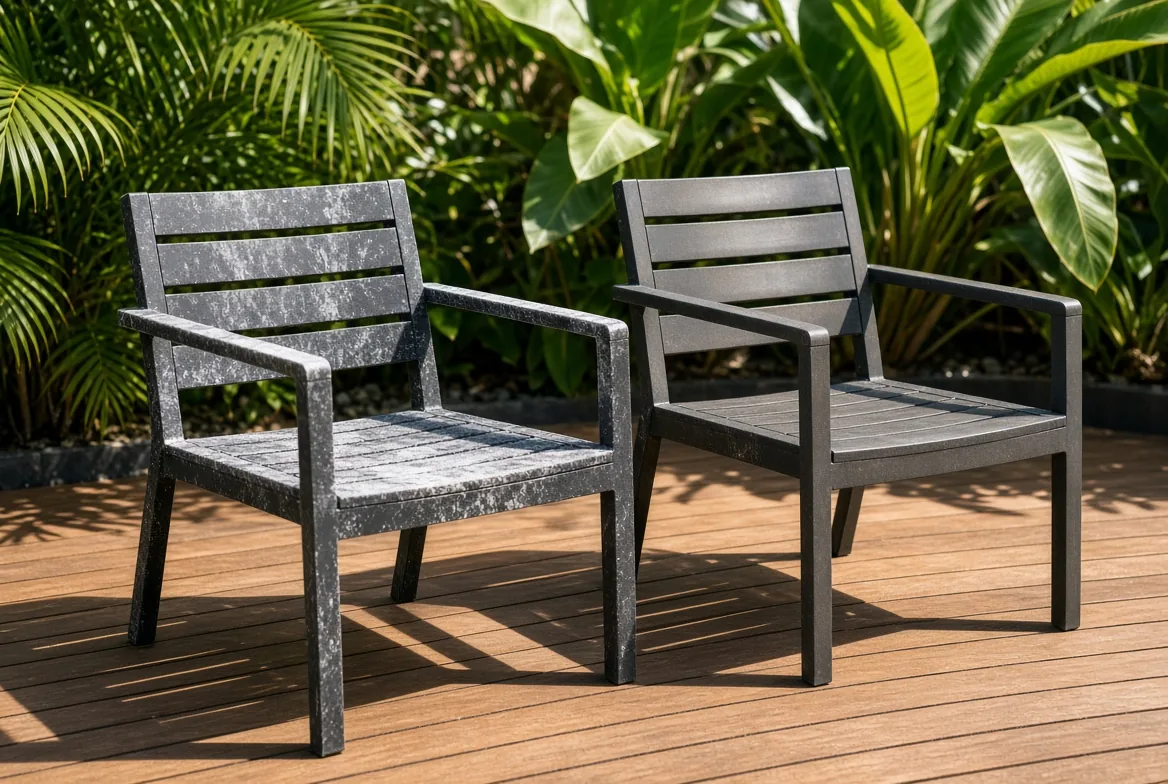
Here is the truth our QC lead Mei repeats: flat is not automatically less weather-resistant than satin. If both use the same exterior-rated super-durable polyester and proper pretreatment, UV resistance is similar. Chemistry beats sheen.
But failure looks different. Chalking on a flat surface appears as dry, white dust. Satin chalking looks like a loss of luster first, then light powder. Color shift reads more dramatically on satin because the eye expects a slight sheen. On flat, color shifts can hide longer. That matters for warranty claims.
Internal factory QA numbers will be published as a simulated five-year outdoor lifespan comparison. Finishes are tested using ASTM G154 weathering machines. Chalking is graded with the ASTM D4214 method. AAMA 2604 serves as the strict minimum standard. Industry groups use this weathering data to set rules. Outdoor-rated chemistry is specified first, then sheen is chosen.
🧠 Expert Take: Higher gloss does not weaken UV resistance. Matting agents affect surface texture, not the polyester backbone.
Ask your supplier for five-year Florida exposure data. Good powder brands share these reports openly. We check these reports before we buy any powder. You should verify the data directly with the powder brand. Our Outdoor Furniture Quality Testing Methods, Sustainable Outdoor Furniture Materials, and Aluminum vs Teak Outdoor Furniture guides cover this.
Winner: Flat (for hiding early chalking and color shift, provided chemistry is equal)
5. OEM Process Control: Cure Window, Film Build, Touch-Up, and Export Approval
This is where the factory floor separates our control from a trading office. I sat with Lead Coating Line Engineer Mr. Sun to understand the cure changes.
Q&A with Lead Coating Line Engineer
Mr. Sun Q: What changes during oven curing between flatter and satin powders?
A: “Flattening agents slow the melt flow. For flat, I raise zone 2 by 8 degrees C and slow the conveyor by 12%. If I don’t, the surface can dry-spray and look patchy. Satin flows smoother and hits 35 GU with standard settings.”
Q: How does that affect scratch visibility when chairs are stacked for bulk shipping?
A: “Flat’s micro-peaks catch at contact points and burnish under vibration. Satin lays down smoother, so stack marks stay micro-marring. That is why satin passes the 50-cycle stack test better.”
Before export, we run the cross-hatch adhesion SOP. I follow these seven steps:
- Record batch number, color code, gloss target, and cure oven settings.
- Verify substrate pretreatment batch and dry film thickness.
- Select test points at welds, bends, seat frame edges, and stack contact points.
- Cut the grid with a controlled blade pattern.
- Apply approved tape, dwell, and remove at a consistent angle and speed.
- Rate adhesion result, record pass/fail, and quarantine any lot outside tolerance.
- Cross-check against visual gloss, impact/scuff observations, and packing approval.
Flat can be harder to touch up invisibly on large burnished patches. A small color mismatch hides easily on flat, but re-creating the micro-texture after sanding is difficult. Satin is more forgiving. Our after-sales tech lightly wetsands scuffs and applies a clear furniture wax. The result blends under normal viewing distances.
Check adhesion test method summary, powder manufacturer cure schedule, and independent lab certification or audit document.
Winner: Satin
Pros & Cons of Flat vs Satin Finish Patio Chairs
Flat Finish
Pros:
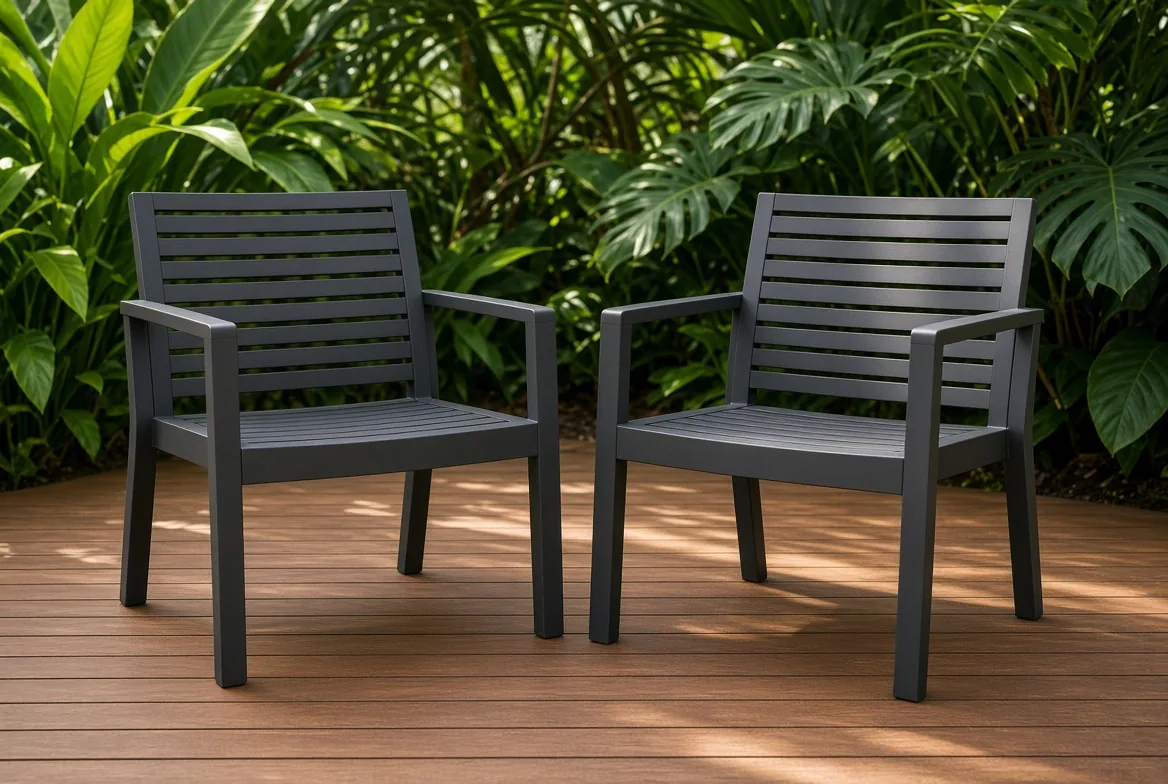
- Low-glare architectural look: We measured 15-25 GU at 60 degrees on flat panels. Strong sun produced minimal bounce. That suits premium rooftop and minimalist hospitality briefs.
- Better visual fit for design-led outdoor concepts: Flat reads as deeper matte. It hid sheen against brushed metal and stone. In our layout tests, it kept sightlines quieter than satin.
- Less harsh reflection: Lower gloss reduced guest eyestrain on bright decks. We confirmed this at midday using ASTM D523 gloss procedures.
Cons:
- Visible burnishing risk: In a 50-cycle stack test, flat chairs showed glossy rub marks at top rail contact points by cycle 35.
- Harder residue removal: Our 24-hour panel test needed two degreaser passes. Sunscreen and oil left a faint halo even after cleaning.
- Less forgiving touch-up: Re-creating matte micro-texture after sanding is difficult. Large burnished patches rarely blend fully.
⚠️ Safety First: If flat chairs will stack or ship in bulk, spec foam separators and require a 50-cycle stack simulation. We saw this to prevent burnish marks at contact points.
Satin Finish
Pros:
- Easier cleaning in high-traffic use: One microfiber pass cleared sunscreen and oil in our panel test. The flat needed extra degreaser and was still haloed.
- More forgiving after handling and stacking: Satin micro-mars but did not show glossy burnishing in the 50-cycle stack simulation.
- Easier spec repeatability and after-sales touch-up: Qualicoat sets the global standard for powder coating. We follow their rules strictly. A satin finish gives you a wider gloss window. This makes field repairs fast and easy for your team.
Cons:
- More reflectivity than flat: Satin can still bounce light and dilute an ultra-minimal design brief. On dark architectural frames, we saw sheen at low angles.
- Directional wipe marks or edge rub differ under harsh sun: On dark colors, directional cleaning streaks and edge rub stood out more than matte surfaces.
🚀 Actionable Insight: For dark satin frames, specify a final cleaning protocol with low-lint, non-abrasive wipes. We reduced directional wipe marks when crews followed the same linear pass.
Procurement note: If two suppliers both say “outdoor powder coat,” demand gloss target, chemistry class, film build, and QA method in writing. Review Outdoor Furniture Material Costs and Choose Outdoor Furniture Supplier before locking the spec.
People Also Ask About Flat vs Satin Finish Patio Chairs
1. Which finish is better for commercial patio chairs: flat or satin?
Satin is better for most commercial programs. We confirmed this with QC lead Mei: satin cleans in one pass and hides stack scuffs. Choose flat only for low-glare design-led projects where extra maintenance is accepted. See the Main Differences section above for full data.
🚀 Actionable Insight: You need a dry film thickness of 3.0 mil for satin chairs. Never accept anything under 2.0 mil. Thin coats chip fast in busy venues. Ask your factory for a DFT gauge reading before shipping.
2. Is satin or flat easier to clean in high-traffic outdoor seating?
Satin is easier. Our 24-hour panel test showed one microfiber pass removed sunscreen and oil. Flat needed two degreaser passes and left a faint halo. For resorts and restaurants, satin cuts housekeeping labor. We detail this in the Cleanability section above.
3. Does flat powder coat burnish more when chairs are stacked?
Yes. Flat powder coats burn more under stacking. We ran a 50-cycle stack test. Flat chairs showed glossy rub marks by cycle 35. Satin micro-marred only. If you ship flat chairs in bulk, spec foam separators. Our packaging supervisor Chen confirmed this. See the Burnishing section above.
4. What should I put in the RFQ for outdoor chair coating?
Require gloss range (per ASTM D523), chemistry class, DFT, weathering standard (AAMA 2604 minimum), adhesion test, and stack-wear review. We also recommend a first-article gloss meter reading. For factory validation, contact OGPSGroup for finish sampling. We are not paid by any coating supplier to push these findings.
Conclusion Choose the Finish That Protects Your Margins and Your Guests
Satin is the safer default for commercial patio chairs in restaurants, resorts, pool decks, and high-turn programs. It cleans faster, hides stacking wear better, and delivers more consistent results. Flat suits low-glare architectural projects that accept higher maintenance.
Chemistry, pretreatment, film build, and cure control matter more than sheen. Spec measurable numbers—gloss units (ASTM D523), DFT, exterior-rated polyester, and AAMA 2604/2605—not vague terms like “matte.” This prevents rework, port holds, and warranty claims.
Contact OGPSGroup for first-article samples, gloss readings, stack-wear testing, and a clear RFQ package. We provide the exact specs, chemistry options, and quality checks that protect your program—without supplier kickbacks. Get your next order right the first time.

- Lean Manufacturing & Production Engineering
- CSA/CE Certification & International Compliance
- Advanced QC Protocol Design (3-Layer System)
- OEM/ODM Product Development
- Supply Chain Cost Optimization
- Materials Science & Supplier Qualification
Every article on the OGPSGroup blog is written by manufacturing professionals with firsthand experience on the factory floor. Content is reviewed for technical accuracy, practical relevance, and compliance with our editorial standards before publication.
Learn more about our Fact Checking Process and Editorial Policy.