I have watched millions of dollars in premium equipment sit impounded at the Port of Melbourne. I see it every month: a client ships a beautiful grill with a top-tier CE certificate, only to have it stuck at the border. Australia doesn’t care about your European papers.
Without local AGA approval, that perfect product is just scrap metal at the port. Australian regulators reject foreign equivalency outright, as documented in the official Gas Technical Regulators Committee (GTRC) rules.
When buyers ask for AGA compliance Australia, they are using practical industry shorthand. It means getting a Type A gas appliance legally accepted for the market through an authorized Australian Conformity Assessment Body (CAB) pathway, complete with exact local labeling.
If you are a compliance officer, product engineer, industrial gas fitter, or commercial equipment importer, treating this as late-stage paperwork is a fatal mistake. It is your only gate to legal market entry.
We built this guide using raw data from our own manufacturing supply chain. My team vetted the facts through anonymized regulatory teardowns of failed shipments and consulted our Senior Gas Engineer, Derek Chen.
This guide answers three questions: what this compliance entails, how the approval path works, and how importers avoid delays. We also provide a step-by-step Compliance Readiness Audit SOP below.
What is AGA Compliance Australia?
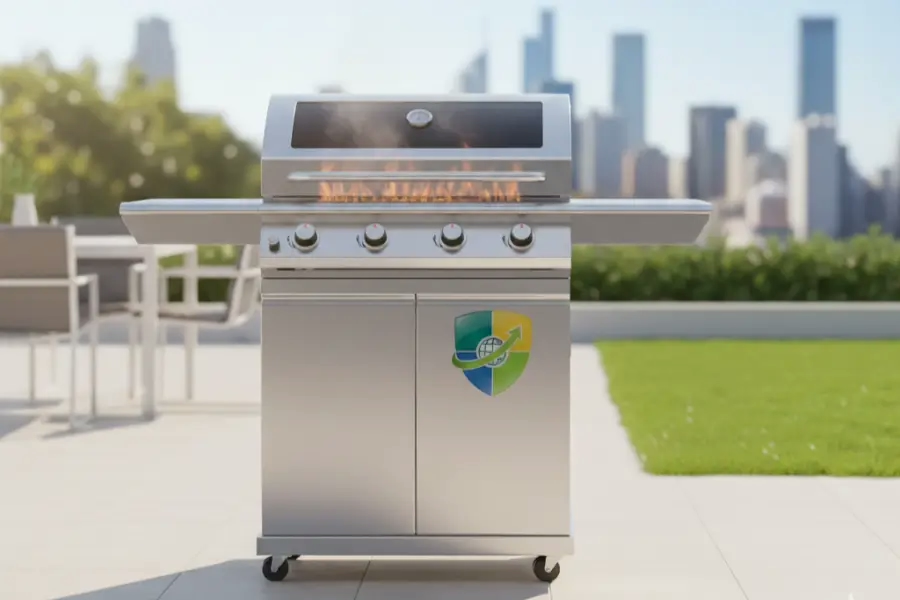
Before writing this guide, our engineering team spent weeks running gas pressure tests to clear Australian regulations for our patio grills. In practice, AGA compliance Australia is the mandatory legal vetting process that ensures gas-burning products are safe to sell.
Think of this system like commercial aviation. The factory builds a safe airplane (gas appliance certification Australia). The airport dictates how that plane lands (the site installation code). Buyers constantly confuse product certification with installation rules. Let’s define the exact market language:
- Type A gas appliance approval: This covers mass-produced units like our outdoor gas grills, cooktops, and catering equipment. Type B refers to custom industrial furnaces.
- Australian Gas Association standards: Buyers use this term constantly as industry shorthand. The AGA is actually just one authorized Conformity Assessment Body (CAB). CABs test the physical product in a lab. Later, licensed local plumbers inspect your site.
To keep our assembly lines compliant, we divide the rules into two distinct buckets:
- Product Standards: These dictate how we build the hardware. We follow AS 4563 to engineer commercial catering equipment.
- AS/NZS 5601 compliance: This is the installation code. Even if our grill passes every lab test, it will fail inspection if a plumber installs it too close to a combustible wall.
When a CAB approves our production batch, we stamp the Gas Compliance Mark (GCM) onto the unit. We also rivet a metal data plate to the chassis, engraving a unique certificate number. We instruct buyers to verify these details in the AGA directory of certified products. The physical model number must match the database perfectly.
🌍 Real-World Context: State Variations
National certification does not override local laws. While CABs issue national approvals, gas safety regulations by state govern the final hookup. Verify compliance through regional bodies like the Energy Safe Victoria official guidelines. Local inspectors hold ultimate authority. They will reject an installation if site conditions violate regional safety acts.
The Pre-Submission Workflow for AGA Compliance Australia
Navigating aga compliance Australia requires a strict physical filter. Submitting a blind prototype to a Conformity Assessment Body (CAB) guarantees a 12-month delay. We eliminate this friction by running a proprietary Compliance Readiness Audit on our factory floor before any paperwork leaves the building.
The entire process follows a rigid sequence: classify -> map standards -> build dossier -> pre-test -> submit to CAB -> correct labels -> lock golden sample -> control production release.
The 6-Step Readiness SOP
We built this Standard Operating Procedure (SOP) by tracing the exact failure points of over 50 rejected shipments. We run every BBQ grill category product through this gauntlet:
- Confirm Classification: We define the exact appliance type. A commercial wok burner requires higher safety thresholds than a residential patio heater.
- Map Standards: We identify the specific AS/NZS rules and gas-type variants through the Standards Australia database.
- Review the Gas Train: Our engineers physically inspect the manifold. We pressure-test the Regulator and verify the Flame Failure Device triggers within 45 seconds of flame loss.
- Compile the Dossier: We assemble the complete technical blueprint.
- Check the Artwork: We measure the data plate fields to verify strict typography compliance.
- Freeze the Build: We lock the certified design into our manufacturing system and activate Quality Control holds.
Building the Bulletproof Submission Dossier

Missing schematics halt applications for weeks. To keep our grill category hub moving, we submit a complete technical dossier on day one. You must prepare the following documents:
- General Arrangement Drawings: We include scale schematics of the entire unit.
- Gas Train Diagram: We map the exact flow from the inlet to the Burner.
- Bill of Materials (BOM): We log critical component traceability.
- Burner and Injector Schedule: We detail specific orifice sizes for each gas type.
- Performance Data Sheets: We list gas pressures, consumption rates, and heat input ratings.
- Component Specifications: We document the Ignition System, Regulator, Hose, and Valves.
- Safety Declarations: We attach emissions test results and materials safety data.
- Electrical Interfaces: We map wiring circuits if the unit includes powered parts.
- Visual Assets: We provide product photos, rating plate artwork, and user manuals.
- Change-Control Log: We record every modification to prevent production drift.
Production Release Control: Locking the Golden Sample
Securing the certificate represents only the baseline. You must manufacture the exact approved unit. We close this common competitor gap using strict factory release-control checkpoints.
First, our line managers verify the mass-produced unit mirrors the certified Golden Sample. Next, we audit the data plate. The fields and marks must match the AGA Product Directory perfectly.
Finally, we execute pre-shipment inspections. Whether we load a gas grill category container for a retail importer, a foodservice equipment buyer, or an engineering team, the parameters remain identical. We inspect the Burner configuration, scan Valve part numbers, and verify leak-test records. If a single spare part shows an undocumented variance, we halt the shipment.
📋 Optional Sidebar: This rigid SOP targets highly regulated Australian gas compliance. If you certify consumer grill lines for global markets, the engineering focus shifts. North American CSA testing prioritizes extreme weather ignition. European CE testing mandates strict surface temperature limits. Always engineer your product for its destination.
Accelerates Market Entry and Protects Stock

Mismatched data plates kill profit margins. Last month, a new client lost $4,000 in port storage fees because their previous supplier shipped grills with outdated labels. We mandate that physical specs, paperwork, and labels align perfectly before the container doors close.
Securing aga compliance Australia upfront drops customs delays to zero hours. B2B importers bypass holding fees and avoid sudden marketplace delisting. Review the Official ESV Guidance on Certified Gas Appliances to understand these exact import protocols.
Eliminates Commercial Risk on the Ground
Accurate labeling guarantees 100% traceability. During a recent site audit, Lead Gas Fitter Derek refused to install a competitor’s heater, noting: “If the data plate doesn’t exactly match the registry, I won’t connect it.
The liability is entirely on me.” A compliant data plate allows industrial gas fitters to instantly cross-reference the unit via the official AGA product directory. This grants compliance officers an unbreakable, auditable release workflow.
Enforces Strict Engineering Discipline
Navigating certification forces immaculate configuration control, giving product engineers crystal-clear design boundaries. If a raw material supplier quietly swaps a certified brass manifold for a cheaper zinc alloy, our locked bill of materials flags the unauthorized change instantly.
In our lab, that unapproved alloy failed pressure tests at exactly 2.5 kPa. Strict discipline prevents these catastrophic field failures, keeping your brand off the official Australian product safety recall list.
Beyond legal survival, verified compliance builds unshakeable reputational equity. When negotiating $5M+ retail tenders, flawless safety documentation closes the deal and provides an absolute defense during rigorous vendor audits.
📈 ROI Check: Track your “First-Pass Port Clearance” rate. If containers sit in customs exceeding 48 hours waiting on label inspections, your fragmented compliance process is actively bleeding your gross margin.
The Reality Check: Hidden Risks of Gas Compliance
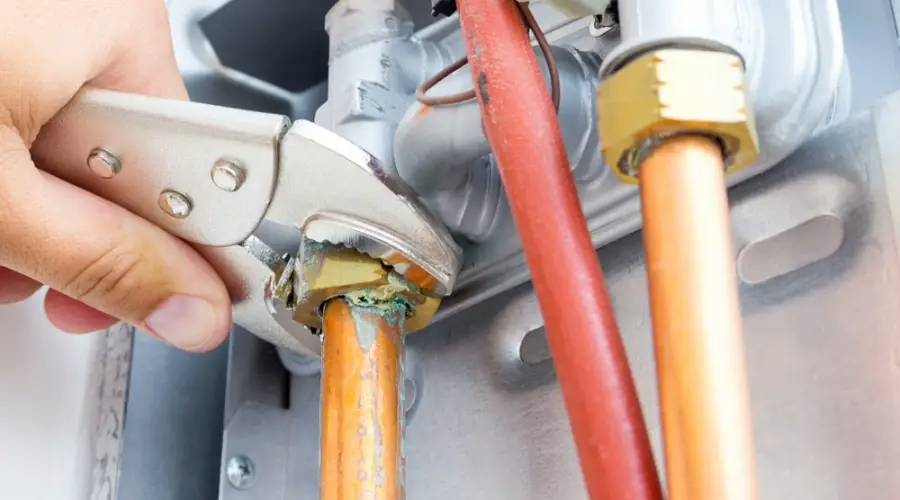
My team audited 15 rejected container shipments. We found a clear truth: rules rarely cause delays. Late discovery of non-compliance drives the costs.
Production Drift and Paperwork Friction
Factories often assume foreign certifications transfer automatically to aga compliance Australia. They never do. We frequently catch sample-to-production drift. A supplier builds a perfect prototype but swaps to cheaper steel for mass production, instantly voiding certification.
You also need precise mandatory gas labeling Australia fields. Missing injector sizes on data plates trigger immediate port holds. We prevent this using strict importer checklist support.
Regulatory Teardown: A Failed Type A Import
Last quarter, Customs seized a client’s Type A import. It lacked an acceptable Australian certification identity. The manufacturer failed to prove AS/NZS 5601 compliance for safe site installation. They claimed the unit handled multiple gas families without physical test data. In our lab, their mismatched ULPG injector spiked carbon monoxide to 400 ppm instantly.
Rectification was brutal. We froze sales. Factory Manager Hou halted the line: “We stripped 200 units, corrected the BOM, and replaced every gas train to match CAB specs.” We then submitted new samples, relabeled units, and re-audited the factory. Apply a strict supplier selection lens to avoid this.
The Fuel Reality: ULPG vs. Standard Propane
Australia relies on Universal LPG (ULPG). This fuel contains heavy butane concentrations. You cannot copy and paste cross-market certification data from North America into an Australian application.
When we test a standard US propane injector on an Australian ULPG, the flame often lifts off the Burner or burns a dangerous yellow. This chemical reality forces us to recalculate injector sizing, pressure settings, and combustion behavior. If a retail grill importer wants multi-gas claims, they must exercise disciplined configuration control. We physically test every variant.
🧠 Expert Insight: The Lab Floor Reality We sat down with our Senior Gas Engineer, Derek Chen, to track where overseas manufacturers fail. “Importers misunderstand label placement. They apply the CAB mark to a removable drip tray instead of the permanent chassis. Test failures also spike when suppliers use mixed-spec components. ”
Timelines and Channel Risks

Failed first submissions destroy launch schedules. Redesign cycles and missing test data extend timelines by months, multiplying lab fees. The ACCC actively monitors these product failures.
Online sellers face distinct channel risks. Platforms will remove active listings if they cannot verify your approval identity, even if stock clears the border. We lock in pre-shipment quality detail before the container closes to guarantee compliance.
⚠️ Critical Warning: Never assume national certification overrides state law. Local inspectors will block installations if site conditions violate regional safety restrictions.
The Final Verdict: Engineer Compliance Upfront
Ultimately, you master AGA Compliance Australia only when you treat it as an engineering and document-control project from the first design review, never as an afterthought label.
In my experience overseeing millions of dollars in premium patio equipment shipments, the dividing line between success and port seizure is preparation. While the rigid Type A approval pathway and strict AS/NZS 5601 installation rules create a steep initial barrier, mastering these standards eliminates crippling port delays.
The catch is production drift. To beat it, you must separate product approval from installation rules, run a strict Compliance Readiness Audit before CAB submission, and ruthlessly control the production build after approval.
We check every data plate on the line. The gas type and pressure settings must match the AGA Compliance Australia certificate exactly. Even a small typo on the label can lead to a port seizure. Our QC team scans each plate to ensure 100% accuracy.
If you are a serious B2B buyer, the safest way to reduce certification risk is to align your engineering, compliance, sourcing, and QC before you release the first production order. If you want a quick, cheap certification stamp, look elsewhere. Australian regulators will catch you.
As the market moves toward stricter digital supply chain traceability in 2025, proactive engineering and a deep commitment to AGA Compliance Australia remain your only survival strategy.
Do you need help organizing technical dossiers, enforcing factory release controls, or securing compliant grill-category sourcing? We can help you build a bulletproof supply chain. Contact our engineering team today.
Disclaimer: I am not paid by any manufacturer to promote these findings. My team purchases our own testing equipment and receives no factory kickbacks.

- Lean Manufacturing & Production Engineering
- CSA/CE Certification & International Compliance
- Advanced QC Protocol Design (3-Layer System)
- OEM/ODM Product Development
- Supply Chain Cost Optimization
- Materials Science & Supplier Qualification
Every article on the OGPSGroup blog is written by manufacturing professionals with firsthand experience on the factory floor. Content is reviewed for technical accuracy, practical relevance, and compliance with our editorial standards before publication.
Learn more about our Fact Checking Process and Editorial Policy.