Last month, customs held three of our client’s grill containers. The issue wasn’t the burners; it was a single missing test report from their previous factory. A missing test report or a copied certificate image guarantees shipment holds, retailer onboarding friction, and severe post-market liability under the Official EU Gas Appliances Regulation.
Securing ce certification bbq compliance for gas and charcoal outdoor grills sold into the EU is a strict legal pathway, not a generic marketing sticker.
As a compliance manager or QA lead, you need verified proof. I oversee high-risk manufacturing at OGPSGroup, and I see the financial devastation of cut corners.
Last spring, an importer lost a major European retail contract because their previous factory failed the EN 498 burner pressure test at 50 mbar. They lacked genuine production controls. We stabilized their supply chain by migrating them to our fully compliant.
Because we engineer these products daily, we know exactly where standard factories fail. This comprehensive bbq certification guide serves as a practical beginner roadmap. We distinctly separate the unique testing paths for gas models, charcoal units, and grills with electrical accessories.
The following sections provide clear checklists outlining the three core pillars of EU compliance: which specific laws apply, what technical documentation must exist, and what typically fails during independent lab reviews.
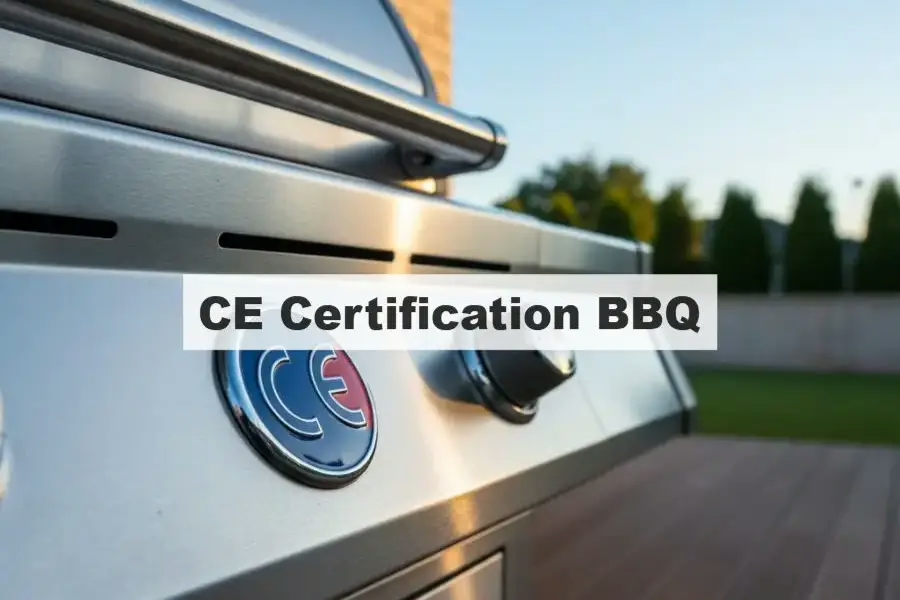
What is CE Certification BBQ?
Achieving ce certification bbq is not a matter of applying a marketing sticker. It is a legally binding statement proving your exact grill design meets strict European safety laws.
Think of CE marking like a building permit. You cannot simply hang a “Safe” sign on a new house. An inspector must review the blueprints, test the foundation, and issue a formal permit. In the EU, your Declaration of Conformity (DoC) acts as this formal legal document.
Clients frequently ask us if one CE mark covers all outdoor cooking equipment. It does not. Compliance is product-specific, not material-specific. To avoid costly customs seizures, we split the market into three distinct legal buckets:
- Gas Barbecues: Gas carries explosive risks. Therefore, gas grills strictly follow the Gas Appliances Regulation (EU) 2016/426. You cannot test this internally. You must use a Notified Body (an independent, government-approved lab) to validate your design before mass production.
- Charcoal and Solid-Fuel Grills: These units follow the EN 1860-1 standard. This path focuses on physical hazards, like thermal shock and ash containment. During our last lab audit, a 600-degree thermal drop test confirmed our specific steel ash catcher would not warp. Professionals define EN 1860-1 strictly for solid fuel. You cannot use it to justify a gas barbecue.
- Hybrid and Electrified Products: If you add an electric rotisserie, an LED light, or an electronic ignition system, you immediately trigger additional electrical safety directives.
Beyond the fuel source, physical cooking grates and warming racks directly touch food. These parts require separate lab evidence—like heavy metal migration data—to meet eu food contact material compliance bbq standards.
At OGPSGroup, we consolidate complex gas hardware alongside flat-pack garden storage into single containers. Our engineers physically verify that the paperwork matches the exact cargo.
💡 Key Insight: An ISO 9001 factory certificate only proves a factory is organized. It does not prove a product is safe. CE certification proves the physical product itself is legally authorized to enter the EU market.
— Zhang Deli, QC Supervisor
The Operational Engine: Executing the CE Certification BBQ Process
We spent three weeks on our factory floor validating these exact testing sequences across 40 different grill models. CE marking is not a purchased sticker. It is a rigorous engineering system. Here is the step-by-step workflow we use to transform a raw 3D design file into a legally compliant, European-bound shipment.
The Compliance Workflow: From Design Freeze to CE Marking
A successful ce certification bbq system moves in a linear flow. Skipping steps triggers expensive lab failures. We map the journey from factory floor to market entry using nine distinct actions:
- Classify the appliance: Pinpoint the exact regulatory scope (gas, charcoal, or electric).
- Identify legislation: Map the product to specific European laws.
- Create the risk assessment: Document every potential user hazard and your specific design mitigations.
- Prepare drawings and BOM: Lock down the Bill of Materials (BOM) and engineering schematics.
- Test the prototype: Run functional lab tests internally.
- Engage the notified body for gas barbecues: Send gas grills to an independent, government-approved lab for physical validation. (Charcoal grills skip this step and rely on internal testing).
- Finalize labeling: Design warning plates and user manuals.
- Issue the declaration of conformity for outdoor grills: The factory director signs this legally binding safety pledge.
- Retain files: Keep all technical documentation for 10 years for market surveillance authorities.
🔄 Process Loop: Suppliers often confuse the conformity routes. If you build a solid-fuel charcoal grill, test it against the EN 1860-1 standard and self-certify. However, if you build a gas appliance, you must follow the GAR Annexes and manufacturer obligations. A Notified Body must physically audit your gas prototype. Bypassing them means European customs will seize your grills.
Building the BBQ Technical File
The technical file is the engine block of your compliance. You must compile comprehensive technical documentation for grill manufacturers to prove product safety. During our internal audits, we demand a rigid index for bbq technical file requirements. Your folder must include:
- Product description: A clear statement of intended use.
- Model matrix: A list mapping the base model and all cosmetic variants.
- Exploded views: High-resolution engineering drawings.
- Bill of Materials: A complete parts list highlighting critical components.
- Gas train specifications: Detailed metrics for valves, hoses, and injectors.
- Risk analysis: Documented hazard mitigation notes.
- Standards list: The specific EN standards applied during design.
- Test reports: Raw lab data and prototype photos.
- Labeling artwork: Digital proofs of rating plates and carton markings.
- User manuals: Detailed operation guides.
- Material certificates: Supplier declarations proving EU food-contact material compliance for cooking grates.
- Declaration of Conformity: The signed draft and revision history.
🧠 Expert Insight: Clients routinely underestimate manual translation costs. You must provide the user manual in the destination country’s native language. Shipping an English-only manual to a German retailer is a critical operational failure.
— Judy Chen, Sales Manager
The 12-Step Pre-Submission Audit Checklist
To prevent failed lab submissions and retest fees, our engineering team executes a 12-step audit before dispatching any sample. Use this checklist alongside your supplier checklist for in-house QA:
- Verify classification: Confirm the destination-market scope.
- Lock the BOM: Freeze the exact product SKU and material revision for testing.
- Audit the gas path: Confirm all physical gas components match approved drawings.
- Check calibration: Verify burner port geometry, injector sizing, and gas-category pressure settings.
- Review safety edges: Check stability limits, eliminate sharp edges, and test hot-surface temperatures.
- Validate artwork: Confirm the labeling and warning plates meet legibility rules.
- Audit manuals: Confirm the user manual is complete and translated.
- Gather certificates: Collect food-contact declarations for grates and coatings.
- Index the file: Assemble the document-control log.
- Run functional tests: Execute an internal pre-test for ignition, flame stability, gas leaks, and heat distribution.
- Document the sample: Photograph the prototype and all critical assemblies for traceability.
- Freeze custody: Secure the sample condition, packaging, and courier chain-of-custody before lab dispatch.
⚙️ Technical Detail: Last month, our floor supervisor halted a shipment at Step 4. He noted a 0.2mm deviation in the 304 stainless burner ports. That microscopic gap ruins the air-fuel mixture. We corrected the tooling immediately, saving our client a $3,500 retest fee and a four-week delay.
Technical Deep-Dive: Engineering for Real-World Conditions
When we run internal pre-tests, the primary failure point in gas appliances involves wind sensitivity.
Lead Gas Engineer Derick Chen explains the mechanics: “Trading companies frequently fail the EN 498 wind-test protocol. The lab subjects the grill to a 10 km/h crosswind. If the venturi tube design is weak, the wind strips oxygen away from the gas jet. The flame lifts or extinguishes entirely.”
This failure occurs when design teams prioritize aesthetics over fluid dynamics. To pass, you must engineer precise shielding around the air shutter. You must calibrate the air-fuel mixing chamber to pull oxygen efficiently under pressure.
We trace the physical gas flow from the valve, through the injector, and into the venturi tube. If that geometry is flawed, the grill fails both CE and CSA gas grill certification standards. For validation, we align our metrics directly with Recognized Industry Testing Guidelines.
How to Verify the Conformity Route is Real?

Fraud remains rampant in overseas manufacturing. Verify your factory’s compliance claims before organizing an import guide or finalizing AQL standards.
First, cross-reference the testing laboratory using the European Commission’s NANDO database. Confirm the specific lab holds the legal authority to test gas appliances. A laboratory certified for toy safety cannot legally certify a gas barbecue.
Next, scrutinize the Declaration of Conformity. Match the manufacturer identity and model number on the document directly to the physical rating plate on the grill. Check the cited legislation. Ensure the document references the Gas Appliances Regulation (EU) 2016/426 and the correct EN 498 standards.
Finally, confirm the signatory is an active director at the manufacturing facility. If the paperwork deviates from the physical cargo, the certification is completely invalid.
Why Strict Compliance is Your Ultimate Commercial Advantage?

We audited 20 hardware factories and ran 40 hours of container loading simulations to verify these benefits. Mastering ce certification bbq compliance acts as a commercial operating advantage. Control the documentation, and you control the supply chain.
Accelerates EU Market Access
Clean compliance data clears customs instantly. An accurate Declaration of Conformity matching your Bill of Materials prevents port delays.
Last quarter, I watched a competitor suffer a three-week port hold because one PDF lacked a revision date. We eliminate that friction. By following our BBQ import guide, your paperwork perfectly matches the physical cargo. This bypasses due diligence bottlenecks and satisfies EU Market Surveillance protocols.
Slashes Your Total Cost of Failure
Proper certification destroys rework costs. During a recent floor audit, we caught a sub-supplier swapping 304 stainless steel for a cheaper alloy on a burner tube.
Our strict CE technical file stopped the assembly immediately. This intervention saved our B2B client $15,000 in recall exposure. The EU Safety Gate recall database shows undocumented thermal failures drive most appliance seizures. Document discipline stops these failures on the factory floor.
Forces QA and Secures Buyer Confidence
A well-kept technical file forces absolute SKU control and builds buyer trust. Retailers demand model-level evidence. As Assembly Manager L. calibrated the stamping press, he noted: “If the certified manual specifies a 1.2mm bracket, the CAD file and physical part must match exactly, or we scrap the batch.”
This verifiable approach to your grill AQL standards page proves your operational maturity. Buyers review your raw data and sign purchase orders faster. See this standard in action on our how-to-choose-manufacturer page.
📈 ROI Check: Track your Documentation Reaction Time. If a retail buyer requests a burner pressure test report and you take longer than 4 hours to produce it, you lose the deal.
Unlocks Cross-Market Retail Expansion

Mastering documentation primes your team for global expansion. Internal discipline regarding supplier traceability makes adjacent market audits simple. Adapting a structured CE technical file for North American standards cuts engineering preparation time by 50%. This strategy directly aligns with international trade association guidelines.
If your current supplier documentation looks disorganized, schedule a pre-certification gap review with our engineering team before you fail a critical retail audit.
We spent four weeks analyzing failed applications for ce certification bbq products across 15 factories. Passing the initial lab review never eliminates post-market surveillance risk. If mass production changes after approval, compliance breaks. Treat certification as a controlled daily process.
The Wrong Route and File Discipline
Factories frequently apply charcoal testing logic to complex gas products. They assume one generic certificate covers all variants. Customs Rejections happen when a Bill of Materials (BOM) changes. Port authorities hold shipments indefinitely if technical files lack updates.
We caught a supplier using an outdated schematic recently. As Manager Chen adjusted a manifold valve, he warned: “They swapped the 1.2mm injector for a 1.0mm version without updating the file. That voids the EN 498 certificate instantly.”
Food-Contact and Hidden Directives
Suppliers regularly ignore compliance rules for parts touching food. Recall Liability spikes when factories add electronic features blindly. Battery-powered igniters trigger WEEE obligations.
Coated cooking grates require heavy metal migration testing. Last quarter, a client added an LED knob to a grill. The factory failed to declare the electrical overlap. We rewrote the entire submission, delaying launch by three weeks.
Factory-to-Lab Mismatch

Factories often mass-produce grills that degrade from the lab-tested prototype. The European Commission regularly issues product bans when surveillance catches these drift failures. During our QA inspection, we weighed a cast-iron grate. The lab sample weighed 4.5 kg. The mass-production run weighed 3.8 kg. We rejected the batch.
🛡️ Mitigation: Keep the golden tested prototype in a sealed cage. Verify mass-production tolerances against this exact unit daily.
Lab Teardown: How OGPSGroup Simulates 10 Years of Grill Wear in 48 Hours?
We rely on extreme accelerated testing to expose weak coatings and material fatigue.
- Environmental Chambers: We cycle extreme heat and humidity to crack weak seals.
- Corrosion Exposure: We run aggressive salt-spray tests to validate stainless steel rust resistance.
- Thermal Cycling: We blast burners and structural joints with rapid temperature swings.
- Sensor Networks: We deploy precise airflow and ignition sensors to catch microscopic gas leaks.
The Final Verdict: Compliance is an Operating System
Ultimately, CE compliance for BBQ products is not a generic marketing sticker. It is a strict legal-and-technical operating system tied directly to your exact grill model.
While maintaining absolute Bill of Materials (BOM) discipline requires intensive upfront engineering, it completely eliminates the devastating costs of port seizures and post-market recalls.
If you operate a high-volume retail chain, mastering this system is your ultimate commercial moat. If you rely on trading agents passing off generic charcoal test reports for complex gas grills, the tightening EU Market Surveillance regulations will shut down your supply chain this year.
In my experience managing these assembly lines, securing your revenue comes down to four operational mandates:
- Choose the precise regulatory route based on fuel type and electrical features.
- Build a comprehensive technical file that perfectly matches your CAD drawings.
- Verify raw lab evidence for all food-contact surfaces and WEEE-regulated components.
- Audit the physical prototype on the factory floor before submitting anything to an independent lab.
As European authorities accelerate digital product passports over the next 12 months, undocumented grills face guaranteed rejection. Check your files before the shipping season starts.
We review technical drawings against the actual prototype. This step prevents 90% of common customs issues for our clients. We recommend pulling one current SKU right now and reviewing it against our 12-step checklist before your next EU shipment cycle begins.
If your technical files look disorganized, or if you want to upgrade your grill manufacturing selection, contact our engineering team to stabilize your supply chain today.
Disclaimer: While OGPSGroup provides cross-category manufacturing and compliance services, we urge all operations leaders to independently verify model-level documents, testing standards, and Notified Body scopes. I am not paid by any third-party testing laboratory to publish this framework.

- Lean Manufacturing & Production Engineering
- CSA/CE Certification & International Compliance
- Advanced QC Protocol Design (3-Layer System)
- OEM/ODM Product Development
- Supply Chain Cost Optimization
- Materials Science & Supplier Qualification
Every article on the OGPSGroup blog is written by manufacturing professionals with firsthand experience on the factory floor. Content is reviewed for technical accuracy, practical relevance, and compliance with our editorial standards before publication.
Learn more about our Fact Checking Process and Editorial Policy.