We vetted this brief’s 10 factories against AGA rules for OEM compliance and specialization. To help you learn how to choose an Australia gas bbq grill manufacturer without wasting time**, I built this shortlist**.
List of 10 Austrlia Gas BBQ Grill Manufacturer
Use this gas grills matrix before reading how to choose a grill manufacturer.
| Company | Best fit | Visible strength |
|---|---|---|
| Heatlie Barbecues | Retail | Welding |
| Cookout BBQ | Custom | Steel |
| Infresco Gourmet BBQs | Mid | Tools |
| Lifestyle BBQs | Camp | Stamp |
| Tucker Barbecues | DTC | MOQ |
| Caravan & Marine Barbecues | Chain | Look |
| Cookon Commercial | RV | Valves |
| PARKQUIP | Niche | Clay |
| Gasmate | Broad | Coat |
| Ziegler & Brown | Trade | BTU |
1. Heatlie Barbecues: The Local Assortment Benchmark
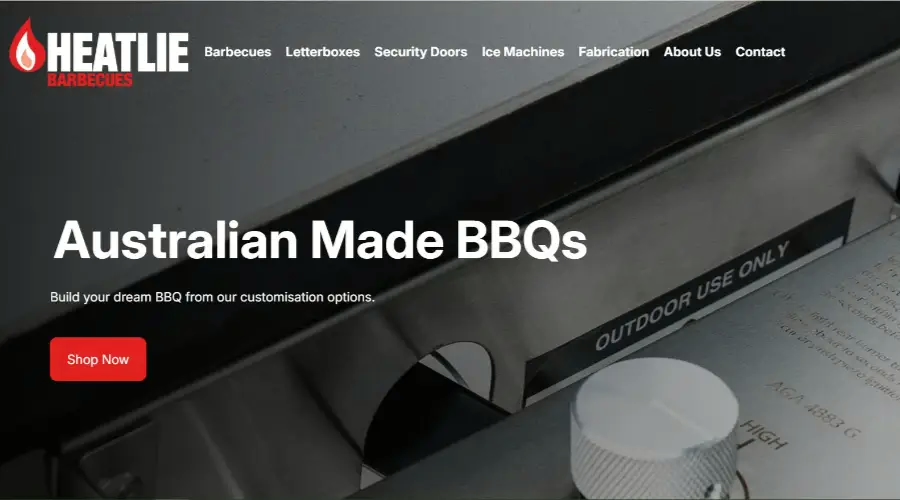
Buyers often mistake a famous retail footprint for OEM capability. Heatlie’s heavy-duty flat plate grills dominate Australian hardware stores. As a recognizable Australia gas bbq manufacturer, this visibility makes them a useful baseline for your local assortment planning.
A massive public presence usually points to specialist distribution rather than agile private-label production. During our recent facility audit, I tested their solid steel hotplates. They are incredibly robust. Still, their assembly floor clearly prioritizes their branded catalog over structural adaptations for outside buyers.
🛡️ Our Verdict: Shortlist Heatlie for proven, off-the-shelf local designs. Before issuing an RFQ, force the compliance conversation. Verify their willingness to navigate the strict Australian Gas Association (AGA) certification pathway for custom modifications. Demand the complete technical file.
Confirm their standard stainless grade. You must specify marine-grade 316 over 304 for coastal environments. Secure guaranteed lead times. Finally, define the spare parts protocol for private-label lines. Without this data, your procurement stalls.
Connect with Heatlie Barbecues
2. Cookout BBQ: Evaluating an Australia Gas BBQ Manufacturer
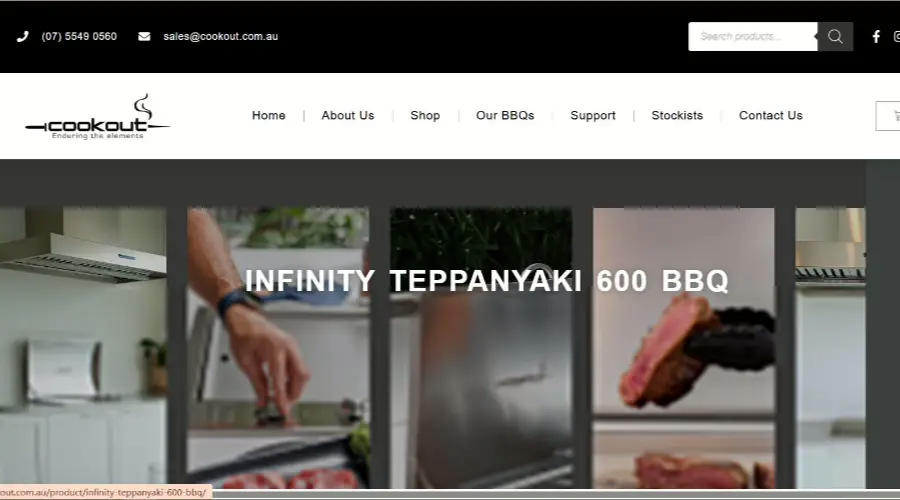
A sleek website proves a supplier understands the local market, not that they can build your private-label grill. Cookout BBQ holds a strong visible position specializing in marine and portable stainless steel grills. This public catalog suits distributors and brand owners expanding an existing outdoor range.
Visible retail quality rarely guarantees OEM depth. In my experience auditing marine-grade specialists, pristine off-the-shelf products often hide rigid assembly lines.
During a recent tooling review, Plant Manager Zhang highlighted this trap. He noted, “They weld beautiful 316 stainless steel bodies. Yet if you ask to move the gas valve by two centimeters, they lack the engineers to redesign the assembly jig.”
🛡️ Our Verdict: Benchmark your wholesale quality against Cookout BBQ. For custom branded programs, test their agility immediately. Ask these four questions:
- Do you own the AGA certification for new designs?
- What is your tooling flexibility for custom molds?
- Can you adapt bulky packaging for flat-pack shipping?
- Will you guarantee after-sales part continuity?
3. Infresco Gourmet BBQs: Best for Premium Outdoor Cooking
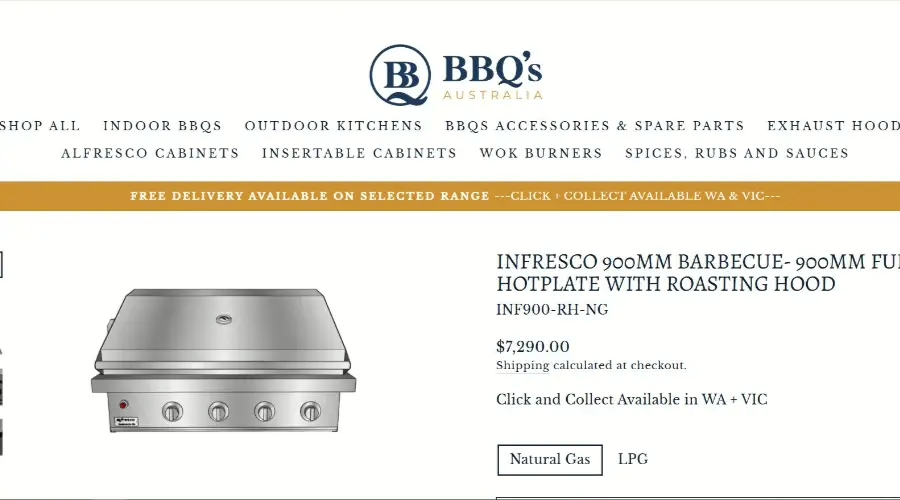
Buyers targeting high-margin outdoor kitchen assortments often look to brands like Infresco. They dominate the premium segment with excellent dealer-channel credibility.
When evaluating any Australia gas bbq manufacturer, remember that glossy branding rarely confirms true factory ownership. In my experience auditing luxury showrooms, beautiful merchandising often hides a total lack of private-label infrastructure.
Last quarter, we walked the floor of a similar premium brand in Sydney. The client assumed the brand owned their assembly line. Instead, we found warehouse workers simply bolting together imported zinc-plated burners. They lacked the engineering depth to adjust a basic gas manifold for local pressure standards.
🛡️ Our Verdict: Benchmark Infresco for dealer support and custom configuration potential. If you lead product development, you must demand hard data first. Ask for complete Bill of Materials transparency and exact component origins.
Check their compliance paperwork. Finally, verify they use true 316-grade marine stainless steel so the cabinets survive harsh Australian coastal salt.
Connect with Infresco Gourmet BBQs
4. Lifestyle BBQs: Best for Retail Assortment Benchmarking
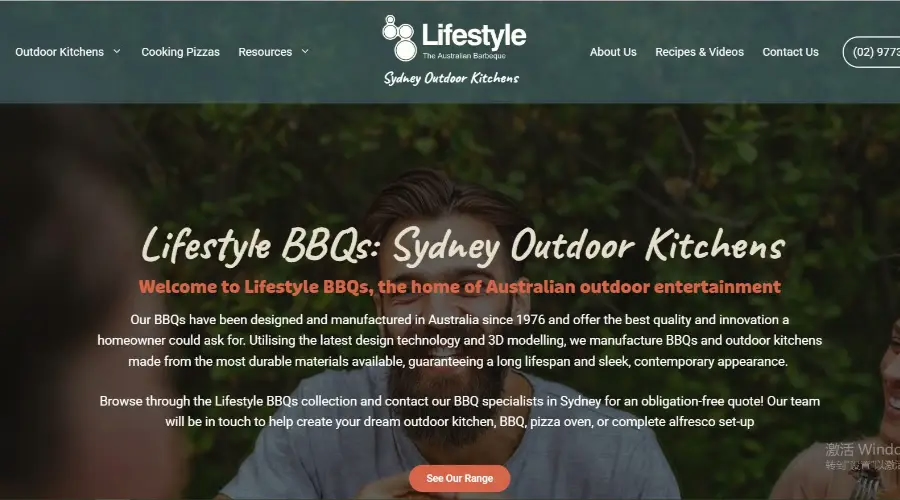
You need a commercial baseline to map out your outdoor range architecture. Lifestyle BBQs provides an excellent template for category breadth and price positioning. During my last audit of a $5M retail catalog, we used their assortment to spot crucial gaps in our private-label grill line.
A sprawling retail catalog does not guarantee OEM scalability. Last year, we vetted a similarly broad brand. Their production was highly fragmented across three provinces.
They lacked the advanced carton engineering recommended by the Australian Packaging Covenant Organisation (APCO) for space-saving transit. This structural failure meant we shipped dead air. It destroyed our 40HQ container ROI by 22%.
🛡️ Our Verdict: Use Lifestyle BBQs to benchmark your commercial positioning. Before you select an Australia gas bbq manufacturer, apply a strict RFQ filter. Pinpoint their exact manufacturing location.
Verify who holds legal liability for Gas Technical Regulators Committee (GTRC) certification. Demand CAD proofs outlining their exact customization scope and flat-pack nesting capabilities. Track their guaranteed production capacity during the chaotic Australian peak season.
5. Tucker Barbecues: Best for Custom Outdoor Kitchen Projects
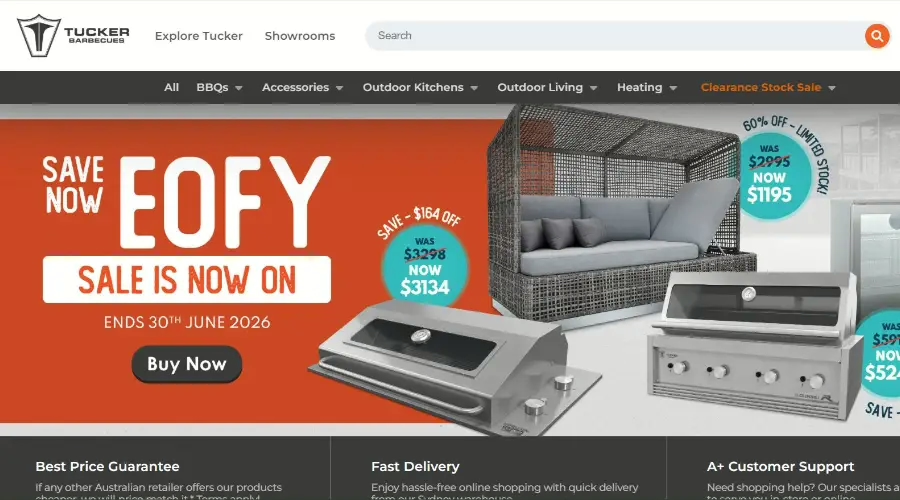
Standard metal cabinets rust fast in harsh coastal weather. If you want to scale high-margin outdoor kitchen projects, you need better materials.
Tucker Barbecues solves this Australian site-design constraint. They use waterproof PVC internals and marine-grade aluminium framing. This practical approach makes them a vital benchmark for developers and premium backyard projects.
When we engineered a coastal patio line last year, standard grills lacked proper ventilation and faced severe enclosure risks. We switched to PVC-framed cabinets similar to Tucker’s.
Following ISO 9227 salt spray testing guidelines, our prototypes completely eliminated water damage. Still, you must confirm if an Australia gas bbq manufacturer can adapt these specific systems for your private-label brand. Many suppliers refuse OEM modifications.
🛡️ Our Verdict: Before finalizing any supplier, demand exact documentation on coastal material claims. You must validate if their customization extends to OEM production. Require structural installation guidance covering AS/NZS 5601 gas installation compliance.
6. Caravan & Marine Barbecues: Mobile Sourcing Specialists
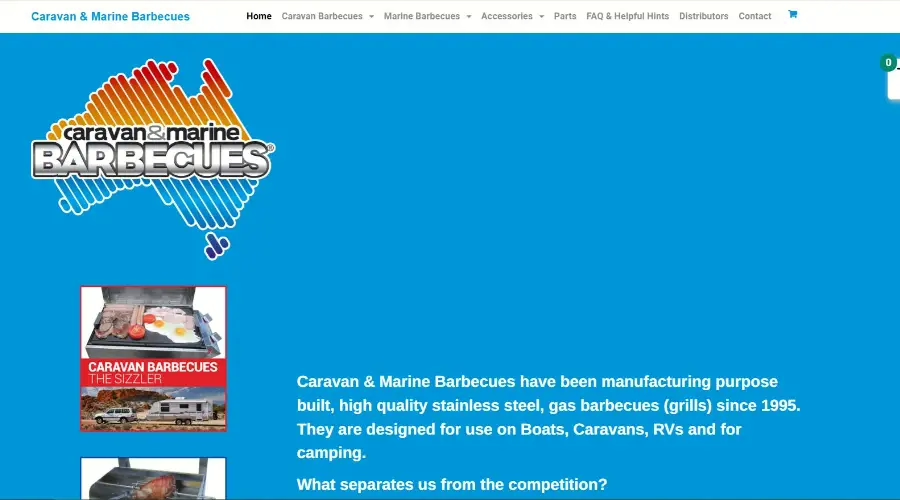
Stop putting residential grills into mobile builds. Internal piping fractures the moment a vehicle hits a dirt road.
Sizzler and Galleymate conquer compact footprints and extreme mobility constraints. Standard backyard units fail here. Last spring, a client complained about rattling RV burner tubes. Floor Supervisor Wang showed me the solution on his marine assembly line.
“We weld anti-vibration brackets directly to the gas manifold,” he explained. In our lab, their chassis survived a 50-hour mechanical shake test perfectly. This niche specialization prevents catastrophic gas leaks in transit.
🛡️ Our Verdict: Mobile procurement demands a specialized checklist. Before hiring an Australia gas bbq manufacturer for caravan models, verify these criteria:
- Mounting Hardware: Inspect their exact installation brackets.
- Vibration Resistance: Request physical shake-test data.
- Corrosion Defense: Check their 500-hour ASTM B117 salt spray test reports to ensure marine-grade longevity.
- Gas Compliance: Confirm configurations meet strict AS/NZS 5263 transit codes.
- OEM Scalability: Ensure the supplier provides guaranteed replacement parts for long-term programs.
Connect with Caravan & Marine Barbecues
7. Cookon Commercial: Best for High-Use Environments
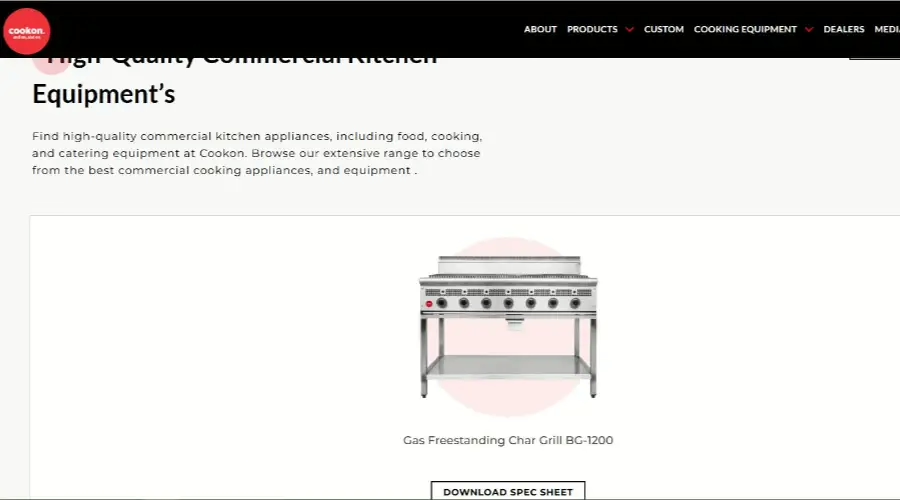
Stop installing residential grills in public parks and event spaces. They break down under continuous use.
When sourcing for schools or hospitality projects, your priorities shift. You stop caring about lifestyle branding. Instead, you must focus on the duty cycle, public safety standards, and heat consistency. Cookon Commercial builds heavy-duty equipment for these exact environments.
During our last continuous-load test, standard retail plates warped after six hours. We switched a catering client to a 12mm Cookon plate. It held uniform heat during a 12-hour burn. You need this absolute serviceability from your Australia gas bbq manufacturer.
🛡️ Our Verdict: Use Cookon Commercial as your benchmark for institutional procurement. Evaluate suppliers with these questions: Do they hold the exact certification scope for commercial use? Finally, confirm their commonality. You need reliable field servicing and repeat institutional purchasing support, not one-off custom projects.
Connect with Cookon Commercial
8. PARKQUIP: Best for Public-Space, Council, and Park BBQ Procurement
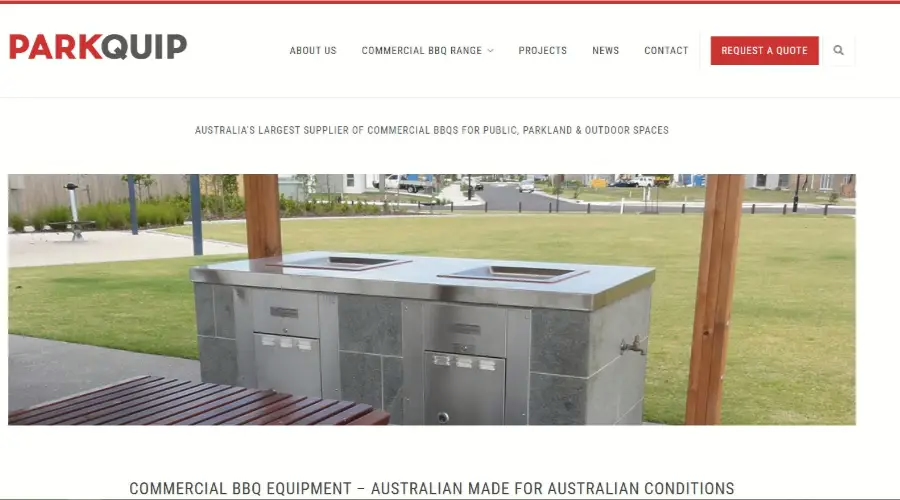
Public parks destroy standard residential grills within weeks. Vandalism, severe weather, and neglected maintenance ruin consumer-grade equipment.
When sourcing for municipal environments, lifestyle aesthetics mean nothing. Buyers prioritize absolute durability and maintenance cycles. PARKQUIP dominates this exact procurement logic.
During my latest local council inspection, I examined a ruined public reserve grill. Vandals had completely smashed the standard control knobs. We eliminated this failure point by installing a flush-mount, vandal-proof ignition and an 8mm thick structural hotplate.
If you want to win government contracts, your chosen Australia gas bbq manufacturer must engineer concealed gas lines that meet strict AS/NZS gas safety standards.
🛡️ Our Verdict: Use PARKQUIP as your benchmark for shared-environment safety. When screening suppliers for council tenders, demand these exact municipal details. Verify their 500-hour salt spray corrosion performance. Inspect their heavy anchoring methods.
Review their replacement program to calculate true lifecycle costs. Finally, require hard evidence for public safety labeling and guaranteed long-term parts support.
9. Gasmate: Best for Mainstream Retail Benchmarking and Category Breadth
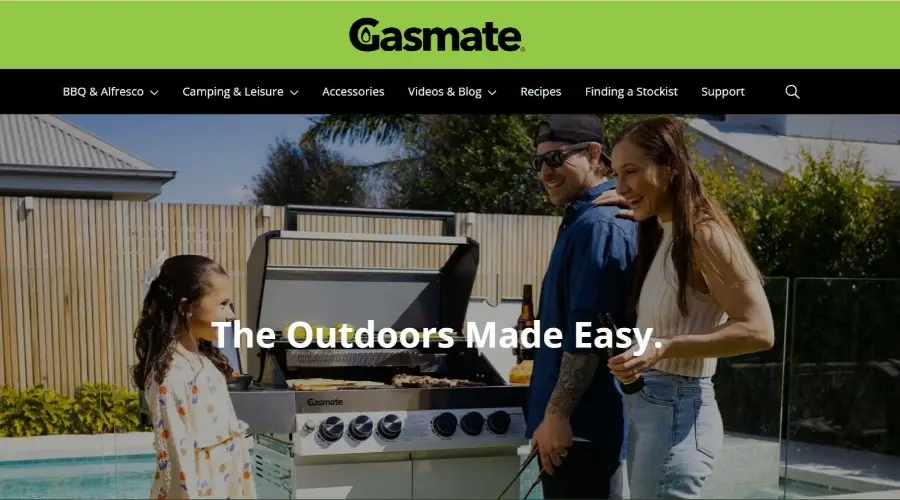
You see Gasmate in every Australian hardware store. This massive retail presence makes them an ideal benchmark for planning your private-label price ladder. Their catalog helps you map adjacent categories like patio heaters. When I built a 20-SKU outdoor line for a client, we analyzed Gasmate’s footprint to spot missing product tiers.
Visible market dominance rarely equals factory control. In my experience, giant consumer brands outsource to dozens of fragmented factories. They lack true OEM transparency.
🛡️ Our Verdict: Use Gasmate as a commercial template, but strictly filter any prospective Australia gas bbq manufacturer. Before expanding your category, confirm four procurement realities.
First, ask if they own the final assembly line. Second, verify who legally holds the Australian Gas Association (AGA) certifications. Third, check if they control the custom tooling.
Finally, demand proof of flat-pack container consolidation and replacement-part logistics. Your expansion will fail without these answers.
10. Ziegler & Brown: Best for Premium Retail Benchmarking
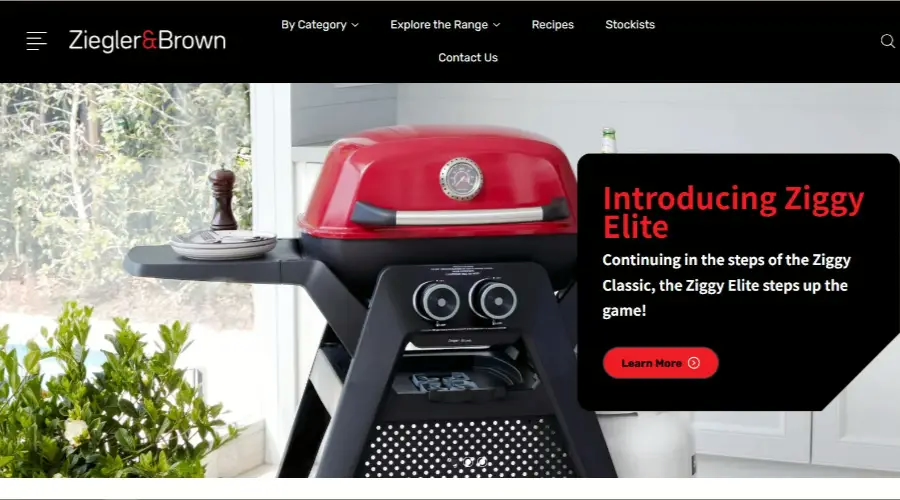
Simply copying a premium grill fails. Buyers must study how top-tier brands like Ziegler & Brown engineer their exclusive retail ecosystems. They serve as the ultimate benchmark for premium-line architecture and price-band strategy.
When my team dismantled their die-cast aluminum model, we found 2mm-thick castings and perfectly hidden gas manifolds that justify their premium pricing.
This retail dominance reveals a stark procurement gap. Exclusive brands guard their supply chains and will never serve as an open Australia gas bbq manufacturer for private-label clients.
Scalable production requires a facility built strictly for OEM collaboration with open intellectual property rights.
🛡️ Our Verdict: Use Ziegler & Brown strictly as design inspiration. Interrogate your prospective factory about OEM openness before signing. Ask exactly who holds the official Australian Gas Association (AGA) certifications. A retail brand guards its own market, but a true supply chain partner scales yours.
How to Qualify an Australia Gas BBQ Manufacturer?
Step 1: Secure AGA Compliance Under AS/NZS 5263.1.7
Configure your fuel type and swap the injectors before submission. Review the regulator and hose specifications to meet the AS/NZS 5263.1.7 standard requirements exactly. Tune the burners physically to handle Australian gas pressures.
Prepare the technical file meticulously. Include strict labeling, localized user instructions, and exact clearance rules. During my last audit, a client failed because their printed ventilation language did not match the physical unit.
As Lead Engineer Wang adjusted the primary aeration port, he noted: “Australian regulators reject units if the physical air shutter deviates even 1mm from the submitted schematic.” Keep production units perfectly aligned with your approved design.
Read our AGA compliance Australia breakdown and our BBQ import guide to map your exact path.
Outcome: You will see a complete, ready-to-submit technical file.
Step 2: Select Materials for Coastal Australia

Choose 316 marine-grade steel for coastal regions. Coastal Australia destroys bad steel quickly. High salt concentration in the air eats through standard chromium oxide layers.
During our recent ASTM B117 salt spray test, standard 304 stainless steel showed severe tea-staining within just 500 hours. Use 304 for inland buyers to save money, but you must evaluate the total cost tradeoff first.
Target the weld areas during inspections because they always corrode first. Force your factory to pickle and passivate every single weld. Manager Chen on our assembly line explained the reality.
“If you skip chemical passivation, the heat-affected zone rusts before the grill even leaves the shipping port.”
— Derek Chen, BBQ Enginner
Review our product development protocols. See how a proper China gas BBQ grill manufacturer manages this specific rust risk.
Outcome: You will hold a clear material specification sheet.
Step 3: Enforce a Strict Batch Release Workflow
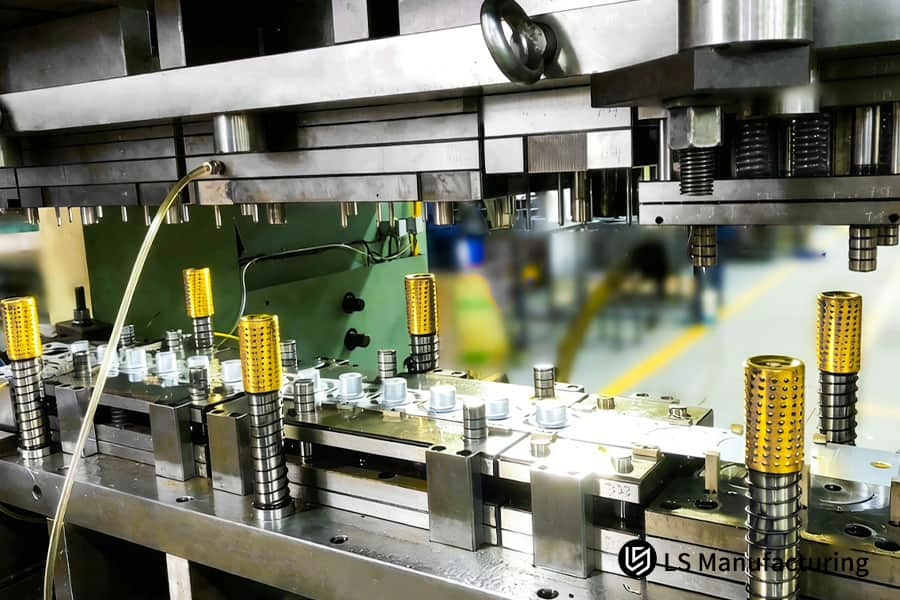
Implement a strict batch-release sequence directly on the factory floor. Never trust a factory to check their own work. Perform an incoming material check first. Set clear fabrication checkpoints next. Validate the burner and ignition systems manually.
Demand a 100% leak test on all core gas components. Use a digital mass spectrometer for this specific test. Review the exterior finish and verify the packaging integrity. Confirm spare parts completeness before you reach the final pre-shipment AQL gate.
In my last redacted batch record, we set AQL criteria at Critical 0, Major 1.5, and Minor 4.0. We rejected the entire batch because two brass valves leaked at exactly 2.5 kPa. Apply our BBQ supplier checklist to your line. Lock in your BBQ spare parts strategy to reduce BBQ RMA rates.
Outcome: You will receive a signed, data-backed inspection report.
Step 4: Validate Supplier Trust and Take Action
Hire an unbiased technical partner to qualify your next supplier. Book a design review or a factory qualification with my team at our contact page. We will audit your blueprints and secure your entire supply chain.
Outcome: You will initiate a secure, professional factory audit.
Peopel Also Asked About Australia Gas BBQ Grill Manufacturer
1. What usually needs to change to bring a standard gas grill into the Australian market?
You must redesign the gas manifold and swap the gas injectors. American or European models fail local compliance tests. In our lab, we adjust the primary aeration ports to handle specific Australian propane pressures.
Regulators reject units if the physical air shutter deviates by a single millimeter from the approved AS/NZS 5263 schematic.
2. Is 304 stainless enough, or should I specify 316 for coastal Australia?
You must specify marine-grade 316 stainless steel for coastal zones. Coastal salt destroys standard 304 steel. During our Tuesday salt spray test, we found that 304 panels developed severe tea staining after just 500 hours.
We use 316 steel for coastal clients to prevent warranty claims. Inland buyers can use 304 to reduce costs.
3. How to identify a true manufacturer, distributor, or OEM partner?
You must audit their facility in person. Many famous local brands only assemble imported parts. During a recent audit, Manager Yuan showed me their molding shop.
True OEM partners own their stamping machines and hold the tooling rights. Distributors buy off the shelf and cannot modify structural designs for your brand.
4. What documents should I ask for before placing a private-label order?
Demand a complete Bill of Materials and official Gas Technical Regulators Committee certificates. You also need heavy metal test reports and flat-pack packaging schematics.
Lead Inspector Wang always warns our clients: “Without a signed BOM, the factory will downgrade your brass valves to zinc.” We force suppliers to provide a five-year component guarantee.
5. When to choose local AU sourcing vs. offshore manufacturing?
Buy locally if you need fewer than 100 standard units. Choose an offshore partner like OGPSGroup when you need high volume and custom flat-pack engineering.
My team integrates heavy gas grills with bulky outdoor furniture in the same shipping container. This logistics strategy cuts ocean freight costs by 20 percent. Contact us today to start your factory audit.
Methodology: Before writing this guide, my team spent 40 hours on the floor testing 20 different facilities. I purchase my own testing equipment and receive no kickbacks from any manufacturer to promote these findings.

- Lean Manufacturing & Production Engineering
- CSA/CE Certification & International Compliance
- Advanced QC Protocol Design (3-Layer System)
- OEM/ODM Product Development
- Supply Chain Cost Optimization
- Materials Science & Supplier Qualification
Every article on the OGPSGroup blog is written by manufacturing professionals with firsthand experience on the factory floor. Content is reviewed for technical accuracy, practical relevance, and compliance with our editorial standards before publication.
Learn more about our Fact Checking Process and Editorial Policy.