
Home Furniture Chain Program. More Selling Weeks. Fewer Chargebacks.
OGPSGroup keeps your stores stocked and your DC quiet: outdoor and seasonal furniture built to your routing guide, on one spec, one carton standard and one consolidated container.
We read the vendor manual before we quote. Carton marks, barcodes, pallet build and ASN fields become production lines, not a conversation at the dock.

A DC Is Not a Warehouse.
It Is an Audit.
A distribution centre receives against a document, not against a promise. When the carton, the label or the pallet does not match the vendor guide, the shipment is not late — it is rejected, reworked and charged back. Every line below is decided before the carton is packed.
| What the DC checks | How it fails | What it costs | Where we close it |
|---|---|---|---|
| Master carton & label | Wrong label, wrong panel, missing barcode. | Fixed fee plus a per-carton charge. | Label artwork and placement signed off with the first sample. |
| Mixed cartons | Two SKUs in one carton to make the count. | Fixed fee plus repack labour. | Carton plan fixed before the first production run. |
| Pallet build | Over height, over weight, wrong footprint, no corner boards. | Per-pallet charge. | TI/HI and stack height fixed in the pallet plan. |
| Routing & appointments | Carrier not booked to the guide, delivery window missed. | Fixed fee plus carrier accessorials. | Routing rules read before the PO, not at the port. |
| Late PO | Shipment lands after the delivery window. | A percentage of COGS, escalating with lateness. | Capacity reserved against the DC calendar. |
| Transit test | Carton fails drop or stack test at intake. | Fixed fee plus rework and lab costs. | ISTA 3A passed on the packed unit before mass production. |
Penalty schedules are set in each retailer’s own vendor guide and vary by programme. The amounts matter less than the pattern: the cause is always a specification that was never read before production.
We Read the Rules
Before We Quote.
A routing guide is not an appendix to the order; it is part of the product specification. We take it at the start, map it line by line, and refuse to quote anything we cannot pack to it.
We take your vendor manual, routing guide and packaging standard, and list every requirement that touches the product.
Each rule becomes a line on the spec sheet with an owner: carton marks, label placement, pallet build, ASN fields.
The first sample ships with a carton mock-up, label artwork, a pallet plan and a scan test — not just the product.
A first-article inspection and an ISTA 3A transit test run on the packed unit before mass production starts.
Every SKU closes with one signed inbound file your DC team can check against the guide.
- Carton and master-carton marks
- GTIN, UPC and SSCC label placement
- Pallet footprint, TI/HI, max height and weight
- Wrapping, banding and corner-board rules
- ASN and EDI field requirements
- Delivery windows and appointment rules
- Mixed-carton and short-carton rules
- Test reports and label artwork your buyer needs
An Assortment a DC
Can Sort.
A chain does not buy a collection; it buys SKUs that can move through a DC without special handling. The range below is engineered around that constraint — same footprint per tier, a carton plan built per SKU, and packaging that can be stacked, scanned and replenished.
 Assortment photo placeholder
| DC question | Why it matters | How we engineer it |
|---|---|---|
| Will it scan? | A rejected label stops the whole pallet at intake. | GTIN on the agreed panel, SSCC on the pallet, one scan test before production. |
| Will it stack? | Compression damage shows up after the DC, not before it. | Carton strength, nesting and a marked stack count on the carton. |
| Will it sort? | One mixed carton can reroute a whole drop. | Consistent footprints by tier and a carton plan set per SKU. |
| Will it replenish? | A changed spec breaks the next reorder. | SKU and spec held stable across seasons; tray-friendly quantities. |
| Will it survive? | Damage found at intake becomes a chargeback. | ISTA 3A, corner protection, hardware bagged by assembly step. |
Scope boundary: this programme covers outdoor and seasonal furniture only — dining and seating sets, loungers and daybeds, shade, outdoor storage and seasonal grills. We do not supply indoor upholstery, mattresses or panel furniture. If your category sits outside that list, we will say so before the first sample.
The range runs on the same production and sourcing model described under outdoor furniture, with product development handled per SKU — see product development.
One Order.
Many Stores.
A chain programme is judged on the second order, not the first. The carton has to work at the DC, the allocation has to survive the split, and the SKU has to stay the same when the buyer reorders.
One order can be split by store at pallet level, so each DC or store receives its own allocation without breaking the range.
Replenishment is triggered by what the first weeks sold, not by a forecast written before the season.
The SKU, carton and barcode stay the same in the next drop, so the DC does not re-learn the item.
We build the load plan for either path — one DC drop, or store-ready cartons carrying the marks the store needs.
Store-level allocation is built on the same mixed-load model used in the consolidation programme. Combining store drops into one container typically saves 15–25% on freight compared with separate shipments.
Packaging That Passes
the Intake Scan.
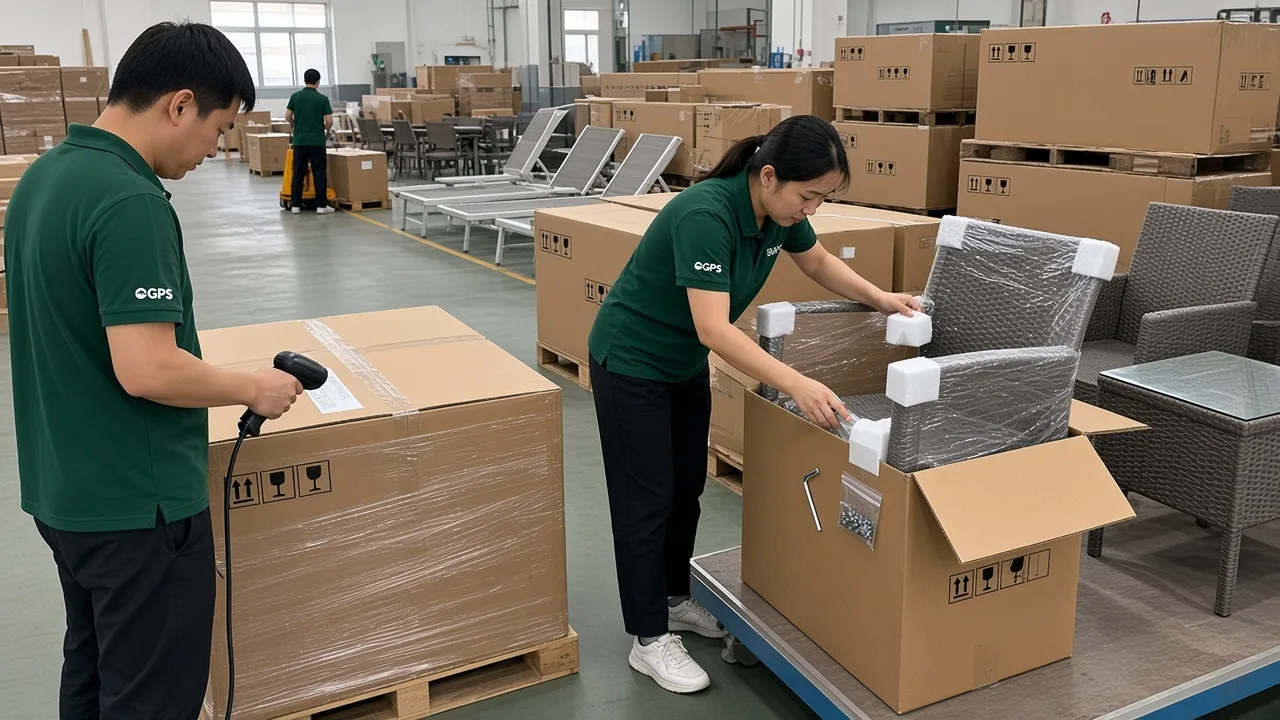
Intake is a machine and a clipboard. The carton has to scan, the mark has to point the right way, and the hardware has to be in the carton it belongs to. We design the pack for that moment, not for the factory gate.
 Packaging photo placeholder
- Carton marks Up arrow, fragile, stack limit and short-carton marks placed to your guide.
- Barcode verification GTIN and SSCC checked by scan, not by eye.
- One SKU per carton No mixed cartons, no surprise repack at the DC.
- Hardware by step Fixings bagged by assembly stage and packed with the carton they belong to.
- Transit proof ISTA 3A drop and stack test on the packed, ready-to-ship unit.
Parcel and marketplace intake is a different path with different tests. That side of the work lives in the ready-to-ship programme.
Pallet-Ready
Is Not Enough.
“Pallet-ready” usually means it fits on a pallet. A DC needs it to fit its own pallet spec, at its own height limit, with a label on the right face and a TI/HI count that matches the ASN.
 Pallet photo placeholder
The File Ships
With the Goods.
A listing stalls on a missing document long before it stalls on price. Every SKU closes with one file — test evidence, declarations, label artwork and the content the buying team needs — packed with the shipment, not chased after it.
The test file for the category and the market, per SKU.
Declarations of conformity and market-specific statements your buyer needs to list the item.
ISO 9001 and social-compliance records from the factory that actually makes the SKU.
Label and warning artwork, barcode placement and print files, approved before production.
Dimensions, materials, finish, assembly and care — one sheet per SKU.
Cut-out and lifestyle imagery, plus the copy your web listing needs.
Market requirements are confirmed per category and per destination — EU, UK or US — before the order is accepted. We do not treat one certificate as proof for a whole range.
Chain Scale Is a
Consistency Test.
One good sample is not a programme. A chain needs the same finish in lot two as in lot one, in every carton, at every store. Quality here is a repeatability problem before it is an inspection problem.
 Quality-control photo placeholder
Each SKU runs in a factory vetted for that category, not in whichever factory has space.
Inspected at the agreed level from incoming frame and finish to pre-shipment packing.
Powder colour, gloss, weave and fabric checked against the golden sample on every lot.
Capacity is reserved to the delivery window, so the appointment is not the first time anyone looks at the calendar.
The inspection method and the escalation route are documented in quality control; the factory network and line setup are covered in the factory tour.
Terms Written
for a Program.
A chain programme has a different rhythm from a one-off order: capacity is held, SKUs are repeated and the specification outlives the season. The terms below are the ones that keep that rhythm intact.
From Three Factories
to One Inbound File.
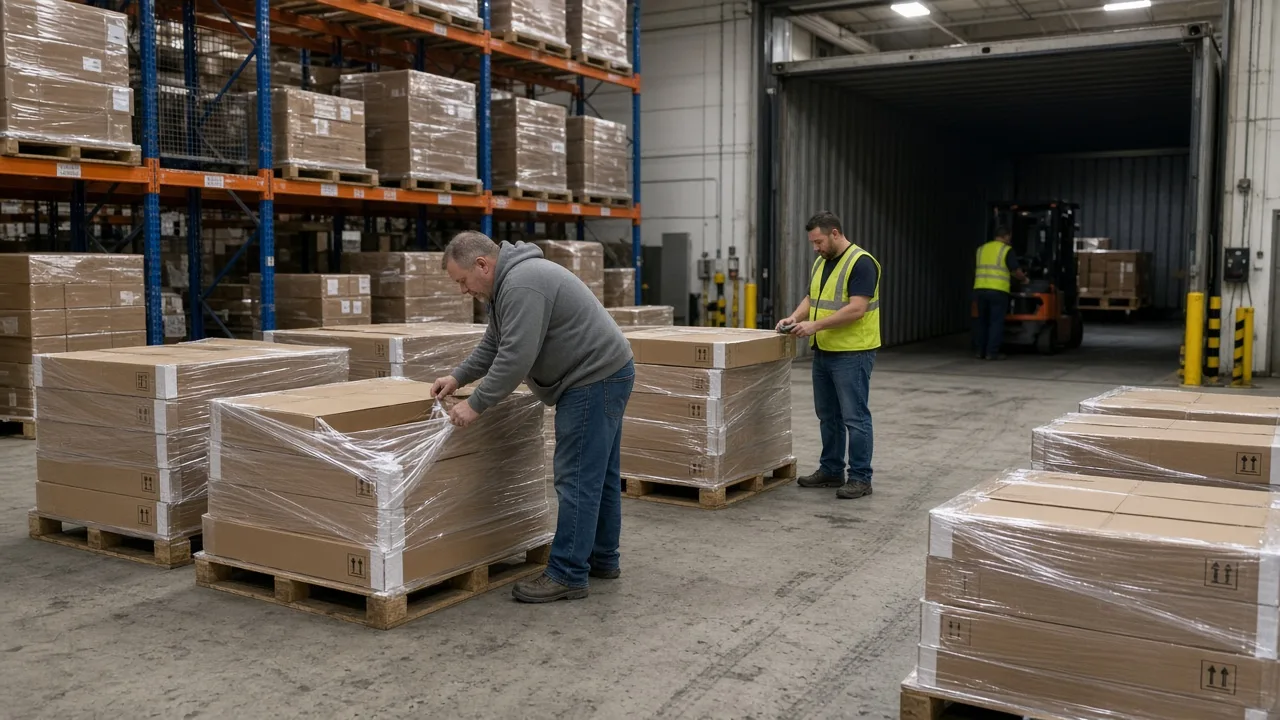
The rewrite below is the same North American big-box programme already documented in the ready-to-ship work, viewed from the DC side — where the cost actually appeared.
 Case photo placeholder
Questions a Buying Team
Actually Asks.
No. This programme covers outdoor and seasonal furniture — dining and seating sets, loungers and daybeds, shade, outdoor storage and seasonal grills. We do not supply indoor upholstery, mattresses or panel furniture.
Yes. The guide is read before the quote, not after the order. Every requirement that touches the product — the carton, label, pallet and ASN fields, plus delivery windows — becomes a line on the spec sheet with an owner and a sign-off point.
You own the GTIN, UPC and SSCC numbers and the artwork standard. We engineer the placement, print to your files and verify the result by scan. If a number or a label is wrong at the source, we flag it before production rather than at the DC.
Yes. Allocation is planned at pallet level, so each store or DC receives its own share without splitting cartons. The load sequence puts the first store or first bay at the door.
A rejection is treated as a specification failure, not a shipping accident. We pull the pack records, the label file and the pallet plan for that PO, identify which gate failed, correct it and re-test the pack before the next drop. The cost conversation happens with the evidence on the table.
No one can guarantee that, because the schedule is set by the retailer. What we can do is close the causes we control: read the guide, build a sample pack, scan-test the label, fix the pallet plan and hand over one signed inbound file per SKU.
Yes. A pilot category can run inside a mixed container, with the same carton and pallet standard the full programme will use. That is usually the fastest way to prove the DC process before committing the range.
We prepare the ASN content and the document set, and we build to the appointment rules in your guide. Booking, carrier routing and portal submission stay with you or your forwarder unless your programme explicitly hands them to us — we will not imply control we do not have.
The spec, carton and barcode are held for the reorder, so the next drop does not restart the approval process. Sell-through and return reasons from the first season feed the next range decision.
Yes. Garden centres are a retail channel with a spring floor-set calendar and display standards. This programme is built around multi-store DC inbound and replenishment. If your buyers sit in that channel, the Garden Center Program is the closer fit.
Send Us Your Routing Guide.
We Will Send Back the Pack.
Tell us the categories, the store count and the delivery window. We will map the carton, label and pallet requirements into a first inbound pack before the first PO.